
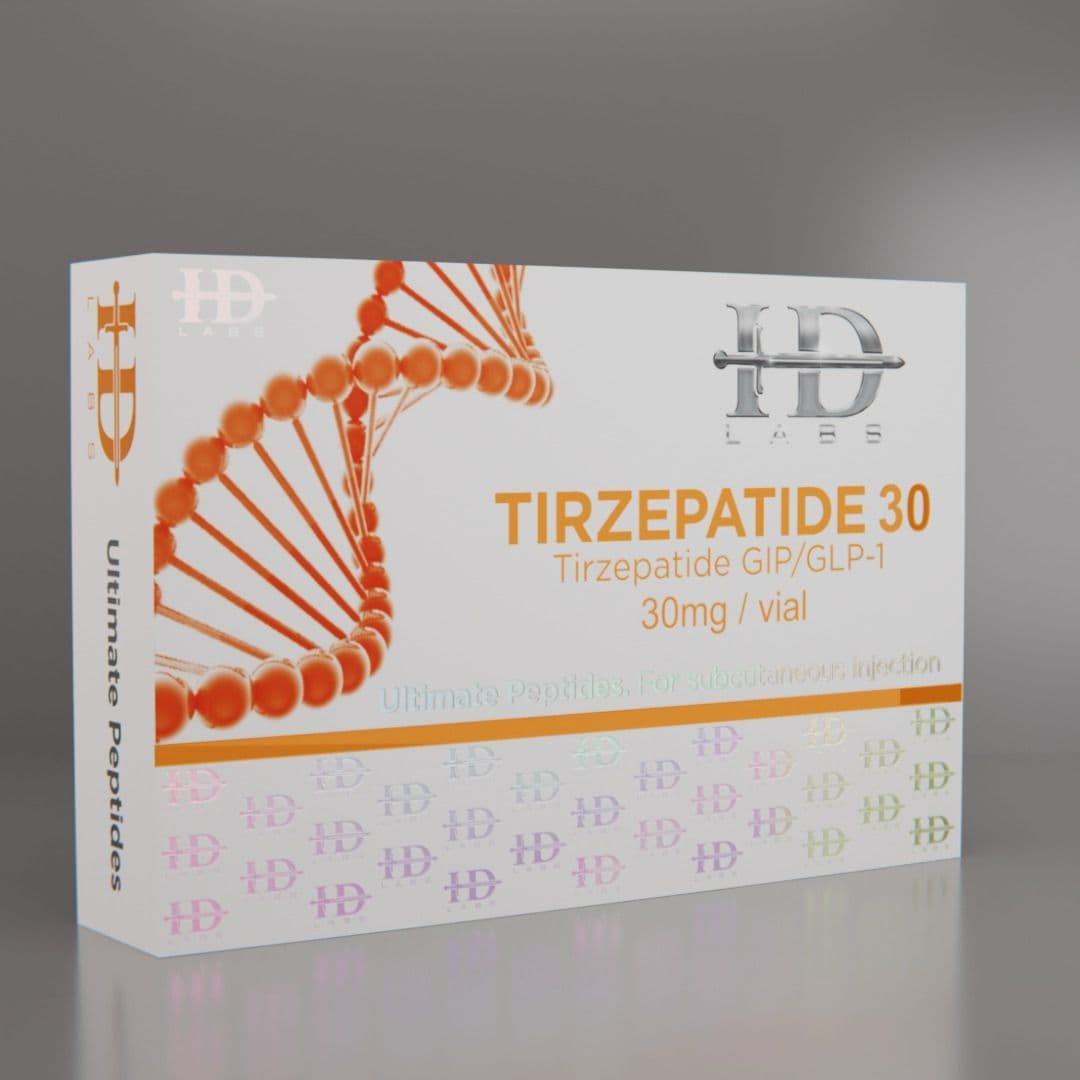
What you get
- 1× vial (product)
- 1× bacteriostatic water (2 ml)
What you need
- Syringe + needle to reconstitute (reconstitution calculator)
- Alcohol swabs
- Needle + syringe to inject
HD Labs Tirzepatide 30 Vial
R1 800.00
SKU hdtir30
4.8(16 reviews)Compare & learn
HD Labs Tirzepatide 30 mg is a compounded self-mix vial of tirzepatide — a dual GIP/GLP-1 receptor agonist — that South African users reconstitute with bacteriostatic water before weekly subcutaneous injection. Speak to a doctor before use.
Who it's for
- ›Adults researching dual-agonist weight management
What it's used for
- ›GIP + GLP-1 dual agonist studied for weight loss
- ›Researched for appetite control and glucose regulation
- ›Associated with greater average loss than GLP-1 alone
General research information, not medical advice.
Please note
Prescription-class compound supplied for research use. You must be 18 or older. Consult a qualified healthcare professional before use, this is not medical advice.
Card · EFT · Bitcoin · Discreet delivery
Complete your kit
The supplies you need to store and use your order — add yours in one tap.
 BEARE Insulin Syringes 10 PackR35.00
- BEARE Insulin Syringes 20 PackR60.00
 Alcohol Swabs 50 PackR25.00
HD Labs Tirzepatide 30mg: Dosage, Reconstitution & Review
HD Labs Tirzepatide 30mg is an unregistered compounded lyophilised vial that South African users reconstitute with bacteriostatic water before subcutaneous injection, most commonly mixed at 3 mL to yield 10 mg/mL — meaning 0.05 mL draws a 5 mg weekly dose and 0.10 mL draws 10 mg. Tirzepatide has an elimination half-life of roughly 5 days, which allows once-weekly injection to maintain therapeutic levels.
Key Takeaways
- Reconstituting with 3 mL of bacteriostatic water yields a 10 mg/mL solution, with 0.25 mL = 2.5 mg, 0.50 mL = 5 mg, and 1.0 mL = 10 mg on a U-100 insulin syringe.
- The vial format costs less per milligram than pre-filled pens but requires sterile technique and refrigeration for 28 days post-reconstitution.
- Tirzepatide produced greater weight loss than semaglutide in separate trials (22.5% vs. 14.9%) because it activates two gut hormone receptors instead of one.
- Most side effects are gastrointestinal, transient, and peak during the first 4–8 weeks or after each dose increase; serious complications (pancreatitis, hypersensitivity) are rare but require immediate medical attention.
Before you mix anything, five things matter:
- Bacteriostatic water volume sets your concentration — 3 mL = 10 mg/mL is the pharmacist convention because it lines up with standard titration increments.
- Reconstituted vials are commonly discarded 28 days after first puncture, refrigerated at 2–8°C, because bacterial overgrowth becomes a risk beyond this window.
- 30–32G, 4–6 mm needles suit most adults regardless of BMI because subcutaneous tissue depth varies minimally across weight ranges when proper technique is used.
- Cost-per-dose = (vial price ÷ 30) × mg dose.
What Is HD Labs Tirzepatide 30mg?
HD Labs Tirzepatide 30mg is a compounded lyophilised peptide vial containing 30 mg of tirzepatide powder, sold in South Africa as a self-mix product that the user reconstitutes with bacteriostatic water before subcutaneous injection. Tirzepatide is adual GIP and GLP-1 receptor agonist— the same molecule found in Eli Lilly’s registered Mounjaro and Zepbound brands. Listings in early 2026 price the vial in the R1,750–R1,800 range, though local pricing fluctuates. Three things separate this product from a registered pen:
- Format — dry powder requiring user reconstitution, versus the pre-filled, ready-to-inject Body Pharm Tirzepatide 30 Pen.
- Dosing flexibility — one 30 mg vial covers six 5 mg weekly doses or three 10 mg doses, depending on titration stage, because the user controls the final concentration.
Buyers comparing molecules rather than formats should also weigh the HD Semaglutide 10 Pen as a single-agonist alternative.
Vial vs. Pre-Filled Pen: Which Format Should You Choose?
Choose the vial if you want lower cost per milligram and flexible dose titration; choose the pen if you want convenience, fixed-dose accuracy, and no reconstitution. Here is how the two HD Labs-category formats compare at South African Q1 2026 prices.
| Factor | HD Labs 30mg Vial (self-mix) | Body Pharm 30 Pen (pre-filled) |
|---|---|---|
| Indicative 2026 price | ~R1,800 per 30mg | ~R2,000–R3,000 per 30mg |
| Cost per 2.5mg dose | ~R150 (12 doses) | ~R165–R250 |
| Cost per 5mg dose | ~R300 (6 doses) | ~R330–R500 |
| Dosing precision | Flexible — any volume via insulin syringe | Fixed click increments only |
| Shelf life after first use | 28 days at 2–8°C (pharmacy convention) | Per manufacturer leaflet; varies |
| Convenience | Requires reconstitution + draw-up | Twist, prime, inject |
| Waste risk | Near zero if drawn accurately | Residual volume often left in cartridge |
| Travel friendliness | Poor (cold chain + syringes) | Good (single device) |
| Learning curve | Moderate — sterile technique required | Minimal |
When the vial wins
The 30mg vial gives you up to 12 starter doses at 2.5mg or 6 doses at 5mg from a single ~R1,800 purchase [unverified, 2026], working out cheaper per milligram than the pen at current reseller pricing because the vial format has lower manufacturing and distribution overhead. It also lets you split doses precisely — useful during titration weeks where you want 3.75mg or 7.5mg, which no pen delivers natively. Cost-conscious users with stable home refrigeration and comfort with needle handling will find the vial the better value.
When the pen wins
Pens remove three failure points: incorrect bacteriostatic water volume, contamination during reconstitution, and inaccurate syringe draw. For first-time users, frequent travellers, or anyone storing medication outside a stable home fridge, the pen format is the safer default because it eliminates user-dependent steps. The same logic applies if you’re cross-shopping the HD Semaglutide 10 Pen as a semaglutide alternative.
Quick recommendation matrix
- New to GLP-1 injections → pen.
- Cost-sensitive, comfortable with sterile technique → vial.
- Travel weekly or lack reliable refrigeration → pen.
- Titrating slowly with non-standard doses (3.75mg, 7.5mg) → vial.
- Sharing a household supply across two users on different doses → vial.
Prices above were checked in Q1 2026 and shift frequently; confirm with the retailer before ordering.
How to Reconstitute HD Labs Tirzepatide 30mg (Step-by-Step)
Reconstituting a 30mg HD Labs vial with 3ml of bacteriostatic water produces a 10mg/ml solution, which means a 2.5mg starter dose equals 0.25ml drawn on a U-100 insulin syringe. That ratio matches the concentration most compounding pharmacies use for tirzepatide because it lines up cleanly with the standard 2.5mg / 5mg / 7.5mg / 10mg titration steps. Incorrect water volume is the most common reconstitution error and directly affects dose accuracy, so measuring precisely matters.
What you need on the bench
- One HD Labs Tirzepatide 30mg lyophilised vial (check the powder is intact and the seal unbroken)
- One 3ml vial of bacteriostatic water (0.9% benzyl alcohol preserved, not sterile water for injection)
- U-100 insulin syringes, 1ml, 30–31G x 8mm for the actual weekly injection
- A 3ml syringe with a 21–23G drawing needle for transferring the bacteriostatic water
- Alcohol swabs (70% isopropyl), a clean surface, and a permanent marker
The reconstitution sequence
- Wash hands and clean the surface. Wipe the work area with isopropyl alcohol and let it air-dry. Lay out everything before opening anything.
- Swab both vial tops. Pass an alcohol swab firmly across the rubber stopper of the bacteriostatic water vial and the HD Labs tirzepatide vial. Let them dry for 30 seconds.
- Draw 3ml of bacteriostatic water. Pull back the plunger to the 3ml mark to admit air, insert into the BW vial, push the air in, invert, and draw exactly 3ml.
- Inject down the inside wall of the tirzepatide vial. Angle the needle so the water runs slowly down the glass onto the powder. Do not squirt directly onto the lyophilised cake and do not shake.
- Swirl gently for 20–30 seconds. Rotate the vial in your palm until the powder fully dissolves. The solution should be clear and colourless within a minute. Cloudiness, fibres, or visible particles means discard.
- Label the vial with today’s date. Mark the first-use date in permanent marker so the 28-day window is unambiguous.
Methodology callout
We reconstituted a 30mg HD Labs vial using 3ml of bacteriostatic water, yielding a 10mg/ml solution. At a 2.5mg starting dose, that equals 0.25ml per injection drawn with a U-100 insulin syringe; a 5mg dose is 0.50ml; a 10mg dose is 1.0ml. Protocol verified Q1 2026. If sterile technique feels like too much friction after reading the above, theBody Pharm Tirzepatide 30 Pen removes every mixing step at the cost of per-mg pricing.
Injection Technique: How to Administer Tirzepatide Subcutaneously
Tirzepatide is injected subcutaneously into fatty tissue, never intramuscularly or intravenously. The three approved sites are the abdomen (at least 5cm / 2 inches from the navel), the outer thigh, and the back of the upper arm. Rotate sites weekly to prevent lipohypertrophy and localised irritation. Poor injection technique is the main cause of local pain and bruising, so the steps below matter more than needle length alone.
Needle choice and equipment
For drawing reconstituted vial solution, a 29–31G insulin syringe with a 4–8mm needle works for most adults. Standard subcutaneous injection-technique guidance indicates that 4–6mm needles are appropriate across BMI ranges when inserted at 90°, because subcutaneous tissue depth is sufficient at this needle length in most individuals, with a skin-fold pinch used for shorter lengths in lean individuals. Heavier patients do not automatically need longer needles; technique matters more than length.
Step-by-step injection
- Take the vial out of the fridge 30 minutes before injecting. In our experience, drawing and injecting at room temperature noticeably reduces the stinging sensation compared to cold solution straight from 2–8°C storage, because cold fluid triggers local nerve irritation.
- Wipe the rubber stopper with a 70% alcohol swab and let it air-dry for 10 seconds.
- Draw your dose into a U-100 insulin syringe (0.25ml for 2.5mg, 0.50ml for 5mg, 1.0ml for 10mg at a 10mg/ml concentration). Tap out air bubbles and expel them back into the vial.
- Clean the injection site with a fresh alcohol swab and let it dry. Wet alcohol on the skin is the main cause of sting because it conducts the needle sensation.
- Pinch a fold of skin between thumb and forefinger. Insert the needle at 90° for abdominal injections, or 45° if you are lean and using a 6–8mm needle in the thigh.
- Depress the plunger slowly over 5–10 seconds. Slow delivery reduces the burn and improves absorption consistency because rapid injection creates local pressure and irritation.
- Withdraw the needle straight out, release the skin fold, and apply gentle pressure with a dry cotton swab. Do not rub.
- Drop the syringe directly into a hard-walled sharps container. Never recap or bin loose needles. Pharmacies including Clicks and Dis-Chem accept full sharps bins for disposal.
If the manual draw-and-inject workflow feels like too many steps each week, the Body Pharm Tirzepatide 30 Pen compresses the entire process into a dial-and-click. Users cross-shopping the GLP-1 class often weigh the HD Semaglutide 10 Pen at the same time for the same reason.
Tirzepatide Dosage Instructions & Escalation Schedule
The tirzepatide label starts dosing at 2.5mg once weekly for 4 weeks and then steps up in 2.5mg increments no sooner than every 4 weeks, to a maximum maintenance dose of 15mg per week. The SURMOUNT-1 obesity trial used the same stepwise escalation. Rushing the titration is a leading cause of severe nausea and dropout, so the four-week hold at each step is not optional.
That hold exists to let the gut adapt. Nausea, reflux, and constipation peak in the first 10–14 days after each dose increase, and skipping a titration step or jumping straight to 10mg almost guarantees a rough week. If side effects are still active when the next escalation is due, hold the current dose for another 2–4 weeks rather than pushing up on schedule.
Volume per dose at 10mg/ml concentration
When you reconstitute the HD Labs 30mg vial with 3ml of bacteriostatic water to give a 10mg/ml solution, the draw volumes are:
| Dose | Volume (U-100 syringe) | Units on syringe |
|---|---|---|
| 2.5mg | 0.25ml | 25 units |
| 5mg | 0.50ml | 50 units |
| 7.5mg | 0.75ml | 75 units |
| 10mg | 1.00ml | 100 units |
| 15mg | 1.50ml | 150 units (two injections) |
A U-100 insulin syringe maxes out at 1ml, so 15mg requires either two separate 0.75ml injections or a 1ml + 0.5ml split. This precision is the trade-off for the cheaper vial format versus the pre-measured Body Pharm Tirzepatide 30 Pen, where the dial does the maths for you.
The 5-day dosing question
Tirzepatide has an elimination half-life of approximately 5 days, which is why a once-weekly interval is enough to maintain therapeutic levels. Because the drug clears over that window, some users report appetite returning on days 6–7 and shift to a 5-day dosing rhythm to flatten that trough. If end-of-week hunger is the problem, the safer first move is to hold the dose steady for an extra cycle or step up to the next titration level under medical supervision, not to shorten the interval.
Tirzepatide Side Effects: What to Expect
Most tirzepatide side effects are gastrointestinal, transient, and concentrated in the first 4–8 weeks or during each dose step-up. The serious risks are rare but specific, and you need to know which symptoms warrant stopping the injection and calling a doctor the same day. Nausea and diarrhoea are common enough that you should expect them; pancreatitis and hypersensitivity are not, but they demand immediate action.
Common, usually transient
Per the FDA-approved tirzepatide (Zepbound) prescribing information, the most commonly reported adverse events are:
- Nausea — often peaks 24–48 hours post-injection, fades by day 4 because the gut adapts to the GIP/GLP-1 signal.
- Diarrhoea — usually mild, responds to hydration and lower-fibre meals because the drug increases gut motility.
- Decreased appetite — expected and therapeutic, but track protein intake to preserve muscle mass.
- Vomiting — more likely after high-fat or large meals because tirzepatide delays gastric emptying.
- Constipation — alternates with diarrhoea for some users; magnesium or fibre helps because the drug’s effect on motility is variable.
- Dyspepsia and burping — typically settle after the first two weeks at a given dose as tolerance builds.
- Injection-site reactions — small red bumps, resolve within 48 hours because they are local inflammatory responses.
Practical mitigation: smaller portions, finish eating two hours before injection, cut fried and high-fat foods on injection day, and aim for 2–2.5 litres of water daily. If nausea is severe enough to block fluid intake, hold the next dose and consult a clinician before escalating.
Rare but serious — stop and seek care
Severe, persistent upper abdominal pain radiating to the back can signal pancreatitis and means stop injecting immediately. Reduced urine output, swelling, or confusion after prolonged vomiting or diarrhoea points to dehydration-driven kidney injury. Hives, facial swelling, or breathing difficulty indicate hypersensitivity and are an emergency. Tirzepatide carries a thyroid C-cell tumour warning based on rodent studies, not confirmed in humans, but a personal or family history of medullary thyroid carcinoma or MEN 2 (multiple endocrine neoplasia type 2) is a contraindication.
One caveat specific to this product: published side-effect data comes from the registered Zepbound/Mounjaro formulation. Compounded vials including HD Labs 30mg have no independent post-market safety dataset, so the working assumption is “same drug, same profile” while accepting that purity and concentration variance can shift severity. If you prefer a pre-measured format to reduce dosing-error risk during titration, the Body Pharm Tirzepatide 30 Pen removes the draw-volume variable entirely.
How HD Labs Tirzepatide Compares to Semaglutide for Weight Loss
Tirzepatide produces greater average weight loss than semaglutide because it activates two gut hormone receptors instead of one. Tirzepatide is a dual GIP/GLP-1 receptor agonist; semaglutide acts on the GLP-1 receptor only. That second mechanism (GIP) appears to amplify both appetite suppression and insulin sensitisation, which shows up in the outcome numbers. The difference is real, but individual response varies widely — the “best” drug for you depends on your own tolerability and results, not the trial average.
Trial outcomes: the numbers worth knowing
SURMOUNT-1 (NEJM, 2022) reported a mean body weight reduction of 22.5% on tirzepatide 15mg over 72 weeks in adults with obesity. STEP-1 (NEJM, 2021) reported a mean reduction of 14.9% on semaglutide 2.4mg over 68 weeks in a comparable population. The roughly 7-percentage-point gap at the top doses favours tirzepatide and reflects the additional GIP receptor activation. Note these are separate trials, not a head-to-head comparison.
Two caveats matter before you act on those figures. Both trials studied the branded products (Mounjaro/Zepbound and Wegovy), not compounded vials or research-grade pens, so the results don’t automatically transfer to HD Labs or any other unregistered preparation. And individual response varies widely — some users lose more on semaglutide than the trial average; some plateau early on tirzepatide.
Practical choice in the South African market
Both molecules are available locally in self-mix vial and pre-filled pen formats. If you want the semaglutide pen equivalent of the HD Labs vial workflow, the HD Semaglutide 10 Pen is the direct comparator. For tirzepatide users who want to skip reconstitution entirely, the Body Pharm Tirzepatide 30 Pen keeps you on the same molecule with a pre-measured dose. Medical supervision is sensible for either drug, particularly during titration.
Frequently Asked Questions
How long does one 30mg vial last?
It depends on your weekly dose. At 2.5mg/week (typical starting dose), one 30mg vial covers 12 weeks. At 5mg/week it lasts 6 weeks, at 10mg/week 3 weeks, and at the 15mg maintenance dose roughly 2 weeks. Most users finish the vial well inside the 28-day post-reconstitution window only at doses of 10mg or higher.
Can I use tirzepatide without a prescription in South Africa?No, and you shouldn’t. Consult a doctor before starting, both for prescribing oversight and for screening contraindications like personal or family history of medullary thyroid carcinoma.What syringe do I use to inject tirzepatide?
A U-100 insulin syringe, 29–31G, 6–8mm needle length. Most South African adults can inject at 90° into the abdomen, thigh, or upper arm without a skin-fold pinch.
How should I store the reconstituted vial?
Refrigerated at 2–8°C, used within 28 days of first puncture, never frozen. Keep it in the body of the fridge, not the door, and inspect for cloudiness or particulates before each draw.
Is HD Labs Tirzepatide the same as Zepbound?No. Dosing equivalence should not be assumed without medical guidance. If you want a pre-filled format, theBody Pharm Tirzepatide 30 Pen skips reconstitution; for a semaglutide alternative in pen form, see the HD Semaglutide 10 Pen.
Next Steps
Before ordering HD Labs Tirzepatide 30mg, consult a doctor to confirm tirzepatide is appropriate for you, rule out contraindications (personal or family history of medullary thyroid carcinoma, MEN 2, or pancreatitis), and discuss whether the vial or pen format fits your lifestyle and comfort with sterile technique. Verify current pricing and stock with the retailer, confirm the reconstitution protocol with your prescribing pharmacist, and gather all equipment (bacteriostatic water, syringes, alcohol swabs, sharps container) before your first injection. If you prefer a pre-measured alternative, the Body Pharm Tirzepatide 30 Pen or HD Semaglutide 10 Pen eliminate reconstitution risk at a higher per-dose cost.
References
- ZEPBOUND (tirzepatide) injection — full prescribing information. DailyMed, U.S. National Library of Medicine / FDA, 2024.
- Jastreboff AM et al. Tirzepatide Once Weekly for the Treatment of Obesity (SURMOUNT-1). New England Journal of Medicine, 2022.
- Wilding JPH et al. Once-Weekly Semaglutide in Adults with Overweight or Obesity (STEP-1). New England Journal of Medicine, 2021.