
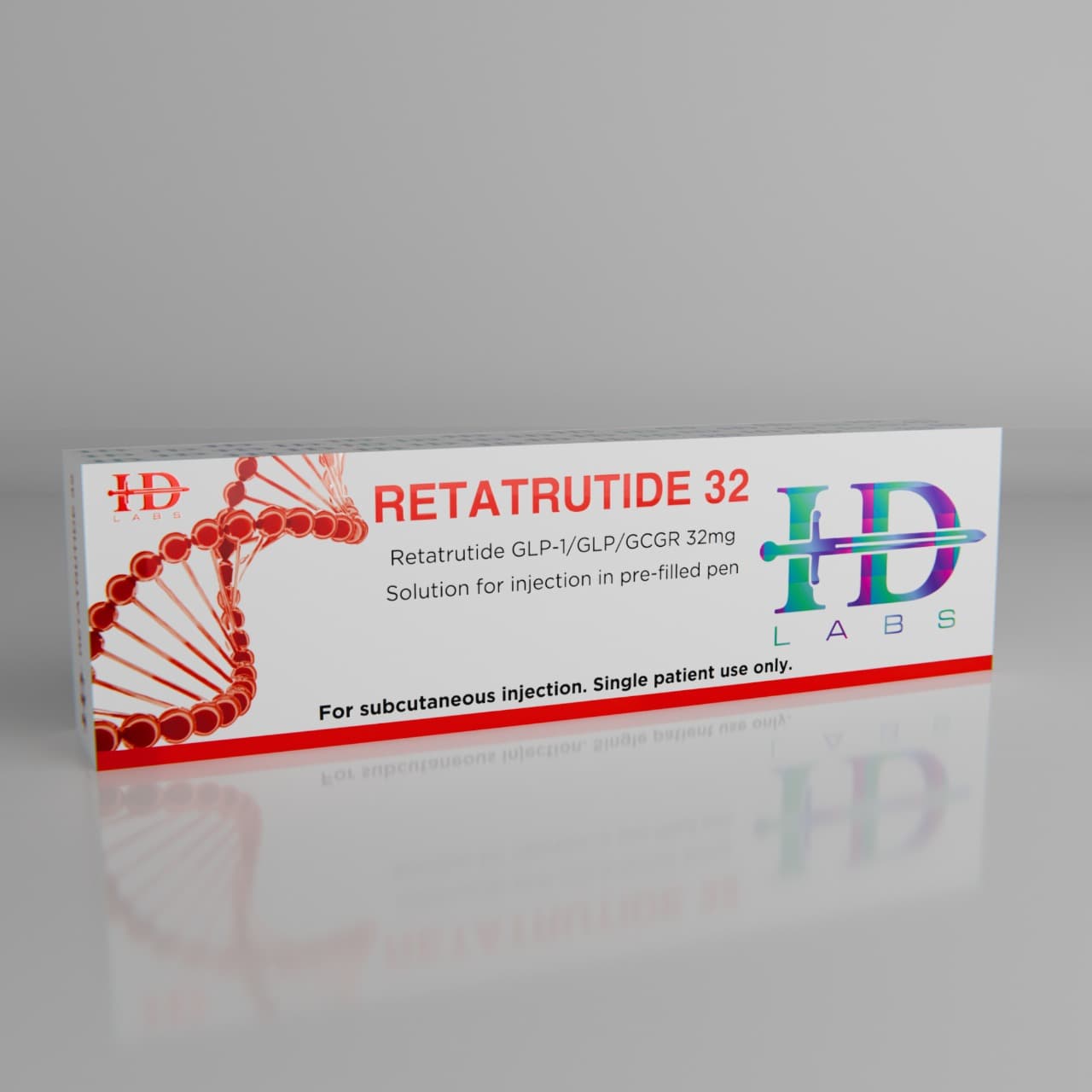
What you get
- 1× pen
- 8× needles
What you need
- Alcohol swabs
HD Labs Retatrutide 32 Pen
R2 500.00
SKU hdreta32pen
4.8(20 reviews)Compare & learn
HD Labs Retatrutide 32 Pen is a triple-agonist research peptide (GLP-1, GIP and glucagon) supplied in a 32 mg dial-a-dose pen, aimed at users who have plateaued on semaglutide or tirzepatide. In Phase 2 obesity trials, retatrutide produced the highest peak weight-loss figures published to date for any GLP-1-class compound. It remains investigational, so it is sold for research use and should only be used under the supervision of a South African–registered practitioner.
Who it's for
- ›Adults researching next-generation weight management
What it's used for
- ›Triple agonist (GIP, GLP-1, glucagon) studied for weight loss
- ›Researched for appetite and metabolic regulation
General research information, not medical advice.
Please note
Prescription-class compound supplied for research use. You must be 18 or older. Consult a qualified healthcare professional before use, this is not medical advice.
Card · EFT · Bitcoin · Discreet delivery
Complete your kit
The supplies you need to store and use your order — add yours in one tap.
 BEARE Insulin 1mL + 30G Needle Syringes 30 PackR90.00
 Body Pharm Pen Needles 6mm x 31G (Box of 30)R120.00
HD Retatrutide 32 Pen: Buy South Africa’s Strongest Weight Loss Peptide
The HD Retatrutide 32 Pen is a South African–stocked triple-agonist peptide (GLP-1, GIP and glucagon receptors) sold in 32 mg pen format, aimed at users who have plateaued on semaglutide or tirzepatide. In the Jastreboff et al. Phase 2 NEJM trial (2023), 12 mg weekly retatrutide produced a mean 24.2% weight loss at 48 weeks, with 83% of participants achieving at least 15% body-weight loss versus 2% on placebo. That result comes from the triple-receptor mechanism, which activates three metabolic pathways at once rather than one or two.
That 24.2% peak is a higher figure than the best published tirzepatide result (about 22.5% in SURMOUNT-1) and more than 1.6× semaglutide’s STEP 1 outcome (14.9%), which is why interest in retatrutide has hardened into actual purchase intent in 2026. Retatrutide remains an investigational medicine: its Phase 3 TRIUMPH programme has begun reporting results, but as of mid-2026 it is not approved by the FDA and holds
Key Takeaways
- Retatrutide produced 24.2% mean weight loss at 48 weeks in a Phase 2 trial, outperforming semaglutide and tirzepatide in published cross-trial data
- The triple-agonist mechanism (GLP-1 + GIP + glucagon) addresses both energy intake and expenditure, unlike dual agonists
- The R2,500 32 mg pen lasts 8–16 weeks depending on dose, with a slow titration schedule required to manage gastrointestinal side effects
- Retatrutide suits users who have plateaued on tirzepatide or semaglutide and want a mechanistically different option under practitioner supervision
What Is the HD Labs Retatrutide 32 Pen?
The HD Labs Retatrutide 32 Pen is a prefilled, dial-a-dose injector containing 32 mg of synthetic retatrutide, a triple-agonist peptide that activates GLP-1 (glucagon-like peptide-1), GIP (glucose-dependent insulinotropic polypeptide), and glucagon receptors in a single molecule. It retails in South Africa at approximately R2,500 per pen and is manufactured by HD Labs, a research-peptide supplier whose products are distributed through local online retailers rather than registered pharmacies.
Retatrutide is the same molecule (LY3437943) Eli Lilly took into Phase 2, where 12 mg weekly produced a 24.2% mean body-weight reduction at 48 weeks(Jastreboff et al., NEJM 2023). The HD Labs version is not Lilly’s commercial product. The pen format removes the reconstitution and syringe-draw steps that introduce dosing errors with vial-based peptides. You dial micrograms the same way a semaglutide ortirzepatide pen does, which reduces the risk of under- or over-dosing compared to manual reconstitution. HD Labs does not publish a formal mg/mL concentration or excipient monograph for this SKU.
Triple-Agonist Mechanism: GLP-1, GIP, and Glucagon
Retatrutide activates three metabolic receptors simultaneously — GLP-1, GIP, and glucagon — rather than one or two. Each receptor controls a different lever of energy balance. Stacking them produces weight-loss figures (24.2% at 48 weeks on 12 mg) that neither monotherapy nor dual therapy has matched in Phase 2 data to date.
GLP-1 receptor activation slows gastric emptying and reduces appetite signalling in the hypothalamus. This is the same mechanism that drives semaglutide’s effect in Wegovy and Ozempic (Novo Nordisk).
GIP receptor activation enhances glucose-dependent insulin secretion and modulates adipocyte fat storage. This is the second lever that tirzepatide (Mounjaro/Zepbound, Eli Lilly) adds on top of GLP-1.
Glucagon receptor activation is the third lever retatrutide adds. It is thought to increase resting energy expenditure and hepatic fat oxidation, raising the calories you burn at rest rather than only suppressing the calories you eat. This expenditure effect is drawn largely from preclinical and mechanistic work rather than large human trials, so treat the magnitude as unquantified in people.
Why three beats two
Semaglutide is a GLP-1 agonist only. Tirzepatide is a GLP-1 + GIP dual agonist. Retatrutide is a GLP-1 + GIP + glucagon triple agonist.
The combination is designed to work on more than one side of energy balance. Appetite suppression (GLP-1) and insulin/fat-handling (GIP) work on the intake side. Glucagon agonism is intended to push the expenditure side upward. You reduce energy in and, in principle, increase energy out from the same weekly injection.
This is why people who plateau on a dual agonist like the HD Labs Tirzepatide 30 often look to retatrutide next. The glucagon component addresses a different physiological pathway.
Retatrutide vs Semaglutide vs Tirzepatide: 2026 Comparison
Retatrutide has produced the highest peak weight-loss percentage of any GLP-1-class peptide in published Phase 2 data (24.2% at 48 weeks, NEJM 2023). It is also the only one of the three that remains unapproved by any major regulator as of mid-2026.
| Peptide | Receptors Targeted | Peak Trial Weight Loss | Trial Duration | Approval Status (2026) |
|---|---|---|---|---|
| Semaglutide | GLP-1 | 14.9% (STEP 1, n=1,961) | 68 weeks | FDA approved (Wegovy, 2021) |
| Tirzepatide | GLP-1 + GIP | 22.5% (SURMOUNT-1, n=2,539) | 72 weeks | FDA approved (Zepbound, 2023) |
| Retatrutide | GLP-1 + GIP + glucagon | 24.2% (NEJM Phase 2, n=338) | 48 weeks | Phase 3 (TRIUMPH), not approved |
The retatrutide 24.2% figure was achieved in 4 fewer weeks than tirzepatide’s 22.5% and 20 fewer weeks than semaglutide’s 14.9%. The trajectory of loss is steeper, not just the endpoint.
At the 12 mg dose, 83% of retatrutide participants achieved at least 15% weight loss at 48 weeks versus 2% on placebo (NEJM 2023). Tirzepatide’s SURMOUNT-1 cohort and semaglutide’s STEP 1 cohort were both substantially larger (2,539 and 1,961 participants respectively). Larger sample sizes produce tighter confidence intervals than retatrutide’s Phase 2 estimate of 338 participants.
What the table doesn’t show
No head-to-head randomised trial directly comparing all three molecules in the same patient population had been published as of mid-2026. Cross-trial comparisons are useful for direction but not for precise effect-size claims. The populations, baseline BMIs, and titration schedules differ across trials.
The Phase 3 TRIUMPH programme (including TRIUMPH-1) has begun reporting topline results in 2026; full peer-reviewed efficacy and safety data are still emerging, so the Phase 2 figures above remain the best-documented basis for comparison for now.
Regulatory certainty and a settled side-effect profile favour tirzepatide. The HD Labs Tirzepatide 30 and Body Pharm Tirzepatide 30 Pen sit in the same grey-market tier as the HD Retatrutide 32 Pen but with a longer evidence base behind the molecule itself.
Prior plateau on a dual agonist makes retatrutide the only option in this table with a mechanistic reason to break that plateau. The glucagon component addresses energy expenditure, a pathway tirzepatide does not target.
Clinical Trial Results: What the Data Actually Shows
The primary efficacy evidence for retatrutide is a single Phase 2 trial: Jastreboff et al., NEJM 2023. The trial enrolled 338 adults with obesity (or overweight with a weight-related condition), randomised to weekly subcutaneous retatrutide at 1 mg, 4 mg, 8 mg, or 12 mg (with 2 mg and 4 mg starting-dose arms) versus placebo for 48 weeks.
Mean percentage weight change from baseline at 48 weeks was −8.7% at 1 mg, −17.1% at 4 mg, −22.8% at 8 mg, and −24.2% at 12 mg, against −2.1% on placebo. At the top dose, 83% of participants achieved at least 15% body-weight loss and 93% achieved at least 10%, versus 2% and 9% respectively on placebo. The weight-loss curve had not plateaued at week 48, meaning the true asymptote in this cohort is unknown.
Tolerability followed the GLP-1 class pattern. The most common treatment-emergent adverse events were gastrointestinal — nausea, diarrhoea, vomiting, and constipation. These were dose-related, mostly mild-to-moderate, concentrated during titration, and partially mitigated by a lower 2 mg starting dose. Dose-dependent increases in heart rate were also reported, peaking around 24 weeks and declining thereafter — worth flagging if you have existing tachyarrhythmia or uncontrolled hypertension.
Clinical evidence at a glance
- Trial: Jastreboff AM et al., “Triple–Hormone-Receptor Agonist Retatrutide for Obesity — A Phase 2 Trial,” NEJM 2023;389(6):514–526
- n = 338, 48 weeks, weekly subcutaneous dosing
- 12 mg cohort: −24.2% mean body weight; 83% achieved ≥15% loss, 93% achieved ≥10% loss
- Placebo: −2.1%
- Phase 3 (TRIUMPH programme, incl. TRIUMPH-1, NCT05929066): TRIUMPH-1 reported topline results in 2026; full peer-reviewed data still emerging
Phase 2 numbers come from a screened, supervised, titration-controlled population. Real-world outcomes on a grey-market pen, without dietitian contact or scheduled bloods, will sit below that ceiling. Adherence to the slow titration schedule is harder to enforce outside a trial setting.
Tirzepatide, with Phase 3 data already in the literature, remains the lower-risk choice if regulatory certainty matters to you. The HD Labs Tirzepatide 30 sits in that category.
HD Labs Retatrutide 32 Pen: Dosing Protocol Guide
The escalation approach used in the NEJM 2023 Phase 2 trial stepped the dose up monthly, broadly:
- 2 mg/week for weeks 1–4
- 4 mg/week for weeks 5–8
- 8 mg/week for weeks 9–12
- 12 mg/week maintenance if tolerated
Monthly step-ups were designed to keep gastrointestinal side effects mild-to-moderate. This is the protocol the trial’s −24.2% mean weight-loss figure is built on. Deviating from it (faster titration, skipping rungs) is where most tolerability failures happen. The gastrointestinal system needs time to adapt to each dose increment.
Practical supply maths on a single 32 mg pen:
- At 2 mg/week it lasts 16 weeks
- At 4 mg/week it lasts 8 weeks
- At 8 mg/week it lasts 4 weeks
- At the 12 mg maintenance dose it lasts roughly 2.5 weeks
A full titration to 12 mg consumes most of one pen across the first 12 weeks. Maintenance at 12 mg then burns through roughly one pen every two to three weeks. Budget accordingly before you start.
Injection technique and pen mechanism
Retatrutide is dosed subcutaneously once weekly. The three validated injection sites are:
- The abdomen (avoiding a 5 cm radius around the navel)
- The front or outer thigh
- The back of the upper arm
Rotate sites week to week to reduce lipohypertrophy, the accumulation of fatty lumps under the skin that can occur with repeated injections in the same location.
The HD Labs pen uses a dial-a-dose mechanism. Turn the dose selector to the prescribed milligram value, attach a fresh pen needle, prime, then inject and hold for 5–10 seconds before withdrawing.
The HD Labs Tirzepatide 30 and the Body Pharm Tirzepatide 30 Pen use the same injection technique and sit in the same category with a more settled evidence base.
Disclaimer: This is reference information drawn from the published trial protocol, not medical advice. Dosing decisions, titration adjustments, and monitoring (heart rate, blood pressure, HbA1c, lipids) must be supervised by a qualified healthcare practitioner registered in South Africa. Retatrutide is as of 2026.
Side Effects and Safety Profile
The most common adverse events in the NEJM 2023 Phase 2 trial were gastrointestinal and dose-related:
- Nausea
- Decreased appetite
- Vomiting
- Diarrhoea
- Constipation
These events were more frequent in the retatrutide arms than on placebo, were mostly mild-to-moderate in severity, and clustered during dose escalation. They were partially mitigated by starting at 2 mg rather than 4 mg, and tend to settle once a weekly milligram step is held before the next titration. The published trial does not report exact per-symptom incidence in its abstract, so treat any single-figure percentage you see quoted elsewhere with caution.
Serious adverse events were reported in both the retatrutide and placebo groups over the 48-week trial. Because the human safety record for retatrutide is still short, the balance of benefit and risk is worth a frank conversation with your prescriber before you start.
Contraindications and unknowns
In line with the GLP-1 drug class, retatrutide should not be used by anyone with a personal or family history of medullary thyroid carcinoma or Multiple Endocrine Neoplasia syndrome type 2, and it should be avoided in pregnancy and breastfeeding. The Phase 2 trial also excluded people with active pancreatitis and severe gastroparesis, conditions that can be worsened by GLP-1 agonism.
Published human safety data extend only to 48 weeks as of mid-2026, because the TRIUMPH Phase 3 obesity programme is still reporting. There are no peer-reviewed real-world cohorts on compounded or grey-market retatrutide use. Treat anything beyond one year of continuous use as unstudied. Run baseline and quarterly bloods (lipase, HbA1c, renal panel, lipids) under a South African–registered practitioner.
The dual-agonist HD Labs Tirzepatide 30 sits on a deeper safety dataset if that uncertainty is a dealbreaker.
Who Should Use the HD Retatrutide 32 Pen?
The HD Retatrutide 32 Pen is intended for adults with a BMI of 30 or higher, or 27 and above with at least one weight-related comorbidity (hypertension, dyslipidaemia, type 2 diabetes, or obstructive sleep apnoea), who have plateaued on semaglutide or tirzepatide and want a triple-agonist option under practitioner supervision.
The Phase 2 trial that anchors the efficacy data enrolled adults with a BMI of 30 or higher, or 27 to under 30 with a weight-related condition. That cohort is the closest practical benchmark for who the trial evidence actually applies to.
Switching is premature if you are still in the dose-escalation phase of tirzepatide and losing weight steadily. You have not yet reached the plateau that retatrutide is designed to break. A reasonable trigger is a stall of three months or more at the maximum tolerated dose, confirmed against a stable food log. In that case, the HD Labs Tirzepatide 30 or Body Pharm Tirzepatide 30 Pen remain the lower-risk choices.
Who should not use it
Pregnant or breastfeeding women, anyone under 18, and people with a personal or family history of medullary thyroid carcinoma or MEN2 should not use this pen. Active pancreatitis and severe gastroparesis were also exclusion criteria in the Phase 2 trial.
How to Buy the HD Retatrutide 32 Pen in South Africa
The HD Retatrutide 32 Pen is R2,500 per pen at Beskinny, in stock as of 2026, with courier shipping to all South African provinces typically arriving within 2–4 working days in an insulated cold pack. Lower-dose entry points exist if 32 mg per pen is more than you want to commit to for a first cycle. The Retatrutide 10 mg and 5 mg vial options on theweight-loss injections category page are sensible alternatives. Users who decide retatrutide is too aggressive can step sideways to the HD Labs Tirzepatide 30 or Body Pharm Tirzepatide 30 Pen without re-ordering.
Storage on arrival
Refrigerate at 2–8 °C immediately, protect from light, and do not freeze. HD Labs does not publish a formal technical data sheet or a validated shelf-life for this SKU, so rely on the printed expiry date on your pen rather than any generic stability figure.
Frequently Asked Questions
Is retatrutide stronger than tirzepatide?
Retatrutide produced ~24.2% mean weight loss at 48 weeks on the 12 mg weekly dose in the Phase 2 NEJM 2023 trial, compared with the ~20.9% reported for tirzepatide 15 mg at 72 weeks in SURMOUNT-1 (NEJM 2022). The two trials had different durations and populations. Retatrutide reached a higher percentage in less time because the triple-agonist mechanism activates an additional metabolic pathway (glucagon) that tirzepatide does not target.
How long does one 32 mg pen last?
One HD Retatrutide 32 Pen lasts between 8 and 16 weeks depending on dose. At a 2 mg weekly starting titration it covers 16 weeks; at a 4 mg maintenance dose it covers 8 weeks; at the 8 mg Phase 2 cohort dose it covers 4 weeks. Most users on a slow titration finish one pen in roughly 2–3 months because they spend the first 12 weeks escalating through lower doses.
Can I use retatrutide if I’ve been on semaglutide?
Yes, prior GLP-1 exposure is the typical profile of people switching to retatrutide. The Phase 2 trial did not exclude participants for previous GLP-1 use, though formal switch protocols have not been published. There is no peer-reviewed real-world data on washout periods as of mid-2026.
A conservative approach is to start retatrutide at the next scheduled weekly injection after the last semaglutide dose. This avoids overlapping GLP-1 agonism.
What is the difference between the HD Labs Retatrutide 32 Pen and the HD Labs Retatrutide 32 vial?
The pen is pre-filled and dial-a-dose, ready to inject. The 32 mg vial requires reconstitution with bacteriostatic water and dose calculation by insulin syringe, which introduces the risk of measurement error. Both contain 32 mg of peptide. The vial is cheaper per mg; the pen is faster and reduces dosing errors.
The pen mechanism is identical to the HD Labs Tirzepatide 30 or Body Pharm Tirzepatide 30 Pen if you’ve used either of those.
Next Steps
If you have plateaued on semaglutide or tirzepatide and want to explore retatrutide, schedule a consultation with a South African–registered healthcare practitioner who has experience with weight-loss peptides. Bring your weight-loss history, current medications, and any existing cardiovascular or thyroid concerns. Your practitioner can assess whether the triple-agonist mechanism suits your metabolic profile and establish a baseline for heart rate, blood pressure, and lipase before titration begins. Once you have clinical clearance, order your first pen from Beskinny and plan for quarterly bloods throughout your treatment cycle.
References
- Jastreboff AM, et al. Triple–Hormone-Receptor Agonist Retatrutide for Obesity — A Phase 2 Trial. New England Journal of Medicine, 2023;389(6):514–526.
- Wilding JPH, et al. Once-Weekly Semaglutide in Adults with Overweight or Obesity (STEP 1). New England Journal of Medicine, 2021;384(11):989–1002.
- Jastreboff AM, et al. Tirzepatide Once Weekly for the Treatment of Obesity (SURMOUNT-1). New England Journal of Medicine, 2022;387(3):205–216.
- A Study of Retatrutide (LY3437943) in Participants With Obesity or Overweight (TRIUMPH-1), NCT05929066. ClinicalTrials.gov, U.S. National Library of Medicine, 2023.