
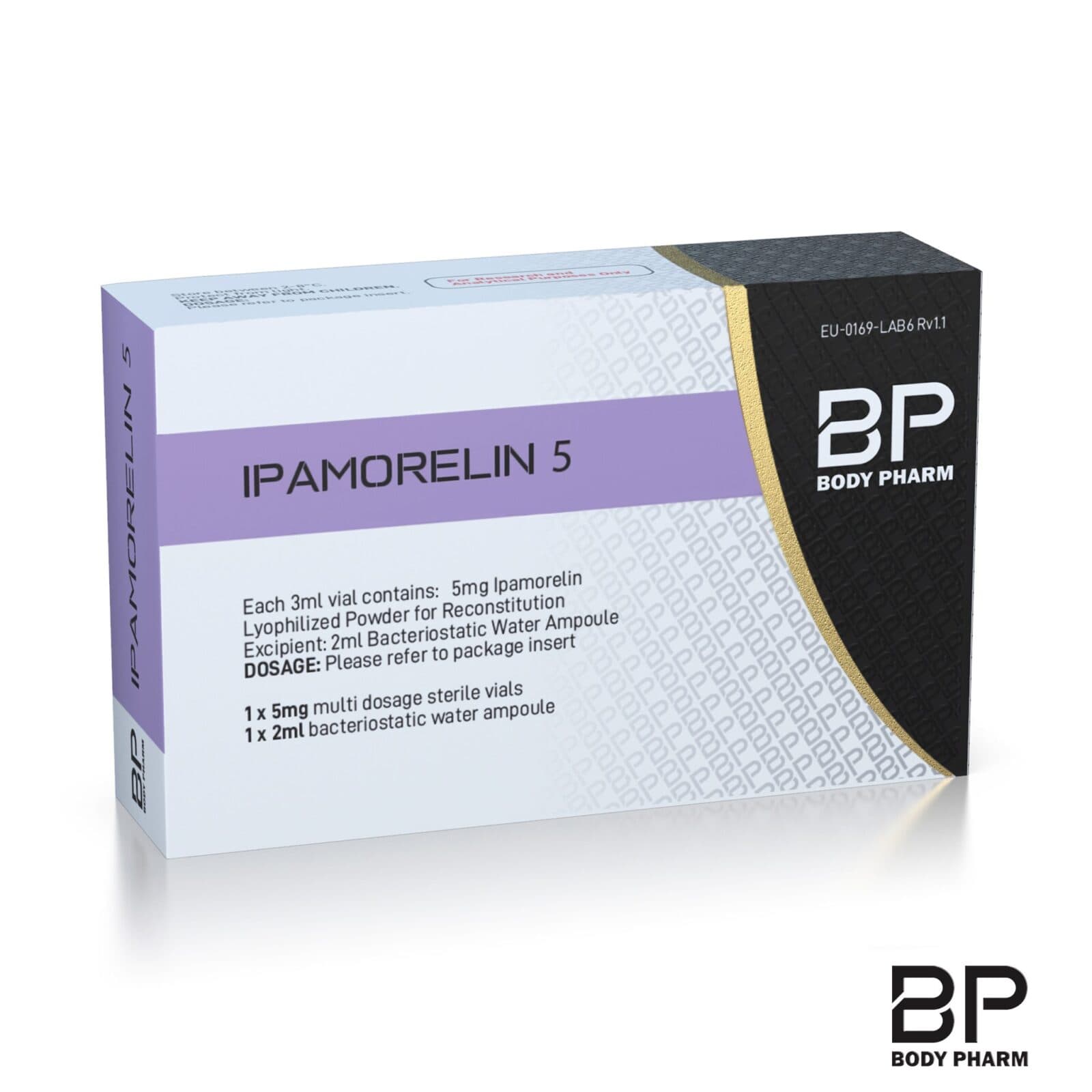
What you get
- 1× vial (product)
- 1× bacteriostatic water (2 ml)
What you need
- Syringe + needle to reconstitute (reconstitution calculator)
- Alcohol swabs
- Needle + syringe to inject
Body Pharm Ipamorelin 5 Vial
R360.00
SKU pepipa5
4.8(6 reviews)Body Pharm Ipamorelin 5mg is a research-grade lyophilised peptide vial (5 mg in a 3 ml multi-dose format) supplied strictly for laboratory research use. This guide covers its growth-hormone-secretagogue mechanism, research-context dosing, reconstitution, and side-effect profile, with primary-source citations throughout.
Who it's for
- ›Adults researching growth-hormone support
- ›Those focused on recovery, sleep and body composition
What it's used for
- ›Growth-hormone secretagogue studied for GH release
- ›Researched for lean muscle, recovery and sleep quality
General research information, not medical advice.
Please note
Prescription-class compound supplied for research use. You must be 18 or older. Consult a qualified healthcare professional before use, this is not medical advice.
Card · EFT · Bitcoin · Discreet delivery
Complete your kit
The supplies you need to store and use your order — add yours in one tap.
 BEARE Insulin Syringes 10 PackR35.00
- BEARE Insulin Syringes 20 PackR60.00
 Alcohol Swabs 50 PackR25.00
Body Pharm Ipamorelin 5mg: SA Pricing, Dosage & Protocol 2026
Body Pharm Ipamorelin 5mg is a research-grade lyophilised peptide vial sold in South Africa, with verified 2026 pricing from R360 on beskinny.store.
Key Takeaways
- Body Pharm Ipamorelin 5mg costs R360 on beskinny.store (verified 2026 ZAR price).
- Reconstitution with 2 ml bacteriostatic water yields 2,500 mcg/ml; research dosing described in the literature is typically 100–300 mcg per injection, one to three times daily.
- Ipamorelin is a selective growth hormone secretagogue-receptor (GHS-R1a) agonist that, in preclinical characterisation, triggered pulsatile GH release without significant cortisol or prolactin elevation.
- No large-scale human RCT confirms efficacy or safety at consumer-research doses as of 2026; benefit claims rest on animal work, and the only controlled human trial studied an unrelated indication (postoperative ileus).
- Request the batch Certificate of Analysis (COA) from beskinny.store before purchase; no third-party COA is published for this listing at the time of writing.
This guide covers:
- Current 2026 ZAR pricing and stock for the beskinny.store listing
- Step-by-step reconstitution and subcutaneous injection protocol
- Dosage ranges cited in the research literature and the mechanistic rationale behind timing and frequency
Five checkpoints before you buy:
- Check live ZAR pricing and stock on the beskinny.store listing (details below).
- Request the batch COA before paying, because purity claims should be backed by batch documentation.
- Reconstitute with bacteriostatic water using the volume matched to your research dosing plan.
- Follow the subcutaneous injection protocol step-by-step, sterile technique throughout.
Each step is covered below, with sourced caveats where the evidence is thin.
What Is Body Pharm Ipamorelin 5mg?
Body Pharm Ipamorelin 5mg is a synthetic pentapeptide growth hormone releasing peptide (GHRP), supplied as a lyophilised peptide powder in a 3 ml multi-dose vial, sold strictly for research purposes and not approved as a medicine in South Africa. The vial sold via beskinny.store contains 5 mg of ipamorelin acetate in a sealed, rubber-stoppered glass vial requiring reconstitution before use.
Five facts worth knowing before checkout:
- Molecule. Ipamorelin is a five-amino-acid sequence (Aib-His-D-2-Nal-D-Phe-Lys-NH₂) classified as a selective ghrelin-receptor agonist.
- Format. 5 mg lyophilised peptide powder per 3 ml vial. Reconstitution with bacteriostatic water is required (volume covered in the protocol section).
- Selectivity. The preclinical literature describes ipamorelin as releasing growth hormone without the cortisol or prolactin elevations seen with older GHRPs, because it targets a single receptor (GHS-R1a) rather than activating multiple ghrelin-pathway branches. Human confirmation of this selectivity profile remains limited as of 2026.
- Labelled for research use only.
- Brand context. Body Pharm produces related GHRH/GHRP products including the Body Pharm CJC1295 & Ipamorelin 20 Pen and Tesamorelin 32 Pen, which sit in the same peptide class but differ in delivery format and pharmacokinetics.
How Ipamorelin Works: The GHRP Mechanism
Ipamorelin binds the growth hormone secretagogue receptor (GHS-R1a, the ghrelin receptor) on somatotrophs in the anterior pituitary gland, mimicking ghrelin and triggering a short, pulsatile GH release. The pulse pattern matters because it preserves the body’s natural feedback loop rather than flooding the system with exogenous GH, which would suppress endogenous GH production through negative feedback.
What distinguishes ipamorelin from earlier GHRPs:
- Receptor target. GHS-R1a agonism on anterior pituitary somatotrophs, the same receptor ghrelin occupies.
- Release profile. Pulsatile, dose-dependent GH release rather than sustained elevation, which aligns with the body’s natural GH secretion pattern.
- Selectivity. Preclinical literature describes minimal cortisol and prolactin elevation because ipamorelin does not activate off-target receptors that older GHRPs (GHRP-6, GHRP-2) engage.
- No appetite spike. Unlike GHRP-6, ipamorelin did not produce the strong hunger response associated with broader ghrelin-axis activation in preclinical work.
- Downstream IGF-1. A GH pulse drives hepatic IGF-1 (insulin-like growth factor 1) output, which mediates much of the anabolic signalling attributed to the GH axis.
- Stacking rationale. Pairing with a GHRH analogue such as CJC-1295 reportedly produces a larger combined GH pulse than either peptide alone, because GHRH primes the somatotroph while GHRP triggers release. That synergy evidence is largely preclinical as of 2026.
Why CJC-1295 Gets Stacked With Ipamorelin
CJC-1295 is a GHRH analogue that acts on a different pituitary receptor (the GHRH receptor) to prime somatotrophs for release, while ipamorelin pulls the trigger via GHS-R1a. In healthy adults, CJC-1295 has been shown to raise GH and IGF-1 for several days after a single dose, which is the pharmacological basis for combining it with a short-acting GHRP. The two mechanisms are complementary on paper because they target sequential steps in the GH secretion cascade, which is why combination products like the Body Pharm CJC1295 & Ipamorelin 20 Pen exist as a single pre-mixed format. Researchers comparing pen-based stacks to separate vials sometimes look at adjacent GHRH-class options such as the Body Pharm Tesamorelin 32 Pen, which targets the same receptor as CJC-1295 but with a different pharmacokinetic profile.
Human efficacy data for the CJC-1295 + ipamorelin combination at consumer-research doses remains absent from the peer-reviewed literature as of 2026.
Ipamorelin Dosage Protocol for Research Use (2026)
The protocol most commonly described in the research literature follows this order:
- Start at 100 mcg per injection for the first 1–2 weeks to assess tolerance and any flushing, head-pressure or injection-site response.
- Inject pre-sleep, roughly 30–60 minutes before bed, when endogenous GH pulses are largest and food intake has tapered, because fasting amplifies the GH response at the pituitary level.
- Add a second pre-workout dose of 100–200 mcg, 20–30 minutes before training, once baseline tolerance is established.
- Add a third morning dose (fasted) only if the research protocol calls for 1–3x daily and total daily exposure stays within the 300–900 mcg envelope cited in the literature.
- Hold each injection at least 2 hours away from food, particularly carbohydrate and fat, because elevated blood glucose and free fatty acids blunt the GH response at the somatotroph level.
- Reassess every 4–6 weeks rather than escalating indefinitely, because pulsatile dosing is the mechanistic rationale, not saturation.
For researchers running a CJC-1295 + ipamorelin combination, the pre-mixed Body Pharm CJC1295 & Ipamorelin 20 Pen fixes the ratio and simplifies dosing arithmetic versus drawing from two separate vials. Adjacent GHRH-class formats such as the Body Pharm Tesamorelin 32 Pen follow a different daily-dose convention and should not be substituted milligram-for-milligram.
Anyone considering these doses in a human-adjacent context should consult a registered South African healthcare professional first. Vendor labelling is explicit: research use only, not for human consumption.
Step-by-Step Reconstitution & Injection Protocol
Reconstituting a Body Pharm Ipamorelin 5mg vial means adding bacteriostatic water to the lyophilised peptide powder, then drawing measured doses with an insulin syringe for subcutaneous injection in a research setting. The volume you add determines the concentration, which determines the syringe markings you’ll use. Follow the package insert that ships with your vial as the primary source. The steps below describe a standard 2 ml dilution that produces clean syringe arithmetic.
Supplies to lay out before you start
- One Body Pharm Ipamorelin 5mg vial (lyophilised, sealed)
- 30 ml vial of bacteriostatic water (0.9% benzyl alcohol preserved)
- U-100 insulin syringes, 0.5 ml or 1 ml, 29–31G
- 70% isopropyl alcohol swabs
- Sharps container and a clean, flat work surface
The six-step protocol
- Sanitise. Wash hands, wipe the vial stopper of both the ipamorelin and the bacteriostatic water with separate alcohol swabs, and let them air-dry for 10 seconds.
- Calculate dilution. Adding 2 ml of bacteriostatic water to a 5 mg vial yields 2,500 mcg/ml. On a U-100 insulin syringe, 0.04 ml (the “4 IU” mark) draws 100 mcg, 0.08 ml draws 200 mcg, and 0.12 ml draws 300 mcg. Choose your dilution before you inject the water, because changing it later means recalculating every dose.
- Inject the water slowly. Draw 2 ml of bacteriostatic water, insert the needle into the ipamorelin vial at an angle, and let the water run down the inside wall of the glass rather than blasting onto the powder cake. Peptides are shear-sensitive and rapid injection can denature the molecule.
- Swirl, do not shake. Roll the vial gently between your palms until the solution is clear. Visible particulates or cloudiness after 60 seconds is a reason to discard the vial.
- Store at 2–8°C. Refrigerate reconstituted vials and use within roughly 28 days, a commonly cited handling window for bacteriostatic-water-reconstituted research peptides; defer to the package insert shipped with your vial. Keep the vial upright and away from the freezer wall.
- Inject subcutaneously. Rotate between abdomen (5 cm from the navel), outer thigh, or posterior upper arm. Swab the site, pinch 2–3 cm of subcutaneous fat, insert the insulin needle at 45–90°, push the plunger slowly over 3–5 seconds, withdraw, and dispose into the sharps container. Rotate sites each dose to prevent lipohypertrophy.
This protocol is written for research administration. Anyone applying it in a human-adjacent context should consult a registered South African healthcare professional and defer to the printed package insert shipped with the vial.
Buying Body Pharm Ipamorelin 5mg in South Africa (2026)
beskinny.store lists Body Pharm Ipamorelin 5mg at R360.00, in stock and shipping nationally. Peptide pricing in South Africa moves with the rand and with import-batch turnover, so re-verify the cart total on the checkout page before paying.
COA and batch documentation
No third-party Certificate of Analysis (COA) is published for this listing at the time of writing, so request the batch COA by email before committing. A COA is the only document that ties a specific vial batch to its stated identity and purity, and it should be your primary quality check on any research peptide.
Stacking and adjacent products
Researchers comparing single-peptide vials against pre-mixed pen formats often cross-shop the Body Pharm CJC1295 & Ipamorelin 20 Pen, which combines the GHRH analogue with ipamorelin in a fixed-ratio pen. The same brand’s Body Pharm Tesamorelin 32 Pen sits in the adjacent GHRH category for researchers documenting growth-hormone-axis peptides side by side. Pen formats remove the reconstitution step but lock you into the manufacturer’s pre-set concentration, which matters for the dilution maths covered earlier in this guide.
Reported Benefits and Research Findings
Ipamorelin is a selective growth hormone secretagogue researched for pulsatile GH release without significant cortisol or prolactin elevation, with all current efficacy signals drawn from preclinical models rather than large-scale human RCTs as of 2026. The three research areas below summarise what the literature actually examines, each with a preclinical caveat that buyers should weigh before any purchase decision.
- GH stimulation and downstream IGF-1 elevation. Ipamorelin binds the ghrelin/GHS-R1a receptor in pituitary tissue, triggering GH secretion that in turn raises hepatic IGF-1 output. Preclinical evidence for ipamorelin specifically; no large-scale human RCT confirms sustained IGF-1 benefit for non-clinical users as of 2026.
- Lean mass and protein synthesis signalling. IGF-1 elevation feeds into the protein-synthesis pathways implicated in skeletal muscle anabolism, which is the mechanistic basis for the “lean mass” framing seen across vendor copy. Preclinical evidence only. No large-scale human RCT confirmation as of 2026.
- Lipolysis and fat oxidation. GH pulses are associated with hormone-sensitive lipase activation and free fatty acid release from adipocytes, which underpins the lipolysis and “fat loss” research framing. Preclinical evidence for ipamorelin specifically. No large-scale human RCT confirmation as of 2026.
Human data on ipamorelin itself is limited: the only controlled human trial to date evaluated it for postoperative ileus recovery after bowel surgery, not muscle growth, fat loss, or anti-aging, and it did not reach statistical significance on its primary endpoint. There is no human trial supporting the physique or wellness uses commonly attached to this peptide.
Stacking with CJC-1295 in research protocols
Research protocols frequently pair ipamorelin (a GHRP) with CJC-1295 (a GHRH analogue) because the two act on different receptors and produce a larger, more sustained GH pulse together than either alone in preclinical models. Researchers documenting that combination in a single-device format often reference the Body Pharm CJC1295 & Ipamorelin 20 Pen, while those comparing GHRH-class agents alongside it cross-reference the Body Pharm Tesamorelin 32 Pen. None of this constitutes a therapeutic claim. The human efficacy data simply isn’t there yet.
Side Effects and Safety Considerations
Reported side effects of ipamorelin in research contexts are typically mild and self-limiting: injection-site redness or transient stinging, short-lived water retention, headache, light-headedness, and mild fatigue following administration. The selectivity profile is the main mechanistic reason researchers prefer ipamorelin over older GHRPs because it avoids off-target receptor activation. In preclinical comparisons it produced less cortisol and prolactin elevation than GHRP-6 at equivalent GH-releasing doses. That selectivity claim rests on animal and early-phase work, not modern long-term human trials.
No large-scale, long-term human safety dataset for ipamorelin exists as of 2026. Chronic-use risk across months to years is genuinely unknown, and anyone purchasing Body Pharm Ipamorelin 5mg should treat the absence of data as a real risk signal rather than a green light.
General research-context cautions documented for GH-releasing peptides include:
- Active or suspected malignancy, because GH/IGF-1 elevation is mitogenic in multiple tumour lines.
- Pregnancy and breastfeeding, because no safety data exists in these populations.
- Pre-existing endocrine disorders (diabetes, pituitary disease), because GH-axis manipulation can disrupt glycaemic control.
- Concurrent use of other GH secretagogues or exogenous GH without clinical oversight.
Medical disclaimer
Body Pharm Ipamorelin vs the CJC-1295 Combo Pen
The standalone 5 mg vial suits researchers who want dosing flexibility at the lowest entry cost (R360 on beskinny.store as of 2026), while the combo pen suits buyers prioritising convenience over granular control. Both formats come from the same brand, so the decision is format and workflow, not manufacturer trust.
When the 5 mg vial wins
Choose the vial if you need to titrate doses precisely, run split AM/PM protocols, or want to stack ipamorelin with a separately-dosed GHRH like tesamorelin. Reconstitution gives you control over concentration (more or less bacteriostatic water equals different units-per-tick on the syringe), and the R360 price point is the cheapest way to access Body Pharm ipamorelin in ZAR.
When the pen wins
Choose the Body Pharm CJC1295 & Ipamorelin 20 Pen if you want a pre-mixed, fixed-ratio GHRH + GHRP combination without measuring, drawing, or storing bacteriostatic water. The pen format trades dosing flexibility for click-and-inject convenience, and it bundles CJC-1295 so you skip buying a second vial. Researchers comparing GHRH-class options should look at the Body Pharm Tesamorelin 32 Pen, which is a different GHRH analogue with its own pharmacokinetic profile.
Vial for control. Pen for convenience. Same brand either way.
Frequently Asked Questions
What is Body Pharm Ipamorelin 5mg used for in research?
Body Pharm Ipamorelin 5mg is a research-grade lyophilised pentapeptide vial used in preclinical and in vitro studies of selective GH secretagogue activity at the GHS-R1a (ghrelin) receptor on anterior pituitary somatotrophs. It is not approved for human therapeutic use in South Africa.
How long does a 5 mg vial last at 200 mcg per day?
A 5 mg (5000 mcg) vial lasts 25 days at a 200 mcg/day research dose because 5000 mcg ÷ 200 mcg = 25 days. Reconstituted with 2 ml of bacteriostatic water, the concentration becomes 2500 mcg/ml, so 200 mcg equals 0.08 ml (8 units on a U-100 insulin syringe).
Does ipamorelin need to be refrigerated?
Yes. After reconstitution, ipamorelin should be stored at 2–8°C and used within roughly 28 days, because bacteriostatic water preserves the solution but does not prevent long-term degradation. Lyophilised (unreconstituted) vials are more forgiving and can sit at room temperature short-term, but refrigeration extends shelf life. Defer to the package insert for the exact window.
Can ipamorelin be stacked with CJC-1295?
Ipamorelin and CJC-1295 are commonly researched together as a GHRP + GHRH pairing because they target complementary receptors and produce a larger combined GH pulse than either alone, with preclinical work suggesting synergistic amplification. Researchers who want the pre-mixed format can look at the Body Pharm CJC1295 & Ipamorelin 20 Pen instead of dosing two vials separately.
What is the difference between ipamorelin and GHRP-6?
Ipamorelin is a selective GHRP that, per preclinical characterisation, does not significantly raise cortisol or prolactin because it targets a single receptor, whereas GHRP-6 stimulates appetite and shows broader off-target hormonal effects. Researchers comparing GHRH-class options can consider the Body Pharm Tesamorelin 32 Pen.
Next Steps
References
- Ipamorelin, the first selective growth hormone secretagogue. European Journal of Endocrinology, 1998.
- Prolonged stimulation of growth hormone (GH) and insulin-like growth factor I secretion by CJC-1295, a long-acting analog of GH-releasing hormone, in healthy adults. Journal of Clinical Endocrinology & Metabolism, 2006.
- Effects of growth hormone on glucose, lipid, and protein metabolism in human subjects. Endocrine Reviews, 2009.
- Prospective, randomized, controlled, proof-of-concept study of the ghrelin mimetic ipamorelin for the management of postoperative ileus in bowel resection patients. International Journal of Colorectal Disease, 2014.