
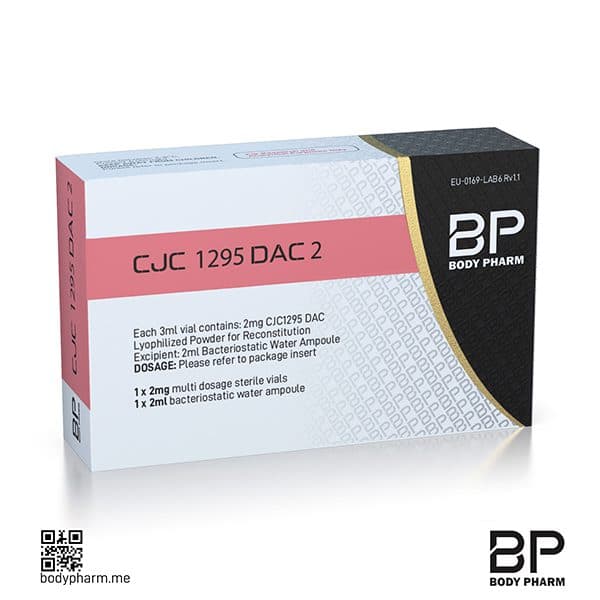
What you get
- 1× vial (product)
- 1× bacteriostatic water (2 ml)
What you need
- Syringe + needle to reconstitute (reconstitution calculator)
- Alcohol swabs
- Needle + syringe to inject
Body Pharm CJC 1295 with DAC 2 Vial
R400.00
SKU bpcjc1295
4.8(4 reviews)Each unit contains : 1x CJC 1295 DAC 2mg in 3ml multi dosage vial 1x Bacteriostatic water 2ml for reconstitution 1x Product insert with dosage and mixing guidelines.
Who it's for
- ›Adults researching growth-hormone support and recovery
What it's used for
- ›Studied to stimulate growth-hormone and IGF-1 release
- ›Researched for muscle growth, fat loss and recovery
General research information, not medical advice.
Card · EFT · Bitcoin · Discreet delivery
Complete your kit
The supplies you need to store and use your order — add yours in one tap.
 BEARE Insulin Syringes 10 PackR35.00
- BEARE Insulin Syringes 20 PackR60.00
 Alcohol Swabs 50 PackR25.00
Body Pharm CJC 1295 DAC 2: Dosage, Benefits & Guide
Body Pharm’s CJC 1295 DAC 2mg kit is a research-grade, lyophilised GHRH analog vial bundled with bacteriostatic water. Many research-peptide vials ship as powder only and leave you to buy the diluent separately; this kit includes it, so the vial is ready to reconstitute out of the box.
Key Takeaways
- At R400 for the 2mg kit (bacteriostatic water and product insert included), a single 200mcg research dose works out to roughly R40, with no separate diluent to source.
- CJC-1295 with DAC has an elimination half-life of roughly 6–8 days in published human data, enabling once- or twice-weekly dosing versus the daily injections required for non-DAC versions.
- Reconstituting the 2mg vial in 2ml of bacteriostatic water yields a 1000mcg/ml solution; commonly cited research protocols use 1–2mg weekly.
- No Phase 3 human efficacy trials have been completed; the available human evidence is early-phase pharmacokinetic data.
What Is CJC 1295 DAC? (Plain-Language Definition)
CJC-1295 DAC is a synthetic analogue of growth hormone-releasing hormone (GHRH) and a growth hormone secretagogue (GHS). It is modified with a Drug Affinity Complex that, in the original human trial, extended its circulating half-life to approximately 5.8–8.1 days versus the roughly 30 minutes of the unmodified peptide. It acts on the anterior pituitary’s GHRH receptors to stimulate the body’s own GH release, and the DAC modification lets the molecule bind covalently to circulating albumin, creating a slow-release depot.
“DAC” stands for Drug Affinity Complex — a lysine–maleimidopropionic acid linker fused to the C-terminus of the modified GRF(1-29) peptide chain. That linker forms a covalent bond with circulating albumin in the bloodstream, which is why the molecule resists the peptidase degradation that would otherwise clear the non-DAC version within minutes.
The pharmacokinetic difference is the main reason researchers pick DAC over Mod GRF 1-29:
- Non-DAC CJC-1295 (Mod GRF 1-29) has a half-life of roughly 30 minutes. Without albumin-binding protection, it requires multiple daily injections to maintain GH pulses.
- CJC-1295 DAC showed an elimination half-life of about 5.8–8.1 days in the original Phase 1 human data, supporting once- or twice-weekly dosing.
- Albumin binding creates a slow-release depot, producing sustained elevation of baseline GH and IGF-1 rather than only discrete pulses. The covalent bond prevents rapid clearance.
Buyers comparing secretagogue protocols against direct HGH often weigh CJC-1295 DAC against options like the Body Pharm Somatropin 40 Pen (HGH). Those building a broader recomposition stack sometimes pair GH-axis peptides with mitochondrial compounds such as the Body Pharm MOTS-C 32 Pen.
CJC 1295 DAC vs. No DAC: Key Differences
The DAC variant’s weekly schedule is the primary practical differentiator. The extended half-life removes the need for daily injections: roughly 2mg per week for DAC versus 100–200mcg daily (or twice daily) for the No-DAC version. If convenience matters, DAC is the obvious choice.
The mechanistic split matters for protocol design. DAC binds covalently to serum albumin and sustains elevated baseline GH and IGF-1. Even so, human data show that GH secretion remains pulsatile under continuous CJC-1295 stimulation rather than flattening into a steady release. No-DAC (Mod GRF 1-29) produces short-lived signals that let researchers study discrete pulsatile GH release closer to endogenous secretion.
| Attribute | With DAC (Body Pharm 2mg) | Without DAC (Mod GRF 1-29) |
|---|---|---|
| Half-life | ~5.8–8.1 days | ~30 minutes |
| Injection frequency | 1–2x weekly | 1–3x daily |
| GH release pattern | Sustained baseline elevation (pulses persist) | Pulsatile, mimics endogenous rhythm |
| Typical research dose | 2mg per week | 100–200mcg per dose |
| Common vial format | 2mg multi-dose vial | 2mg or 5mg vial |
Which variant fits which research goal
Sustained-elevation protocols (DAC) are the standard pick for researchers prioritising convenience and steady IGF-1 readings across a multi-week log. The extended half-life reduces dosing variability. Pulsatile protocols (No-DAC) suit researchers comparing peptide-induced GH spikes against a baseline, or those stacking with GHRPs like Ipamorelin to model synergistic pulses.
For buyers weighing the secretagogue route against direct exogenous hormone, the Body Pharm Somatropin 40 Pen (HGH) sits at the other end of the GH-axis spectrum. The Body Pharm MOTS-C 32 Pen is the mitochondrial peptide most often logged alongside CJC-1295 DAC in recomposition stacks.
CJC 1295 DAC Benefits: What the Research Shows
The evidence base for CJC-1295 DAC sits at “small human trials plus animal data plus community logs.” No large-scale Phase 3 RCT has been published as of 2026. What follows is research context only, not therapeutic claims, and applies to the same 2mg DAC molecule Body Pharm supplies.
GH secretion via the anterior pituitary
CJC-1295 DAC is a GHRH analog that binds covalently to serum albumin and elevates baseline GH and IGF-1 across a multi-day window. In the original human study, single doses produced dose-dependent GH increases of 2- to 10-fold and IGF-1 increases of 1.5- to 3-fold, with IGF-1 remaining above baseline for up to 28 days after repeated dosing. That early pharmacokinetic dataset remains the strongest human evidence cited in 2026 reviews, and no new peer-reviewed human RCT has replaced it.
Lean body composition and muscle protein synthesis
Animal and small human pilot data link sustained GHRH-analog dosing to increased IGF-1, the downstream mediator most associated with muscle protein synthesis. Independent human evidence remains limited to small, short-term studies, and CJC-1295 DAC is investigational rather than an approved therapeutic. No peer-reviewed trial has measured muscle gain or fat loss as a primary endpoint in CJC-1295 DAC users between 2023 and 2026.
Recovery and tissue repair signalling
Elevated IGF-1 is mechanistically associated with collagen synthesis and soft-tissue repair, which is one reason researchers stack CJC-1295 DAC with mitochondrial peptides like the Body Pharm MOTS-C 32 Pen in recomposition logs. Human recovery-endpoint trials specific to CJC-1295 DAC have not been published in 2023–2026.
Anti-aging and skin elasticity markers
Anti-aging claims rest almost entirely on the IGF-1 elevation mechanism plus anecdotal community reporting. No RCT has measured skin elasticity or collagen density as a primary endpoint in CJC-1295 DAC users. Vendor and clinic pages often describe Ipamorelin + CJC-1295 DAC as a combination that “synergistically enhances growth hormone levels,” but that is promotional framing, not peer-reviewed RCT data. Buyers wanting the downstream hormone directly rather than the secretagogue route can compare against the Body Pharm Somatropin 40 Pen (HGH).
Body Pharm CJC 1295 DAC 2mg: What’s in the Kit
The Body Pharm CJC 1295 DAC 2mg kit ships as a three-component bundle for R400 per unit: one 2mg peptide vial, one 2ml ampoule of bacteriostatic water, and one printed product insert with mixing and dosage guidelines.
Itemised contents:
- 1x CJC 1295 DAC 2mg lyophilised peptide powder in a 3ml multi-dose vial. The 3ml headspace accommodates a full 2ml reconstitution volume with room for the syringe needle to draw across multiple weekly pulls.
- 1x bacteriostatic water, 2ml, for reconstitution. Bacteriostatic water is water preserved with 0.9% benzyl alcohol — the correct diluent for any vial you intend to draw from more than once, because the preservative limits bacterial and fungal growth across multiple needle entries. Sterile water lacks the preservative and is single-use only.
- 1x product insert with dosage and mixing guidelines, which removes the guesswork most first-time buyers encounter when a vendor ships powder alone.
Bundling the bac water removes a separate purchase: vial-only SKUs are common and expect you to source the diluent yourself. That single inclusion is what makes the cost-per-dose math in the next section work out the way it does. Researchers stacking this with the Body Pharm MOTS-C 32 Pen or comparing secretagogue protocols to direct HGH via the Body Pharm Somatropin 40 Pen (HGH) don’t need to place a second order before their first injection.
Step-by-Step Reconstitution Guide for the 2mg Vial
Reconstituting the Body Pharm 2mg vial with the included 2ml bacteriostatic water yields a 1mg/ml solution. 2000mcg divided by 2ml equals 1000mcg/ml. Every 0.1ml drawn on a 100-unit insulin syringe equals 100mcg of CJC-1295 DAC.
Follow this sequence exactly:
- Gather supplies. The 2mg peptide vial, the 2ml bacteriostatic water ampoule from the kit, a 1ml / 100-unit insulin syringe (29G–31G), and two alcohol swabs. Source syringes separately — the kit does not include them.
- Swab both vial stoppers with an alcohol swab and let them air-dry for 10–15 seconds. Wet stoppers can contaminate the draw, and residual alcohol can denature the peptide.
- Draw 2ml of bacteriostatic water into the insulin syringe. On a 1ml syringe this requires two pulls. Use the full 2ml ampoule.
- Inject the water slowly down the inside wall of the peptide vial. Angle the needle so the stream runs down the glass rather than blasting directly onto the lyophilised powder cake. Direct impact can cause aggregation and degrade peptide integrity.
- Swirl gently in a circular motion for 20–30 seconds until the powder fully dissolves. Do not shake. The solution should be clear and colourless. Cloudiness or particulates mean the vial is compromised.
- Label the vial with the reconstitution date using a permanent marker. This is the anchor for your use-by window (see storage below).
- Return the vial to the fridge within 10 minutes of mixing. Peptide bonds hydrolyse faster at warmer temperatures, so room-temperature exposure beyond that window starts eroding stability.
Concentration and dose-volume reference
The math: 2000mcg ÷ 2ml = 1000mcg/ml. On a 100-unit insulin syringe, each 10-unit gradation equals 0.1ml.
| Target dose | Volume to draw | Syringe units (100u) |
|---|---|---|
| 100mcg | 0.1ml | 10 units |
| 200mcg | 0.2ml | 20 units |
| 300mcg | 0.3ml | 30 units |
| 500mcg | 0.5ml | 50 units |
At 200mcg per week, the 2mg multi-dose vial yields 10 weekly subcutaneous injections. At 100mcg per week, it stretches to 20. That is the input for the cost-per-dose calculation in the next section.
Storage after reconstitution
Refrigerate at 2–8°C and protect from light by keeping the vial in its box. Do not freeze the reconstituted solution. The 0.9% benzyl alcohol preservative in bacteriostatic water supports repeated withdrawals from a multi-dose vial; reconstituted peptide is commonly used within about 28 days when refrigerated, but the product insert shipped with the kit is the authoritative reference. If its guidance conflicts with anything above, follow the insert.
Researchers running parallel GH-axis protocols with the Body Pharm Somatropin 40 Pen (HGH) should keep reconstituted vials on separate shelves of the fridge door to avoid mix-ups during weekly draws.
CJC 1295 DAC Dosage Protocols in 2026
Commonly cited research dosing for CJC-1295 DAC sits at 1–2mg per week, administered as a single subcutaneous injection or split into two weekly doses. These figures come from vendor literature and practitioner reports, not peer-reviewed RCTs, because no large-scale human clinical trial on CJC-1295 DAC has been published between 2023 and 2026.
The numbers cited most often across vendor and clinic literature:
- Body recomposition / athletic protocols: 2mg once weekly — the most commonly cited DAC dose, because it aligns with the ~6–8 day half-life.
- Anti-aging / lower-intensity protocols: 1mg once weekly, or 1–2mg split as 0.5–1mg twice weekly.
- Combination GH-axis stacks: around 1mg weekly when paired with a GHRP like Ipamorelin, to limit cumulative GH-pulse amplitude, since dual GHRH + GHRP signalling can produce excessive GH spikes.
- First-time research subjects: start at the lower end (1mg/week) for the first 4 weeks before titrating, per common harm-reduction guidance.
Injection timing
Evening administration, roughly 1–2 hours before sleep on an empty stomach, is the most commonly cited timing in 2024–2026 vendor and clinic guides. This timing overlaps with the natural nocturnal GH pulse. The DAC modification’s multi-day half-life means timing matters less than it does for No-DAC versions, whose users inject 2–3 times daily to chase short GH spikes. That weekly-vs-daily convenience gap is the practical reason most South African buyers pick DAC over Mod GRF 1-29.
Research-only status
Stacking CJC 1295 DAC with Ipamorelin
Ipamorelin is the most commonly paired peptide with CJC-1295 DAC because it triggers GH release through the ghrelin receptor and, in its original characterisation study, did not raise ACTH, cortisol, or prolactin — making it the cleanest GHRP partner for a sustained GHRH signal. The mechanical logic is straightforward: CJC-1295 DAC raises the ceiling of each natural GH pulse via continuous GHRH-receptor activation, while Ipamorelin acts as the trigger that fires the pulse itself.
Vendor-side write-ups push the synergy hard, with marketing copy claiming the combination “synergistically enhances growth hormone levels, promoting significant muscle growth and fat loss.” That is promotional language, not peer-reviewed data. No human RCT published between 2023 and 2026 has quantified the stack’s effect versus either peptide alone.
What the protocols typically look like
Common research-use protocols pair 1–2mg CJC-1295 DAC weekly with 200–300mcg Ipamorelin injected 1–3 times daily. This ratio balances sustained GHRH signalling with pulsatile GHRP triggers. Dosing varies widely across clinic and vendor sources, and combined safety data remain unestablished as of 2026.
Buyers concerned about stacking safety should note that no human trial has evaluated the combined pharmacokinetics or adverse-event profile of CJC-1295 DAC + Ipamorelin.
Adjacent peptides researchers compare
Cost Per Dose
Body Pharm’s CJC-1295 DAC 2mg kit is R400 with bacteriostatic water and product insert included. On a 2mg vial that yields ten 200mcg doses (2000mcg ÷ 200mcg = 10), that works out to roughly R40 per 200mcg dose, and because the diluent is already in the box there is no separate bac water purchase to add on top.
When comparing any vial-only listing, add the cost of bacteriostatic water before the per-dose figures line up — a 10ml bottle typically retails around R50–R80, plus the extra order and courier round-trip. Buyers stacking against direct HGH can price-check the Body Pharm Somatropin 40 Pen (HGH), or run a mitochondrial comparator like the Body Pharm MOTS-C 32 Pen on the same per-dose basis.
Side Effects and Safety Considerations
Commonly reported effects in the research and off-label clinical literature include:
- Injection-site reactions — transient redness, itching, or mild swelling at the subcutaneous site, usually resolving within 24 hours.
- Water retention and mild peripheral oedema, most often in the first 1–2 weeks as IGF-1 rises.
- Fatigue or grogginess, particularly when dosed in the morning rather than pre-sleep.
- Headache and facial flushing within 15–30 minutes of injection, linked to a GHRH-driven vasodilatory response.
- Tingling or numbness in the hands, occasionally reported with sustained dosing.
Sustained elevation of GH and IGF-1 can reduce insulin sensitivity over prolonged cycles, because GH antagonises insulin signalling, so fasting glucose and HbA1c are reasonable markers to monitor if you run multi-month protocols. Anyone with a personal or family history of malignancy, active diabetes, or pituitary disorders should consult a registered healthcare provider before purchasing.
Frequently Asked Questions
How long does CJC-1295 DAC stay active after injection?
CJC-1295 DAC has an elimination half-life of approximately 6–8 days in humans, based on early Phase 1 pharmacokinetic data. A single weekly subcutaneous injection sustains elevated GHRH signalling and IGF-1 levels for 7+ days. The albumin-bound depot releases the peptide gradually, which is why once-weekly or twice-weekly dosing schedules are standard rather than daily.
Can CJC-1295 DAC be used for fat loss?
CJC-1295 DAC is researched as a GHRH analog that elevates endogenous GH and IGF-1, which are associated with lipolysis in earlier human studies because GH stimulates hormone-sensitive lipase in adipose tissue. No peer-reviewed 2023–2026 trial confirms standalone fat-loss efficacy. It is sold strictly for research purposes in South Africa, not as a weight-loss therapeutic.
How many doses are in a 2mg vial?
A 2mg CJC-1295 DAC vial reconstituted in 2ml bacteriostatic water yields 10 doses at 200mcg or 20 doses at 100mcg per weekly injection (2000mcg ÷ 200mcg = 10). At a 300mcg weekly research dose, the same vial delivers roughly 6–7 doses.
Does Body Pharm CJC 1295 DAC include bacteriostatic water?
Yes. Body Pharm CJC 1295 DAC 2mg (R400) includes a 2ml bacteriostatic water ampoule and product insert as a complete kit, which reduces buyer friction and eliminates a separate purchase. Many vial-only SKUs require a separate bac water purchase before you can reconstitute.
What is the difference between CJC 1295 DAC and Ipamorelin?
CJC-1295 DAC is a long-acting GHRH analog with a 6–8 day half-life that drives sustained GH signalling; it binds albumin and resists enzymatic degradation. Ipamorelin is a short-acting ghrelin-mimetic GHRP with a ~2 hour half-life that triggers immediate, selective GH release via the ghrelin receptor. They act on different receptors and are commonly researched together for synergistic pulsatility.
How should reconstituted CJC 1295 DAC be stored?
Refrigerate at 2–8°C, keep in the original box to protect from light, and use within about 28 days. Peptide bonds hydrolyse faster at warmer temperatures and light exposure degrades the molecule. The 0.9% benzyl alcohol in the included bacteriostatic water is the preservative that makes the multi-dose window viable. Do not freeze.
Next Steps
References
- Prolonged stimulation of growth hormone (GH) and insulin-like growth factor I secretion by CJC-1295, a long-acting analog of GH-releasing hormone, in healthy adults. Journal of Clinical Endocrinology & Metabolism (Teichman et al.), 2006.
- Pulsatile secretion of growth hormone (GH) persists during continuous stimulation by CJC-1295, a long-acting GH-releasing hormone analog. Journal of Clinical Endocrinology & Metabolism (Ionescu & Frohman), 2006.
- Ipamorelin, the first selective growth hormone secretagogue. European Journal of Endocrinology (Raun et al.), 1998.
- Bacteriostatic Water for Injection, USP (prescribing information). DailyMed, U.S. National Library of Medicine, 2023.