
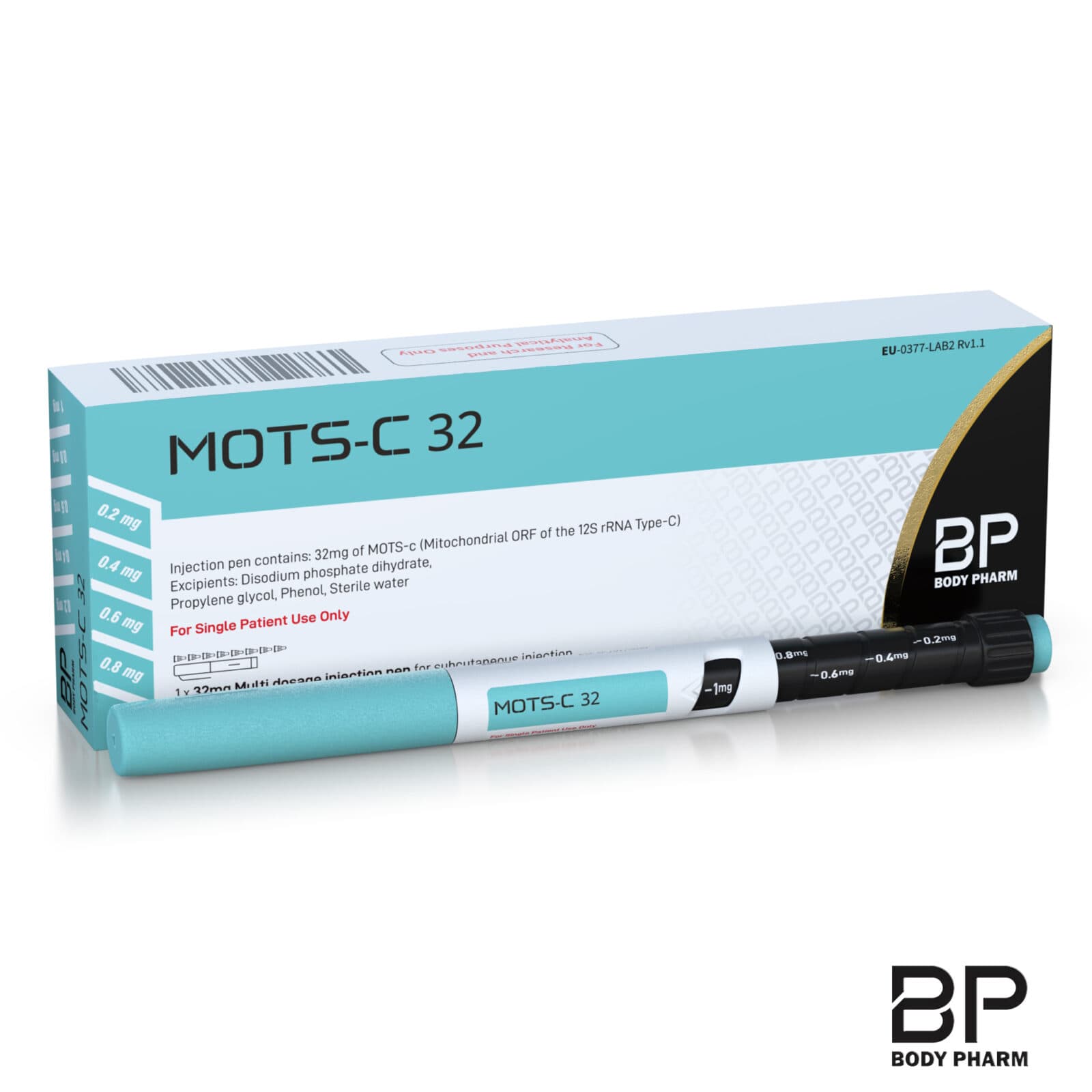
What you get
- 1× pen
- 8× needles
What you need
- Alcohol swabs
Body Pharm MOTS-C 32 Pen
R2 200.00
SKU bpmots32
5.0(4 reviews)The Body Pharm MOTS-C 32 Pen is a high-dose (32 mg) prefilled pen of MOTS-c, a mitochondrial-derived peptide studied in preclinical models for its effects on AMPK signalling, insulin sensitivity and fat metabolism. Human efficacy is not yet established. Each prefilled pen contains 32 mg MOTS-c.
Who it's for
- ›Adults researching metabolism and energy
What it's used for
- ›Mitochondrial peptide studied for metabolic regulation
- ›Researched for energy, endurance and insulin sensitivity
General research information, not medical advice.
Card · EFT · Bitcoin · Discreet delivery
Complete your kit
The supplies you need to store and use your order — add yours in one tap.
 BEARE Insulin 1mL + 30G Needle Syringes 30 PackR90.00
 Body Pharm Pen Needles 6mm x 31G (Box of 30)R120.00
Body Pharm MOTS-C 32 Pen: SA Guide 2026
Key Takeaways
- At R2,200 for 32 mg, the pen works out to roughly R68.75/mg (R2,200 ÷ 32 mg) — verify the live price before ordering, as ZAR peptide pricing shifts frequently.
- The high per-pen dose means a single 32 mg pen typically covers most of a community-protocol cycle, versus several smaller pens.
- Human evidence for MOTS-c is limited: the first registered Phase 2a trial (NCT07505745) only began dosing on 2 February 2026 and has no posted results.
- Almost all efficacy data to date is preclinical (rodent and cell-culture); treat any human fat-loss or insulin-sensitivity claim as extrapolation.
What You’ll Learn in This Guide
What Is the Body Pharm MOTS-C 32 Pen?
The Body Pharm MOTS-C 32 Pen is a prefilled subcutaneous injector containing 32 mg of MOTS-c peptide per pen, manufactured by Body Pharm and retailing at R2,200 on Beskinny.store in 2026. The high per-pen dose is aimed at buyers running a full cycle who want fewer devices to manage.
The pen format matters for buyers who have previously worked with lyophilised vials. Doses are pre-measured by click, there is no bacteriostatic-water reconstitution step, and storage handling is simpler than a multi-dose vial. Total fill volume and mg-per-click calibration are not published on the listing, so confirm those numbers with the retailer before finalising a dosing protocol.
How MOTS-C Works: The Mechanism in Plain Language
MOTS-c is a 16-amino-acid peptide encoded within the mitochondrial 12S rRNA that activates the AMPK energy-sensing pathway (adenosine monophosphate-activated protein kinase). In preclinical models this activation improves insulin signalling in muscle and liver tissue and enhances glucose uptake.
That AMPK activation is the mechanism most retailers reference when marketing MOTS-c pens, because it links directly to metabolic rate and glucose disposal.
A secondary effect described in the mechanistic literature is metabolic flexibility — the cell’s ability to switch fuel sources between glucose and fatty-acid oxidation depending on substrate availability. In rodent studies, MOTS-c treatment prevented diet-induced obesity and both age-dependent and high-fat-diet-induced insulin resistance. These findings, and MOTS-c’s wider role in diabetes and aging-related metabolism, are the data most consumer-facing peptide guides paraphrase when they describe MOTS-c as a “metabolic” or “exercise-mimetic” peptide.
Where the evidence actually sits in 2026
Almost all mechanistic data on MOTS-c up to 2026 comes from rodent and cell-culture work, not humans, because no human efficacy trial had completed by mid-2026. The first registered Phase 2a human trial (NCT07505745) began on 2 February 2026, testing 12 weeks of MOTS-c against insulin-sensitivity endpoints in adults with prediabetes and overweight/obesity, and results are not yet posted. Treat any human dose-response or fat-loss claim from a retailer as extrapolation from animal data until that read-out lands.
That distinction matters for purchasing. You are buying a peptide with a plausible mitochondrial mechanism and meaningful preclinical signal, but without the registered efficacy data that backs a Body Pharm Semaglutide 6 Pen GLP-1 protocol, or even the longer track record behind a Body Pharm CJC1295 & Ipamorelin 20 Pen stack. Price the risk accordingly.
Key Benefits: What the Evidence Actually Shows
No MOTS-c benefit is established by large-scale human randomized controlled trials as of 2026; the strongest claims sit on rodent and cell-culture data, with the first registered Phase 2a human trial (NCT07505745) only initiated in February 2026 and still unreported. Read the list below with that ceiling in mind.
- Enhanced insulin sensitivity via AMPK activation — preclinical/mechanistic. MOTS-c activates AMPK and improves insulin signalling and glucose disposal in muscle and liver tissue in rodent models. NCT07505745 is the first human trial designed to test whether this translates to measurable insulin-sensitivity gains.
- Improved glucose uptake — preclinical. Rodent work shows increased skeletal-muscle glucose uptake in some protocols. No human glucose-clamp data is published as of 2026.
- Fat utilisation and metabolic flexibility — preclinical. In diet-induced obesity models, MOTS-c reduced fat mass and prevented diet-induced obesity. This is the data set retailers paraphrase when stacking MOTS-c alongside GLP-1 protocols like the Body Pharm Semaglutide 6 Pen.
- Endurance and recovery — preclinical / community-reported. In mice, MOTS-c is exercise-induced and improved physical capacity across young, middle-aged and old animals, but human endurance claims circulating in SA peptide forums remain anecdotal. Users frequently pair it with growth-hormone secretagogue stacks such as the Body Pharm CJC1295 & Ipamorelin 20 Pen, again without controlled human data.
- Longevity and healthy ageing — preclinical. MOTS-c expression declines with age and late-life MOTS-c treatment increased healthspan markers in mice. Extrapolation to human lifespan is speculative.
Treat any retailer claim presenting these as proven as a marketing claim, not a clinical one.
Cost Per Pen and Per Cycle
At R2,200 per pen, the 32 mg format works out to roughly R68.75 per mg (R2,200 ÷ 32 mg) on Beskinny.store in 2026. Peptide-pen pricing in ZAR shifts with import costs and stock, so verify the live price on the product page before ordering.
A commonly cited community protocol runs three subcutaneous injections per week for about five weeks (roughly 15 injections) at 5–10 mg per injection. This dosing baseline is anecdotal and drawn from peptide-community protocols, not from any completed human trial, because the only registered Phase 2a MOTS-c study in humans (NCT07505745) started in February 2026 and has no posted results. On that baseline, a single 32 mg pen covers a large share of a cycle:
- At 5 mg per injection (~75 mg per cycle): about 3 pens (3 × R2,200 = R6,600).
- At 10 mg per injection (~150 mg per cycle): about 5 pens (5 × R2,200 = R11,000).
Wastage matters: dialling a 5 mg dose from a 32 mg pen leaves a partial last-dose remainder, so confirm the pen’s mL volume and click calibration with the supplier before committing, because concentration data is not published on the listing. If you are stacking MOTS-c with a Body Pharm Semaglutide 6 Pen or a Body Pharm CJC1295 & Ipamorelin 20 Pen, add those line items to your cycle budget before deciding.
Dosing and Administration: What Users Report
Community-reported MOTS-c protocols run 3–5 subcutaneous injections per week over a 4–6 week cycle, followed by a break of similar length, though all of this is anecdotal because no completed human efficacy trial has been published as of 2026 and the only registered study (NCT07505745) is still running.
The prefilled pen format removes the reconstitution step that vial-and-bacteriostatic-water setups require. You dial, prime and inject — typically into the abdomen or upper thigh, rotating sites between injections to avoid localised irritation.
Storage is straightforward but non-negotiable: refrigerate between 2–8 °C, protect from light, and do not freeze, per the storage conditions on the accompanying BodyPharm certificate of analysis. A frozen peptide pen is a dead pen. If you are travelling, an insulated cooler with an ice pack (not in direct contact with the cartridge) is the standard workaround.
Who Is the Body Pharm MOTS-C 32 Pen Best For?
The 32 mg pen is best suited to experienced peptide users running a full 4–6 week MOTS-c cycle who want the fewest devices to manage, because the higher dose-per-pen means one unit typically covers a full cycle at community-protocol frequencies.
The 32 mg pen fits you better if:
- You’ve run MOTS-c before and already know your tolerated dose.
- You’re committed to a standard 4–6 week cycle and want fewer pens in the fridge and fewer mid-cycle reorders.
- You’re stacking MOTS-c with other peptides like a Body Pharm Semaglutide 6 Pen or a Body Pharm CJC1295 & Ipamorelin 20 Pen and want to control total device count.
It may be more than you need if:
- It’s your first MOTS-c run and you’d rather tolerance-test at a lower upfront commitment before buying a large pen.
- You’re planning a short 2–3 week trial or a sub-standard dose.
A note on dose framing
We deliberately don’t recommend mg-per-injection figures because the only registered human trial (NCT07505745) hasn’t reported results and community protocols vary widely. The guidance above is about cost structure and commitment level, not clinical dosing — that conversation belongs with your prescribing clinician.
MOTS-C and the Broader Beskinny Stack
MOTS-c is most often run alongside other injectable peptides rather than in isolation. Two community stacking patterns dominate SA forum discussion through 2025–2026.
The most common pairing is with a GLP-1 agonist for metabolic work: users running the Body Pharm Semaglutide 6 Pen often add MOTS-c 2–3× weekly on the rationale (preclinical, not clinically proven) that mitochondrial-derived peptides may complement appetite-driven weight loss with a metabolic-rate angle. For body-composition users, MOTS-c sits next to growth-hormone secretagogues like the Body Pharm CJC1295 & Ipamorelin 20 Pen, with the GH peptide handling lean-mass support and MOTS-c running as a separate metabolic input.
A smaller subset uses the 32 mg pen standalone as a 4–6 week metabolic block between other cycles. These are community-reported patterns, not therapeutic combinations endorsed by any registered protocol.
Frequently Asked Questions
What is MOTS-c used for?
MOTS-c is a mitochondrial-derived peptide studied for insulin sensitivity, metabolic regulation and exercise capacity, with mechanistic data drawn almost entirely from rodent and cell-culture work. In community protocols, South African buyers typically use it for fat-loss support and metabolic conditioning, often stacked with a GLP-1 like the Body Pharm Semaglutide 6 Pen. Human efficacy remains unproven pending results from NCT07505745, which only began enrolling in February 2026.
How much does the Body Pharm 32 mg pen cost?
The Body Pharm MOTS-C 32 Pen retails at R2,200 on Beskinny.store in 2026, or roughly R68.75/mg. Always verify the live price on the product page before ordering, because SA peptide pricing shifts with import costs and stock.
How is MOTS-c administered?
MOTS-c is administered by subcutaneous injection, typically into abdominal fat, using the pen’s click-dose mechanism, which allows repeatable dosing without reconstitution. Community protocols commonly run 2–3 injections per week. Exact mg-per-click depends on the pen’s fill volume and concentration, which is not published on the product page, so confirm with the supplier before dialling a dose.
How should the pen be stored?
Store the pen refrigerated at 2–8 °C, protected from light, and never frozen, per the storage conditions on the accompanying BodyPharm certificate of analysis. Freezing destroys the peptide.
Next Steps
If you’ve decided the Body Pharm 32 mg pen fits your protocol and budget, verify the current price and stock on Beskinny.store before ordering. Confirm the pen’s fill volume and mg-per-click calibration directly with the supplier so you can dial your intended dose accurately. If you’re stacking MOTS-c with a GLP-1 or GH secretagogue, map out the full cycle cost for all products. Consult a qualified practitioner before injecting — MOTS-c is unregistered in South Africa, and medical supervision matters when running a novel compound.
References
- The mitochondrial-derived peptide MOTS-c promotes metabolic homeostasis and reduces obesity and insulin resistance. Cell Metabolism (Lee et al.), 2015.
- MOTS-c is an exercise-induced mitochondrial-encoded regulator of age-dependent physical decline and muscle homeostasis. Nature Communications (Reynolds et al.), 2021.
- Mitochondrial-Encoded Peptide MOTS-c, Diabetes, and Aging-Related Diseases. Diabetes & Metabolism Journal, 2023.
- A Phase 2a Study to Evaluate the Efficacy, Safety and Pharmacodynamics of MOTS-c in Adults With Prediabetes and Overweight/Obesity (NCT07505745). ClinicalTrials.gov, 2026.
- BodyPharm Certificate of Analysis (storage and handling conditions). Body Pharm, 2026.