
Skip to content
BeSkinny Store
3rd party tested
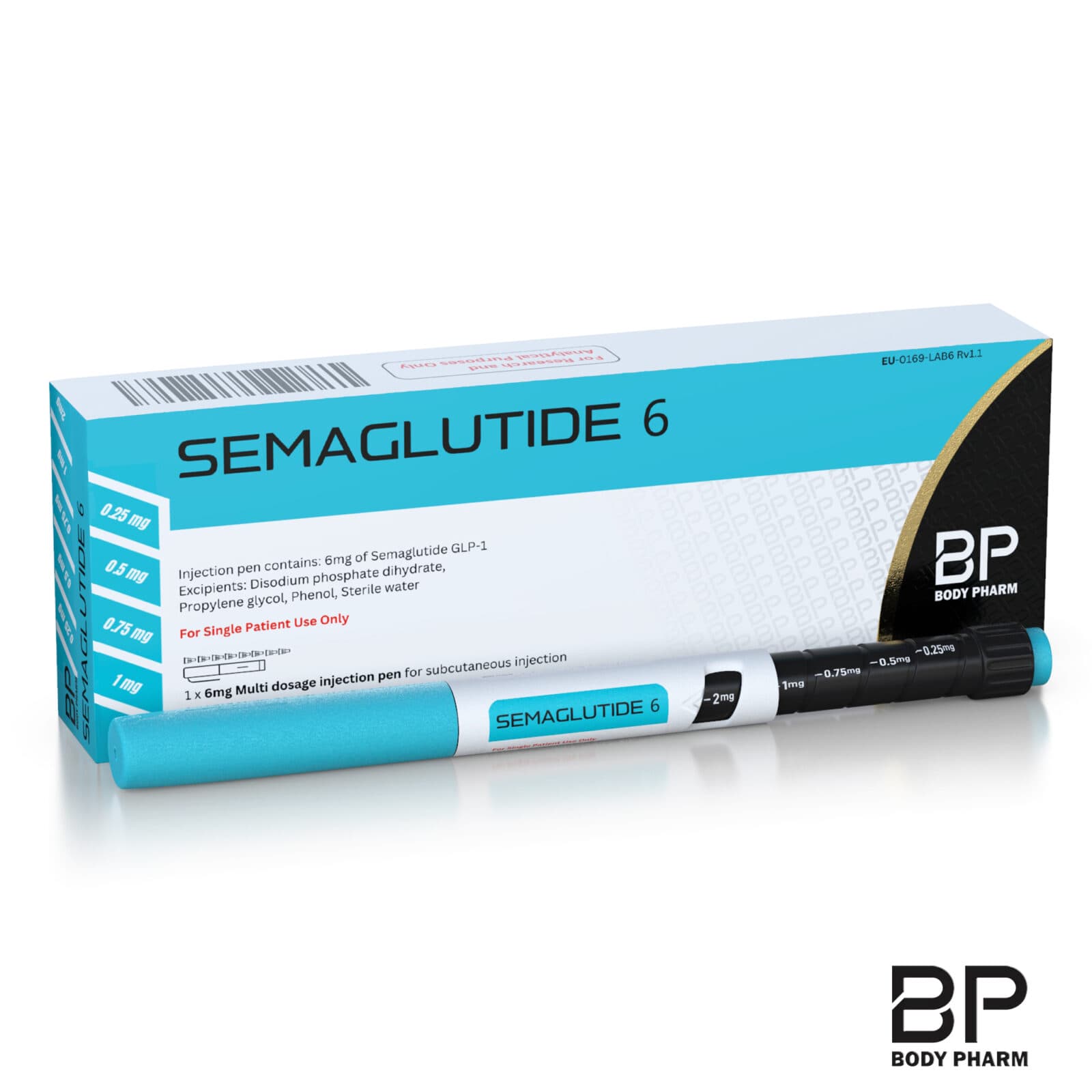
Body Pharm Semaglutide 6 Pen

Body Pharm Semaglutide 6 Pen

R1 600.00

SKU pepsem6

Body Pharm Semaglutide 6 Pen is a GLP-1 receptor agonist used to manage type 2 diabetes and promote weight loss by regulating blood sugar and appetite

Please note

Prescription-class compound supplied for research use. You must be 18 or older. Consult a qualified healthcare professional before use — this is not medical advice.

EFT payment · Discreet delivery

  • Purity tested
  • Cold-chain
  • COA on request

Body Pharm Semaglutide 6 Pen: SA Buyer’s Guide 2026

The Body Pharm Semaglutide 6 Pen is an unregistered medicine in South Africa as of mid-2026. SAHPRA named it in its November 2024 communication on online weight-loss injections, and it does not appear on the SAHPRA medicine register under any “Body Pharm” listing [1][2]. Selling or supplying it for routine use without a patient-specific Section 21 authorisation is not legal, even though retail pages at Beskinny and MyAntidote continue to list it [3][4].

This guide documents exactly what SAHPRA has said (and not said) about the 6 mg pen between November 2024 and 2026. It compares the Body Pharm pen side-by-side with SAHPRA-registered semaglutide options—Ozempic and Wegovy—on price, 16-week dose escalation, and legal purchase pathway. You will learn the regulatory risk before paying, and why a prescription from a registered South African doctor matters regardless of which product you choose.

Key Takeaways

  • Body Pharm Semaglutide 6 Pen is unregistered with SAHPRA and has no legal purchase pathway in South Africa; selling or supplying it without Section 21 authorisation is a criminal offence.
  • Ozempic (registered) costs R1,700–R2,500 per pen and requires a Schedule 4 prescription from a licensed pharmacy; Body Pharm costs ~R1,600 but carries regulatory and safety risks.
  • A single 6 mg Body Pharm pen cannot complete a full 16-week titration to 2 mg maintenance; you would need multiple pens and clinical supervision.
  • Unregistered semaglutide pens lack SAHPRA-reviewed package inserts, GMP certification, independent assay confirmation, and a functioning pharmacovigilance pathway.
  • Semaglutide is appropriate only for adults with BMI ≥30 kg/m² or BMI ≥27 kg/m² with weight-related comorbidities; a consultation with an HPCSA-registered doctor is mandatory before starting any formulation.

What Is Body Pharm Semaglutide 6 Pen?

Body Pharm Semaglutide 6 Pen is a compounded or research-grade semaglutide injection pen marketed online in South Africa as containing 6 mg of semaglutide total per pen, intended for once-weekly subcutaneous injection across a multi-week titration [3][4]. The concentration in mg/mL and the cartridge volume are not disclosed on either the Beskinny or MyAntidote product pages. No independent lab analysis has been published, so the “6 mg” figure is the marketed total content rather than an independently verified specification [unverified][3][4].

Semaglutide is a GLP-1 receptor agonist—it binds to glucagon-like peptide-1 receptors in the body, mimicking endogenous GLP-1. That triggers insulin release from the pancreas only when blood glucose is elevated (glucose-dependent), suppresses glucagon, slows gastric emptying, and acts on appetite centres in the brain to reduce hunger. That combination drives both the glycaemic effect in type 2 diabetes and the weight loss seen in obesity trials.

The Body Pharm pen is not the same as Novo Nordisk’s Ozempic (semaglutide registered with SAHPRA for type 2 diabetes) or Wegovy (semaglutide 2.4 mg for obesity) [2]. Branded pens are manufactured under Novo Nordisk’s quality system, registered with SAHPRA, and sold through licensed pharmacies on prescription. Body Pharm pens are not on the SAHPRA medicine register under any “Body Pharm” listing [2]. The 6 mg total is structured to span a roughly 6–8 week early titration (0.25 mg → 0.5 mg weekly) rather than to deliver a single dose.

How it’s positioned against other compounded pens

Retailers list adjacent products in the same compounded category, including the HD Semaglutide 10 Pen at a higher total content and the Semaglutide 2mg GLP-1 bundle, which was also named in SAHPRA’s November 2024 communication on unregistered weight-loss injections [1]. All sit outside the SAHPRA register. Higher total mg in the box does not bring regulatory approval or safety oversight.

SAHPRA Registration Status in 2026

Body Pharm Semaglutide 6 Pen is not registered with SAHPRA as of mid-2026. SAHPRA named it in its November 8, 2024 media statement as an unregistered GLP-1 product, alongside HD Labs Semaglutide 5, Semaglutide 2mg GLP-1, and HD Labs Tirzepatide 10 [6][3]. Selling or supplying it without Section 21 authorisation is a statutory offence under the Medicines and Related Substances Act 101 of 1965.

“Unregistered” has a specific legal meaning here. The product has not been evaluated by SAHPRA for quality, safety, or efficacy because no dossier has been submitted for review. No manufacturing site has been inspected against South African Good Manufacturing Practice standards. No Single Exit Price has been gazetted. Under Section 14 of Act 101 of 1965, no person may sell a medicine subject to registration unless it is registered. Section 29 makes the sale or supply of an unregistered medicine a criminal offence, with penalties including fines and imprisonment.

Section 21 provides the only lawful route for an individual patient to access an unregistered medicine. A registered prescriber must apply to SAHPRA with a clinical motivation, product details, and patient consent. Approval is patient-specific, time-limited, and does not authorise resale [7][8]. I have found no public record of a Section 21 authorisation being granted for Body Pharm Semaglutide 6 Pen specifically. No SAHPRA enforcement notice has named the brand by name since November 2024, though SAHPRA has reiterated its general position on unregistered slimming injections through 2025–2026 [6].

The contrast with registered semaglutide is straightforward. Ozempic (Novo Nordisk, semaglutide for type 2 diabetes) is on the SAHPRA medicine register and sold on prescription through licensed pharmacies [1]. Wegovy (semaglutide 2.4 mg for obesity) appears in SAHPRA register data with Novo Nordisk as holder, but broad retail availability in South Africa remains limited as of 2026 [unverified][1][2]. SAHPRA’s position can change; verify the current status of any of these products at sahpra.org.za before purchase.

Adjacent compounded pens named in the same November 2024 communication, including the HD Semaglutide 10 Pen and the Semaglutide 2mg GLP-1 bundle, sit in the same regulatory category as the Body Pharm pen.

Regulatory Research Methodology

The status above was checked against the SAHPRA electronic medicine register [1], SAHPRA’s news and safety alert archive [3][6], and the Section 21 portal documentation [7][8]. Where a fact could not be confirmed from a primary SAHPRA source, it is marked [unverified]. No SAHPRA register entry was found for “Body Pharm” as a holder or for “Body Pharm Semaglutide” as a product name in searches conducted for this guide.

Body Pharm vs. Registered Semaglutide: Side-by-Side

The Body Pharm Semaglutide 6 Pen retails around R1,600 per pen with no legal purchase pathway in South Africa—it is unregistered and no Section 21 brand approval has been located. Ozempic sits roughly in the R1,700–R2,500 range per pen but requires a prescription dispensed through a SAPC-registered pharmacy [9][11]. The table below summarises the practical differences a buyer faces in 2026.

Product SAHPRA Status Approximate SA Price (2026) Legal Purchase Pathway
Body Pharm Semaglutide 6 Pen Unregistered [5][6] R1,600 per pen [9] [unverified for 2026] None. No registration, no Section 21 brand approval located [5]
Ozempic 0.25/0.5 mg pen Registered [1] ~R1,700–R2,500 [11] [unverified] Schedule 4 script + SAPC-registered pharmacy [12]
Ozempic 1 mg pen Registered [1] ~R1,700–R2,500 [11] [unverified] Schedule 4 script + SAPC-registered pharmacy [12]
Wegovy (semaglutide 2.4 mg) Registered, limited SA retail availability [1][2] [unverified] No stable public SA retail price identified [unverified] Schedule 4 script + SAPC-registered pharmacy if/when stocked [2]

Ozempic cartons include NovoFine Plus needles: 6 needles with the 0.25/0.5 mg starter pen and 4 needles with the 1 mg and 2 mg pens (Drugs.com, March 20, 2026). Body Pharm pens ship without manufacturer-bundled needles and without a verifiable certificate of analysis [9][10].

For Ozempic and (where stocked) Wegovy, the pathway is straightforward: consult a registered SA medical practitioner, receive a Schedule 4 prescription, and have it dispensed by a SAPC-registered pharmacy drawing stock from a licensed wholesaler. Every step is auditable. For the Body Pharm Semaglutide 6 Pen, that chain does not exist. Possession or supply of an unregistered Schedule 4 medicine outside a granted Section 21 authorisation contravenes the Medicines and Related Substances Act [13]. Secondary-market listings on platforms like Yaga.co.za compound the risk: these are peer-to-peer sales with no batch traceability, no cold-chain guarantee, and no recourse if the pen contains under-, over-, or non-semaglutide content. The same caveat applies to the HD Semaglutide 10 Pen and the Semaglutide 2mg GLP-1 bundle, both named alongside Body Pharm in SAHPRA’s November 2024 communication [6].

Dosing Schedule: How the 6 Pen Works

The Body Pharm Semaglutide 6 Pen retail listings describe a standard GLP-1 titration: 0.25 mg once weekly to start, escalating to 0.5 mg, then 1 mg, and (for weight management) a 2 mg weekly maintenance dose reached over a minimum 16-week period [1][2]. That escalation mirrors the international Wegovy obesity protocol of 0.25 → 0.5 → 1.0 → 1.7 → 2.4 mg in four-week steps [5][6]. The Body Pharm product page stops at 2 mg rather than 2.4 mg, and neither retailer publishes a manufacturer datasheet to confirm it [1][2].

What 6 mg of total content actually buys you

The pen is marketed as containing 6 mg of semaglutide in total. Neither Beskinny nor MyAntidote states the concentration in mg/mL or the cartridge volume, so the exact number of clicks-per-dose is [unverified] [1][2]. The arithmetic is straightforward: at 0.25 mg/week the pen would cover 24 weeks; at 0.5 mg, 12 weeks; at 1 mg, 6 weeks; at 2 mg, only 3 weeks. A full 16-week titration to 2 mg consumes roughly 14 mg of semaglutide in total. One 6 mg pen cannot complete the escalation. You would need to purchase multiple pens, and each purchase carries the same regulatory and safety risks.

Injection technique and supervision

Semaglutide is a once-weekly subcutaneous injection. Rotate sites between the abdomen, thigh, and upper arm, and inject on the same day each week. A registered SA prescriber should guide titration decisions, side-effect management, and whether to escalate past 1 mg—not a retail product page. Buyers comparing the HD Semaglutide 10 Pen or the Semaglutide 2mg GLP-1 bundle face the same gap: higher total mg in the box does not substitute for clinical oversight.

Side Effects and Safety Considerations

Semaglutide’s most common adverse effects are gastrointestinal: nausea, vomiting, diarrhoea, constipation, and abdominal pain. These are usually worst in the first weeks after each dose step-up and ease as the body adapts [1][12]. Hypoglycaemia risk is low with semaglutide alone but rises sharply when stacked with a sulfonylurea or insulin, so dose reviews of background diabetes medication matter at initiation [12]. Injection-site reactions (redness, itching, small nodules) are usually mild. Pancreatitis is rare but documented in GLP-1 receptor agonist prescribing information. Renal function should be monitored in anyone who becomes significantly dehydrated from vomiting or diarrhoea [11][12].

What changes when the product is unregistered

For the Body Pharm Semaglutide 6 Pen, three safety layers that exist for Ozempic are simply absent. There is no SAHPRA-reviewed package insert, so the contraindications, interaction list, and dose-adjustment guidance you would normally hand a prescriber are missing or sourced from generic semaglutide information rather than this specific product [3][4]. There is no published GMP certification or independent assay confirming sterility, endotoxin levels, or that each pen actually contains 6 mg of semaglutide at a stated concentration [7][8]. There is no functioning pharmacovigilance pathway: SAHPRA’s MedSafety reporting system is built around registered products and identified marketing-authorisation holders. Adverse events from a Body Pharm pen have no clear regulatory recipient and won’t feed into a safety signal database [3][10].

That gap is not theoretical. 2024–2025 case reports and poison-centre analyses on compounded and non-pharmacy-channel semaglutide describe dosing errors and severe GI events linked to unclear concentrations and unfamiliar pen mechanics [1][2]. The same uncertainty applies to the HD Semaglutide 10 Pen and the Semaglutide 2mg GLP-1 bundle: higher mg per box does not bring a package insert, a batch certificate, or a reporting channel.

Who Should Consider Semaglutide for Weight Loss?

Semaglutide is clinically appropriate for adults with a BMI ≥30 kg/m² (obesity), or BMI ≥27 kg/m² with at least one weight-related comorbidity such as type 2 diabetes, hypertension, or dyslipidaemia [4][5]. Outside those thresholds, the risk-benefit calculation shifts against pharmacotherapy regardless of which pen you’re looking at.

There are firm contraindications. Semaglutide should not be used by anyone with a personal or family history of medullary thyroid carcinoma or Multiple Endocrine Neoplasia syndrome type 2 (MEN2), during pregnancy or while planning pregnancy, or by anyone with known hypersensitivity to semaglutide or its excipients [4]. A history of pancreatitis, severe gastroparesis, or active gallbladder disease warrants a direct conversation with your doctor before starting.

The prescriber step is not optional

Before you order any semaglutide product in South Africa—including the Body Pharm Semaglutide 6 Pen, the HD Semaglutide 10 Pen, or the Semaglutide 2mg GLP-1 bundle—you need a consultation with an HPCSA-registered medical practitioner. For SAHPRA-registered products like Ozempic, that consultation produces the valid prescription a licensed pharmacy needs to dispense [2][10]. For unregistered products, the same clinical screen still applies: BMI, comorbidities, contraindications, and baseline bloods don’t change based on the supply channel. A doctor’s assessment protects you regardless of which formulation you choose.

Other Semaglutide Options at Beskinny (2026)

If you want to compare the Body Pharm Semaglutide 6 Pen against other GLP-1 products in the same catalogue, Beskinny stocks several options across the Semaglutide category and the broader Weight Loss Injections category. All sit in the same regulatory bracket as the 6 Pen: none of the Body Pharm or HD-branded GLP-1 pens appear on SAHPRA’s medicine register as of 2026 [3][7].

The HD Semaglutide 10 Pen is a higher-dose option in the same semaglutide class. The Semaglutide 2mg GLP-1 (Buy 1 Get 2 Free) bundle delivers 6 mg total across three pens and was also named in SAHPRA’s November 2024 statement on unregistered weight-loss injections [7][8].

For buyers looking beyond GLP-1 monotherapy, Beskinny lists Body Pharm Tirzepatide 30 Pen (GIP/GLP-1 dual agonist), Body Pharm Retatrutide 32 Pen (GIP/GLP-1/glucagon triple agonist), and the HD Tirsema 44 Pen tirzepatide-semaglutide combination. Comparative efficacy between these classes in unregistered formulations has not been established in peer-reviewed South African data.

Frequently Asked Questions

Is Body Pharm Semaglutide 6 Pen the same as Ozempic?

No. Ozempic is a SAHPRA-registered semaglutide product manufactured by Novo Nordisk and indicated for type 2 diabetes [5]. Body Pharm Semaglutide 6 Pen is an unregistered semaglutide product named in SAHPRA’s November 2024 communication on unregistered weight-loss injections [1][2]. They are not bioequivalent. No independent lab analysis of the Body Pharm pen has been published [unverified].

Can I buy semaglutide online legally in South Africa?

Only registered semaglutide products (currently Ozempic, with Wegovy availability still limited as of 2026) can be legally dispensed, and only by a licensed pharmacy against a valid prescription [5][10]. Unregistered semaglutide pens sold via direct online stores fall outside SAHPRA’s medicine register and can be seized. Both seller and prescriber face regulatory risk [1][2].

How long does one Body Pharm Semaglutide 6 Pen last?

A 6 mg pen lasts roughly 16–24 weeks depending on titration. At the typical escalation of 0.25 mg weekly for 4 weeks, then 0.5 mg for 4 weeks, then 1 mg weekly, one pen covers about 4 months before reaching higher maintenance doses [12]. The exact mL/mg-per-click concentration is not published by the supplier [unverified] [6][7].

What is the difference between the 3 Pen and 6 Pen versions?

The number refers to total semaglutide content: a 3 Pen contains 3 mg, a 6 Pen contains 6 mg [6][7]. The Semaglutide 2mg GLP-1 (Buy 1 Get 2 Free) bundle delivers 6 mg total across three pens. Higher-content options like the HD Semaglutide 10 Pen extend duration further but sit in the same unregistered bracket [1].

Does semaglutide require a prescription in South Africa?

Yes. Semaglutide is a prescription-only (Schedule 4) medicine under the Medicines and Related Substances Act 101 of 1965, dispensable only by a licensed pharmacy against a script from a registered prescriber [10]. Supplying it without a prescription, or supplying an unregistered brand outside a Section 21 authorisation, breaches the Act [13].

Next Steps

Schedule a consultation with an HPCSA-registered medical practitioner who can assess your BMI, comorbidities, contraindications, and baseline health markers. If you qualify clinically, ask your doctor about SAHPRA-registered options (Ozempic or Wegovy where available) and the prescription pathway through a licensed pharmacy. If you are still considering an unregistered product, discuss the regulatory and safety gaps with your doctor and verify the current SAHPRA status at sahpra.org.za before purchase. A prescription from a registered South African doctor is the only step that protects you regardless of which product you choose.