
Weight loss injections
CagriSema
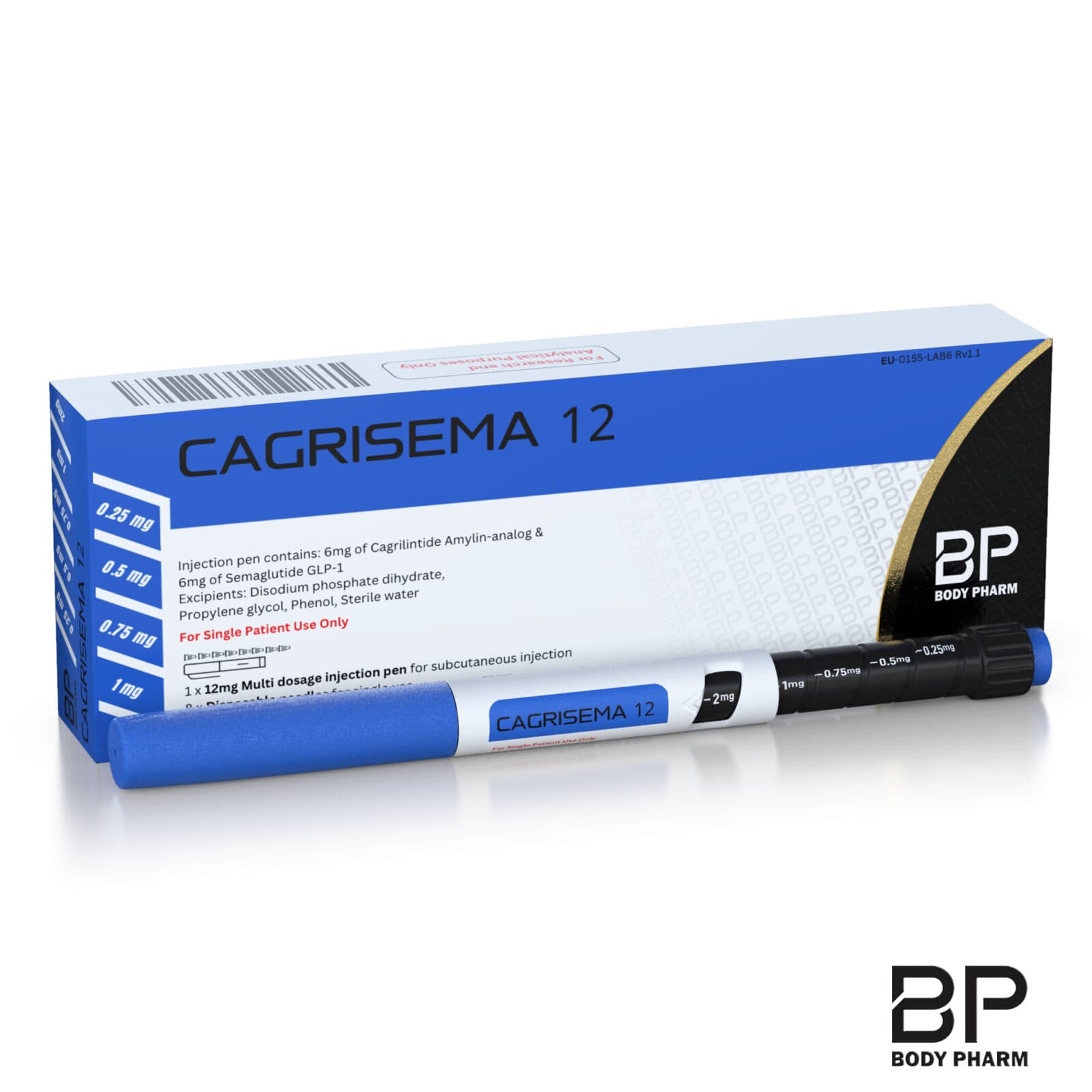
A cagrilintide + semaglutide combination for weight management, ready-to-use pens, third-party tested for purity and identity.
What this means for South African buyers
Key Takeaways
- Trial data shows 23.0% weight loss at 84 weeks, placing it between semaglutide (15%) and tirzepatide (25.5%), but no head-to-head comparative trials exist
- Compounded local pens lack independent verification of active-ingredient content, sterility and bioequivalence; safety data from REDEFINE trials does not apply to them
- Any GLP-1 or amylin therapy requires a prescription and medical supervision from a registered South African practitioner
What Is CagriSema? A Plain-Language Definition
How the two ingredients work together
The combination targets weight and glucose control through two separate appetite pathways. Cagrilintide mimics amylin, a hormone co-secreted with insulin, which slows gastric emptying and signals satiety through the area postrema in the brainstem [4]. Semaglutide activates GLP-1 receptors, reducing appetite via hypothalamic pathways and improving glucose-dependent insulin secretion — the same mechanism behind Ozempic and Wegovy [1].
In the phase 2 trial summarised at ECO 2026, weekly cagrilintide 2.4 mg co-administered with semaglutide 2.4 mg produced substantially greater weight loss than either agent alone over 32 weeks, which is the rationale for combining them in a single pen [4].
How it's given
CagriSema is designed as a once-weekly subcutaneous injection, titrated from a low starting dose over several weeks to a full maintenance dose, similar to how Wegovy and Mounjaro are escalated in local practice [5][7]. Novo Nordisk has not yet published a definitive milligram-by-milligram titration schedule for the phase 3 REDEFINE and REIMAGINE programmes [5][6].
If you are researching where to buy CagriSema in South Africa, be aware that any pen currently on local shelves is a compounded product, not the Novo Nordisk trial drug. Readers comparing options often start with registered semaglutide injections instead, which we cover later in this guide.
How CagriSema Works: Dual Mechanism Explained
CagriSema lowers body weight by hitting two appetite-control pathways simultaneously: amylin signalling via cagrilintide and GLP-1 signalling via semaglutide. The 22 June 2025 NEJM report on the cagrilintide–semaglutide combination found significant and clinically relevant body-weight reductions versus placebo because the two hormones act on partly separate brain circuits, producing additive rather than overlapping effects [1][4].
Cagrilintide: the amylin side
Cagrilintide is a long-acting analogue of amylin, a hormone your pancreas releases alongside insulin after a meal. It binds amylin and calcitonin receptors in the area postrema and hypothalamus, dampening hunger signalling and slowing gastric emptying so meals feel filling for longer [4]. Because native amylin breaks down within minutes, the engineered cagrilintide molecule was designed for once-weekly dosing, matching the cadence of semaglutide in the same pen.
Semaglutide: the GLP-1 side
Semaglutide mimics glucagon-like peptide-1 (GLP-1), the gut hormone released when you eat. It triggers glucose-dependent insulin secretion from the pancreas, suppresses glucagon (which would otherwise push blood sugar up), and acts on hypothalamic neurons to reduce appetite and food reward [1]. This is the same molecule sold as Ozempic and Wegovy, which is why local clinicians comparing options often start patients on standalone semaglutide injections before considering combination therapy.
Why the combination beats either alone
Amylin and GLP-1 act on partly separate brain circuits, so stacking them produces additive rather than overlapping effects. In the phase 2 trial summarised at ECO 2026, cagrilintide 2.4 mg plus semaglutide 2.4 mg drove substantially greater 32-week weight loss than either agent on its own [4]. That pharmacological rationale is what drives demand to buy CagriSema in South Africa, even though the Novo Nordisk product itself remains investigational.
CagriSema Efficacy: What the 2025–2026 Trials Show
CagriSema 2.4 mg produced a mean body weight reduction of 23.0% at 84 weeks in the REDEFINE 1 obesity trial, alongside an HbA1c reduction of 1.91% in REDEFINE 2 participants with type 2 diabetes and clinically significant reductions in systolic blood pressure [1][11]. Those are the headline numbers South African readers should anchor expectations to — with the caveat that 84 weeks is currently the longest comparative window in the public record.
The REDEFINE 1 result, reported in early 2026, places CagriSema slightly behind Zepbound (tirzepatide), which delivered 25.5% weight loss over a comparable timeframe [1]. REDEFINE 2 data released by Novo Nordisk on 2 February 2026 showed the 1.91% HbA1c drop in people with type 2 diabetes, competitive with the best GLP-1 monotherapy results to date [11]. Cardiovascular signal data published in AHA Journals on 2 December 2025 added meaningful systolic and diastolic blood pressure reductions to the picture, though the REDEFINE 3 cardiovascular outcomes trial (NCT05669755) is still running and will provide the definitive event data [3].
How CagriSema compares to semaglutide and tirzepatide
The table below summarises the comparative efficacy figures most relevant to a South African reader weighing options. No head-to-head randomised trials exist for any of these agents, and anything beyond 84 weeks is extrapolation.
| Agent | Mean weight loss | HbA1c reduction | Administration |
|---|---|---|---|
| CagriSema 2.4 mg | 23.0% at 84 weeks [1] | 1.91% [11] | Weekly subcutaneous injection |
| Semaglutide 2.4 mg (Wegovy) | ~15% at 68 weeks [10] | ~1.6% [10] | Weekly subcutaneous injection |
| Tirzepatide (Zepbound) | 25.5% at 84 weeks [1] | ~2.1% [10] | Weekly subcutaneous injection |
For readers already on standalone semaglutide injections who have plateaued, the additional 7 to 8 percentage points of weight loss seen with CagriSema is the clinical rationale most often cited by local prescribers when patients ask to buy CagriSema in South Africa. The long-term obesity study NCT05394519 is still active and will extend the duration evidence base [4].
CagriSema vs Zepbound vs Semaglutide: 2026 Comparison
| Feature | CagriSema | Zepbound (tirzepatide) | Semaglutide (Wegovy/Ozempic) |
|---|---|---|---|
| Mechanism | Amylin + GLP-1 | GIP + GLP-1 | GLP-1 only |
| Trial weight loss | 23.0% at 84 weeks [1] | 25.5% at 84 weeks [1] | ~15% at 68 weeks [4] |
| HbA1c reduction | 1.91% [1] | ~2.1% [4] | ~1.6% [4] |
| Dosing | Weekly injection | Weekly injection | Weekly injection |
| FDA status | Investigational [6] | Approved | Approved |
| Not registered [2] | Registered | Registered | |
| SA self-pay (2026 est.) | R3,500 to R5,500 (compounded, unverified) | R3,000 to R4,500 [17] | R2,000 to R3,500 [16] |
The 2.5 percentage-point gap between Zepbound (25.5%) and CagriSema (23.0%) comes from a single 84-week readout reported by ClinicalTrialsArena on 23 February 2026 and reflected in Novo Nordisk's ADA 2026 dataset [1]. No head-to-head randomised trial has been run, and longer-term comparative data beyond 84 weeks does not exist for any of the three agents.
CagriSema Side Effects: What the Evidence Says in 2026
CagriSema's side-effect profile in phase 3 trials is dominated by gastrointestinal symptoms typical of the GLP-1 class: nausea, vomiting, diarrhoea, constipation, and injection-site reactions. A 2025 to 2026 Ahmed et al. analysis concluded the tolerability profile is broadly comparable to semaglutide alone despite the added amylin component [4]. Most events were mild to moderate and concentrated during dose escalation, as the body adapts to GLP-1 signalling over the first 8 to 12 weeks [4].
In the REDEFINE 1 readout reflected in Novo Nordisk's ADA 2026 dataset, gastrointestinal adverse events were the most frequently reported. Nausea typically peaked in the first 8 to 12 weeks of titration and tapered as participants stabilised on the maintenance dose [2][4]. Discontinuation rates due to adverse events were in the same range reported for semaglutide 2.4 mg in earlier obesity trials [4].
Contraindications and Class Warnings
CagriSema inherits the GLP-1 class warnings. It should not be used by people with a personal or family history of medullary thyroid carcinoma (MTC) or multiple endocrine neoplasia syndrome type 2 (MEN2). Caution is advised in anyone with a history of pancreatitis, severe gastroparesis, or gallbladder disease [1][4]. Pregnancy and breastfeeding are exclusion criteria across the REDEFINE programme [6][7].
Why Compounded CagriSema Safety Data Does Not Carry Over
Important distinction: The trial safety data above applies only to the Novo Nordisk investigational CagriSema used in REDEFINE and REIMAGINE studies. It does not automatically apply to compounded pens such as the Body Pharm "CagriSema 12 Pen" or similar products sold in South Africa. The active-ingredient content, sterility, excipients, and bioequivalence of these compounded versions are unverified [11][12], and they have not been studied in the same patient populations under the same monitoring conditions.
CagriSema in South Africa: Compounded Pens vs the Real Drug
Two completely different products are being called "CagriSema" in South Africa right now, and conflating them is the single biggest mistake a buyer can make. The first is Novo Nordisk's investigational CagriSema, a fixed-dose cagrilintide and semaglutide combination still in phase 3 trials and not commercially available anywhere in the world as of February 2026 [7]. The second is a category of locally compounded pens, most visibly the Body Pharm CagriSema 12 Pen, sold through South African peptide and weight-loss retailers [1].
What "compounded" actually means
What this means for the Body Pharm pen
Buyer disclaimer — read before purchase
- The Body Pharm CagriSema 12 Pen is not the Novo Nordisk investigational drug.
- Purity, exact dosing and sterility have not been independently verified [1][2].
- No phase 3 trial safety data applies to this formulation.
- Discuss any GLP-1 or amylin therapy with a registered South African prescriber first.
Due diligence before you buy
CagriSema Price in South Africa: 2026 ZAR Costs
The Body Pharm CagriSema 12 Pen sells on BeSkinny at R2,000 in 2026, discounted from a listed original of R2,500 [7]. That price covers a single prefilled multi-dose injection device intended as a 12-week course (one weekly dose, marketed as a "12 Pen"), although the exact mg-per-dose of cagrilintide and semaglutide is not independently verified [7][8]. Pricing on the live buy CagriSema in South Africa page changes regularly, so confirm the current figure before ordering.
How it compares to other GLP-1 options
Against the rest of the BeSkinny range, R2,000 for the CagriSema 12 Pen sits at the lower end. Archived 2024 to 2025 snapshots show semaglutide injections priced from roughly R2,000 to R3,500 per month, with tirzepatide commonly R3,000 to R4,500 per month depending on dose [9][10]. Bundle pricing on the BeSkinny bundles page can reduce per-month cost further if you're committing to a multi-month course.
A lower sticker price does not equal better value when active-ingredient concentration and sterility are unverified [7][8]. Treat the R2,000 figure as a self-pay aesthetic-clinic price for a compounded pen, not a like-for-like cost comparison with registered Novo Nordisk products available through registered pharmacies.
Who Is CagriSema For? Candidate Profile
CagriSema is being studied in adults with a BMI of 30 or higher, or a BMI of 27 or higher with at least one weight-related comorbidity such as type 2 diabetes, hypertension or dyslipidaemia [3][4]. That mirrors the inclusion criteria used in the REDEFINE obesity programme and gives you a reasonable proxy for who the drug is being developed for: adults whose weight is already affecting metabolic or cardiovascular health, not people chasing the last 5 kg before a wedding.
The REDEFINE 3 trial (NCT05669755) specifically enrols adults with established cardiovascular disease, which signals that Novo Nordisk is positioning CagriSema as a cardiometabolic therapy rather than a cosmetic weight-loss tool [4][7]. If you have type 2 diabetes alongside obesity, you fit the profile being studied in the REIMAGINE programme [7].
Who should not use it
Trial exclusion criteria and the known GLP-1 class label rule out several groups:
- Anyone with a personal or family history of medullary thyroid carcinoma or Multiple Endocrine Neoplasia syndrome type 2 (MEN2)
- People who are pregnant, planning pregnancy, or breastfeeding
- Anyone with known hypersensitivity to cagrilintide, semaglutide or excipients
- People with a history of pancreatitis or severe gastrointestinal disease
- Children and adolescents under 18, who were excluded from the REDEFINE programme
Before you consider any product marketed locally as CagriSema, see a South African registered medical practitioner or HPCSA-registered specialist for a proper assessment, baseline bloods and a discussion of alternatives. This applies whether you're looking at the compounded buy CagriSema in South Africa pen or registered semaglutide injections. A prescription and ongoing medical supervision aren't optional extras with injectable weight-loss therapy — they're what keeps you out of A&E.
How to Use CagriSema: Dosing and Administration
CagriSema is administered as a once-weekly subcutaneous injection, with both the cagrilintide and semaglutide components co-formulated for delivery from a single pen [4][6]. In the REDEFINE phase 3 obesity programme, participants titrate from a low starting dose over several weeks up to a fixed maintenance dose of 2.4 mg, mirroring the cautious escalation used with Wegovy to limit nausea, vomiting and other GI effects [4][6].
Injection sites and technique
Rotate between the abdomen (avoiding a 5 cm zone around the navel), the front of the thigh, or the back of the upper arm. Pick a different spot each week to reduce lipohypertrophy. Inject on the same day every week, at any time of day, with or without food.
What "12 Pen" actually means
That matters. Dosing for any compounded product should come from the prescribing practitioner who knows the actual concentration in the vial, not from REDEFINE trial protocols or generic Wegovy guides. If you're weighing up options, the prescriber overseeing your buy CagriSema in South Africa script, or a registered alternative like semaglutide injections, should give you a written titration plan. This section describes clinical trial protocols and is not medical advice.
Frequently Asked Questions About CagriSema
Is CagriSema approved in South Africa?
How does CagriSema compare to Ozempic?
What are the most common CagriSema side effects?
The most frequently reported effects in REDEFINE trials are gastrointestinal: nausea, vomiting, diarrhoea, constipation and reduced appetite, mostly during the titration weeks [6][7]. Trial commentary suggests the side-effect profile is broadly comparable to semaglutide at matched doses, with cagrilintide adding modest extra GI burden [6].
Can I buy CagriSema without a prescription in South Africa?
How long does it take to see results with CagriSema?
REDEFINE phase 3 obesity trials measure outcomes over 68 to 84 weeks, with weight loss accumulating gradually after the multi-week titration period [8][9]. Most participants see meaningful changes from around weeks 12 to 20, with full effect closer to a year [6][9].
What is the difference between CagriSema and tirzepatide?
Next Steps for South African Readers
Compare & learn