
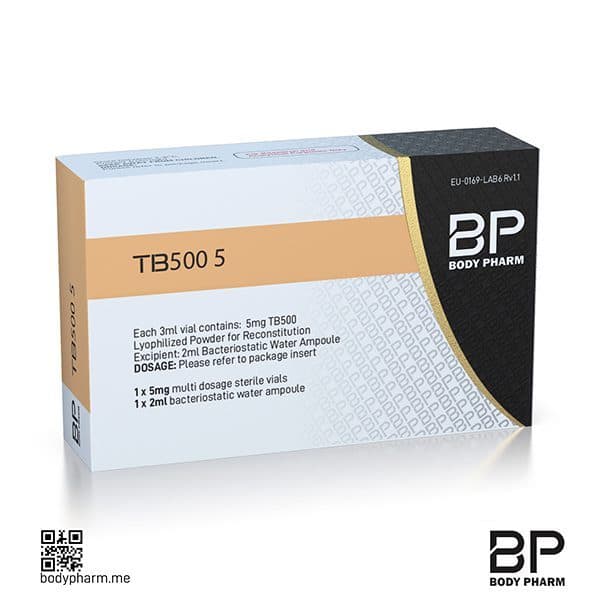
What you get
- 1× vial (product)
- 1× bacteriostatic water (2 ml)
What you need
- Syringe + needle to reconstitute (reconstitution calculator)
- Alcohol swabs
- Needle + syringe to inject
Body Pharm TB500 5 Vial
R420.00R390.00On sale
SKU bppeptb500
4.8(4 reviews)Body Pharm TB500 5mg is a research-grade synthetic fragment of Thymosin Beta-4 (Tβ4), studied in preclinical (animal and in-vitro) models for tissue repair, angiogenesis, and injury recovery. It is sold for laboratory research use only (not for human use) and is prohibited in sport under WADA Category S2.
Who it's for
- ›Athletes and active individuals managing injuries
What it's used for
- ›Studied for muscle, tendon and ligament recovery
- ›Researched for flexibility and reduced inflammation
General research information, not medical advice.
Card · EFT · Discreet delivery
Complete your kit
The supplies you need to store and use your order — add yours in one tap.
 BEARE Insulin Syringes 10 PackR35.00
- BEARE Insulin Syringes 20 PackR60.00
 Alcohol Swabs 50 PackR25.00
Body Pharm TB500 5mg: SA Buying Guide & Injection Protocol
This guide does five things a generic global explainer won’t:
- Breaks down the rand price-per-mg and how to sanity-check any SA supplier before you buy
- Explains what purity documentation (CoA) to ask for and why shipping and cold-handling matter
- Walks through reconstitution maths for a 5mg vial at 1mg/mL and 2.5mg/mL
- Lays out a research injection protocol with needle gauge, site rotation, and 2-8°C storage handling
Published human clinical-trial evidence on the injectable TB-500 fragment remains absent from PubMed and ClinicalTrials.gov. Everything below is framed for research, not therapy.
Key Takeaways
- No peer-reviewed human clinical trials on the TB-500 fragment exist; all TB-500-specific evidence is preclinical or anecdotal, and the human data that does exist is for full-length Tβ4 in other formulations
- Body Pharm TB500 5mg is priced per 5mg vial at beskinny.store; confirm the live rand price at checkout. Reconstitution uses 1-2mL bacteriostatic water and community protocols run 2.5-5mg weekly over 4-6 weeks (non-clinical convention, not a validated human dose)
- Injection-site reactions, fatigue, and a theoretical oncological concern are reported but unverified in humans
- Stacking with BPC-157 or other peptides compounds uncertainty; single-agent protocols are preferable for research documentation
What Is TB500 (Thymosin Beta-4)?
TB-500 is a synthetic peptide fragment that reproduces the active region of Thymosin Beta-4 (Tβ4), a naturally occurring 43-amino-acid protein involved in actin sequestration, cell migration, and tissue repair. The shorter fragment mirrors the functional domain responsible for regenerative signalling observed in preclinical models, which is why suppliers market it for research convenience and synthesis cost.
Native Tβ4 occurs in high concentrations in blood platelets, wound exudate, and most nucleated cells, where it modulates G-actin pools and angiogenic signalling. The tb500 5mg peptide sold by Body Pharm is a chemically synthesised analogue of that domain, not an extract of human or animal Tβ4.
Where it sits in Body Pharm’s range
Body Pharm formulates several injectable research peptides sold through the same SA reseller channel, including the Body Pharm CJC1295 & Ipamorelin 20 pen and the Body Pharm MOTS-C 32 pen. A multi-product catalogue suggests manufacturing continuity rather than a one-SKU flip operation, which is worth considering when you’re benchmarking lot consistency across the brand.
TB500 Research Benefits: What the Evidence Shows
TB-500’s reported benefits sit in four mechanistic buckets, all observed primarily in animal models and in vitro work, not in published human RCTs on the fragment. Treat the list below as a map of research signals, not clinical outcomes.
Tissue repair across muscle, tendon, ligament, and skin — in animal models, Thymosin Beta-4 has been shown to accelerate wound healing through actin-binding and cell-migration pathways; TB-500 is marketed as reproducing that soft-tissue and tendon/ligament repair signal.
Recovery from strains, sprains, and overuse injuries — preclinical and anecdotal reports describe faster recovery timelines in animal injury models, but no large-scale human trial confirms this for athletes or rehab populations.
Anti-inflammatory signalling — Tβ4 is described as reducing injury-associated inflammatory markers in animal studies, which is part of its appeal in stacking discussions alongside BPC-157.
Angiogenesis — promotion of new capillary formation in soft tissue is one of the more consistently reported Tβ4-domain effects, with the peptide’s actin-binding site shown to promote angiogenesis in preclinical work, which underpins the wound-healing narrative.
How strong is the evidence?
Weak by clinical standards. A PubMed and ClinicalTrials.gov search for “TB-500” and “thymosin beta-4” returns no completed peer-reviewed human RCT on the synthetic TB-500 fragment used in peptide circles. The human trial data that does exist is for full-length Thymosin β4 in specific formulations — for example, a phase 2 randomised trial of a Tβ4 ophthalmic solution for severe dry eye — not for the injectable TB-500 fragment marketed to researchers. The evidence base for TB-500 itself is animal-model, in vitro, and anecdotal gym-floor reports — not regulatory-grade clinical proof.
What this means for your protocol
Anchor expectations to preclinical signal strength, not marketing copy. Researchers cross-referencing peptide stacks often look at growth-axis tools like the Body Pharm CJC1295 & Ipamorelin 20 pen or the metabolic Body Pharm MOTS-C 32 pen for parallel pathway work, but each carries its own unverified-in-humans caveat.
TB500 Injection Protocol: Loading, Maintenance & Reconstitution
Reconstitution. Swab the vial stopper with alcohol. Draw 2mL of bacteriostatic water into a 3mL syringe and inject slowly down the inside wall of the 5mg vial. Do not shake. Swirl gently until fully dissolved. At 2mL diluent, concentration is 2.5mg/mL, so 0.2mL (20 units on a U-100 insulin syringe) delivers 0.5mg. At 1mL diluent, the same 20 units delivers 1mg. Body Pharm’s own bacteriostatic-water volume is not published on the public product page, so the 1-2mL convention is a community standard, not a manufacturer instruction. Store reconstituted solution at 2-8°C and discard after 28-30 days as a general peptide-handling rule; no TB-500-specific stability data exist in peer-reviewed form.
Loading phase. 2.5-5mg per week subcutaneously for 4-6 weeks, typically split into two injections (e.g., 2 x 1.25mg or 2 x 2.5mg) to smooth plasma exposure (community/supplier convention, not a clinical protocol).
Maintenance phase. 2.5-5mg every two weeks subcutaneously after the loading block, continuing as long as the research protocol calls for it (community/supplier convention, not a clinical protocol).
Subcutaneous technique and site rotation. Pinch the skin on the lower abdomen (at least 5cm lateral to the navel) or outer thigh, insert the insulin needle at 45-90°, aspirate briefly, inject slowly, and withdraw. Rotate sites each injection across abdomen quadrants, flanks, and thighs to avoid lipohypertrophy and bruising. Use a fresh needle every time.
Researchers stacking growth-axis tools alongside TB-500 commonly pair it with the Body Pharm CJC1295 & Ipamorelin 20 pen, keeping injection sites and timing separate to isolate effects.
Reconstitution Step-by-Step
Reconstituting a TB500 5mg vial correctly takes about two minutes once your kit is laid out. This is a research-use procedure, not a medical instruction.
Lay out your kit. One sealed Body Pharm TB500 5mg vial, a vial of bacteriostatic water (0.9% benzyl alcohol), a 1mL insulin syringe (29-31G) for drawing the diluent, alcohol swabs, and a sharps container. Work on a clean, dry surface.
Wipe both vial tops with a fresh alcohol swab and let them air-dry for 10-15 seconds. Do not touch the rubber stopper after wiping.
Draw your bacteriostatic water. Choose your concentration first: 2mL gives 2.5mg/mL (each 10-tick mark on a U-100 syringe = 0.25mg); 5mL gives 1mg/mL (each 10-tick = 0.1mg). The 2mL fill is the common biohacker default for 1.25mg and 2.5mg dose increments.
Inject the water slowly down the inside wall of the TB500 vial. Do not blast it directly onto the peptide pellet — the lyophilised powder is fragile and shear forces can degrade the peptide chain.
Swirl, do not shake. Roll the vial gently between your palms for 20-30 seconds until the powder fully dissolves into a clear solution. Cloudiness or particulates means discard.
Refrigerate at 2-8°C immediately. Label the vial with the reconstitution date. Discard after 28-30 days as a general peptide-handling rule; no TB-500-specific stability data are published in peer-reviewed form.
Researchers building broader peptide kits can apply the same swirl-not-shake rule to vials like the Body Pharm MOTS-C 32 pen, though pre-filled pens skip the reconstitution step entirely.
TB500 Side Effects: What Research Indicates
TB-500 has no established human side-effect profile because no peer-reviewed human clinical trials on the fragment have been published. What follows is drawn from preclinical work, vendor disclaimers, and critical commentary, not from controlled safety data. Researchers concerned about unknown long-term effects should note that chronic-exposure data in humans do not exist.
Reported and theoretical adverse effects in the research literature and gym-floor anecdote:
Injection-site reactions — transient redness, mild swelling, or stinging at the subcutaneous site, typically resolving within hours. Most often the benzyl alcohol carrier in bacteriostatic water triggers the response rather than the peptide itself.
Fatigue and lethargy — anecdotally reported in the 24-48 hours following loading doses, with no mechanistic study confirming the link.
Head-rush or transient dizziness — reported on biohacker forums, again without controlled data.
Theoretical oncological concern — Thymosin Beta-4 upregulation has been linked to tumour metastasis and angiogenesis in preclinical cancer models, raising a hypothetical risk that exogenous Tβ4 could influence proliferation in pre-existing malignancy. The same angiogenic and proliferative mechanisms that make Tβ4 attractive for repair may warrant caution in anyone with undiagnosed neoplastic tissue. This is preclinical only and has not been demonstrated in humans.
The strongest counterargument in circulation is straightforward: absent human trials, the angiogenic and proliferative mechanisms that make Tβ4 attractive for repair are the same mechanisms that warrant caution in anyone with undiagnosed neoplastic tissue. That argument is logically coherent and should be weighed seriously by any researcher before purchase.
Consult a qualified healthcare provider before any use involving human subjects. Researchers stacking peptides like the Body Pharm CJC1295 & Ipamorelin 20 Pen or Body Pharm MOTS-C 32 Pen face compounded uncertainty because multi-peptide interaction data are even thinner than single-agent safety data.
WADA Anti-Doping Status: Athletes Must Read This
TB-500 is banned in competitive sport. WADA’s 2026 Prohibited List classifies Thymosin-β4 and its derivatives, including TB-500, under Category S2: Peptide Hormones, Growth Factors, Related Substances and Mimetics, prohibited at all times — in-competition and out-of-competition.
What this means in practice:
All-time prohibition. There is no washout window that makes TB-500 “safe” before a tested event — S2 substances are banned year-round.
Derivatives count. WADA names “Thymosin-β4 and its derivatives,” so research-labelled TB-500 fragments fall inside the ban.
Local legality is not a defence. TB-500 being unscheduled in SA does not exempt you from SAIDS sanctions.
Stacks carry the same risk. Adjacent peptides marketed alongside TB-500, including the Body Pharm CJC1295 & Ipamorelin 20 Pen and Body Pharm MOTS-C 32 Pen, sit in WADA-prohibited categories of their own — check each compound individually.
If you are a tested athlete, stop here. The rest of this guide is written for non-competitive researchers operating outside SAIDS jurisdiction.
Body Pharm TB500 5mg: Pricing & How to Vet Any SA Supplier
Body Pharm TB500 5mg is priced per 5mg vial on the beskinny.store listing. Because peptide pricing tracks the rand-dollar pair and stock cycles closely, confirm the live ZAR price on the product page at checkout rather than relying on any figure quoted here. To compare value across suppliers, divide the vial price by milligrams to get rand-per-mg — the only fair cross-supplier metric.
How to vet a supplier before you order
Open the product page on the day you buy and record the ZAR price and vial size exactly as listed, then work through this checklist:
- Rand-per-mg, not sticker price. Divide price by milligrams so a 5mg vial and a 10mg vial can be compared honestly.
- Transparency. Flag any vendor that hides company registration number, a physical address, or research-use-only disclaimer language.
- Purity documentation. Ask whether a lot-specific Certificate of Analysis (CoA) with an HPLC purity figure is available for the batch you’ll receive.
- Handling and dispatch. Lyophilised peptide ships stable at ambient temperature short-term, but confirm dispatch timelines and that the vial arrives sealed and intact.
- Range depth as a continuity signal. A vendor with a stocked catalogue — Body Pharm publishes the CJC1295 & Ipamorelin 20 Pen and MOTS-C 32 Pen among others — suggests manufacturing continuity rather than a one-SKU flip operation.
Treat any price figure older than 60 days as stale and re-pull it before checkout.
Why Choose Body Pharm TB500 5mg?
Body Pharm is a peptide-specialist manufacturer whose catalogue on beskinny.store extends well beyond a single SKU. A multi-product vendor suggests manufacturing continuity rather than a flip risk, which matters before you commit rand to any 5mg vial.
Here’s how the brand stacks up against the criteria that actually matter for SA research buyers:
Range depth as a continuity signal. Body Pharm produces the CJC1295 & Ipamorelin 20 Pen and MOTS-C 32 Pen, plus Somatropin HGH and other research peptides on the same retailer. A manufacturer with a stocked range tends to maintain quality control processes a single-product reseller cannot afford.
Vial format matches research convention. The TB500 5mg vial ships as lyophilised (freeze-dried) powder, which is the standard format for research peptides and the format that best survives international transit and SA courier handoff.
Accessible support and SA dispatch. Local courier dispatch from a SA-based retailer beats waiting for an overseas order to clear customs, and gives you a real contact path if a vial arrives compromised.
What’s still missing. No public CoA library, no batch-linked HPLC report. Request a lot-specific CoA by email before you order if purity documentation matters to your protocol.
Body Pharm clears the structural credibility bar. The purity-documentation gap is the honest caveat.
TB500 and BPC-157: Should You Stack Them?
Stacking TB-500 with BPC-157 is the most common combination researchers reference, but the evidence for combined use is anecdotal and preclinical, with no published human RCT data on the pair. Most protocol chatter around the combination originates in community and social discussion, not peer-reviewed literature.
The rationale researchers cite breaks down like this:
Different proposed mechanisms. TB-500 is hypothesised to act systemically through actin sequestration and angiogenesis signalling, while BPC-157 is described in preclinical work as acting more locally on tendon, ligament, and gut tissue.
Theoretical coverage of the repair cascade. Stackers argue the two address different stages — angiogenic/migratory versus local fibroblast and collagen response — though this framing is preclinical extrapolation, not validated in humans.
Added complexity. Two peptides means two reconstitutions, two injection schedules, two purity unknowns, and confounded observation if you’re tracking a single research endpoint.
If you’re documenting a research protocol, run one compound at a time first. Body Pharm’s range, including the CJC1295 & Ipamorelin 20 Pen and MOTS-C 32 Pen, gives you options to sequence rather than stack blindly.
Frequently Asked Questions: TB500 in South Africa
How long does a 5mg vial of TB500 last on a standard protocol? A 5mg vial covers roughly 2 weeks at a research dose of 2.5mg twice weekly, or about 5 weeks at a 1mg twice-weekly maintenance schedule, because Body Pharm’s 5mg vial is a single reconstitution unit. These are non-clinical convention figures, not a validated human dose.
How should I store TB500 before and after reconstitution? Store the lyophilised vial sealed and refrigerated at 2-8°C where possible, away from light. After reconstitution with bacteriostatic water, keep it at 2-8°C and discard after 28-30 days based on general peptide-handling convention, since TB-500-specific stability data in bacteriostatic water are not published in peer-reviewed form.
Can I use TB500 if I compete in sport? No. WADA’s 2026 Prohibited List bans “Thymosin-β4 and its derivatives” under Category S2 (Peptide Hormones, Growth Factors), prohibited at all times in and out of competition. Any SAIDS-tested athlete risks an anti-doping rule violation.
What is the difference between TB500 and TB4? TB-500 is a synthetic fragment of the full 43-amino-acid Thymosin Beta-4 (TB4) protein, marketed in peptide circles as a research analogue because human clinical data on the TB-500 fragment specifically remain absent from PubMed. What evidence exists is preclinical, or relates to full-length TB4, which has been taken into registered clinical trials in ophthalmology (dry eye) and studied in cardiology contexts.
Researchers sequencing additional compounds can review the Body Pharm CJC1295 & Ipamorelin 20 Pen and Body Pharm MOTS-C 32 Pen listings on the same supplier.
How to Buy Body Pharm TB500 5mg in South Africa
Body Pharm TB500 5mg is available directly from beskinny.store — confirm the live rand price at checkout before ordering because stock and pricing shift with exchange rates.
What lands at your door:
One lyophilised 5mg vial of Thymosin Beta-4 fragment (TB-500), sealed and labelled for research use only.
No bacteriostatic water included — order separately or source from a local supplier.
No printed CoA in-box; lot-linked third-party purity reports are not published on the public listing, so request one by email if you need it.
Add to cart and expect roughly 3-5 business days to most SA metros via local courier once payment clears. Outlying areas run longer; request tracking on dispatch.
Researchers building a broader Body Pharm shelf can cross-reference the CJC1295 & Ipamorelin 20 Pen and MOTS-C 32 Pen on the same domain to consolidate shipping.
Next Steps
Before you order, confirm the live price on beskinny.store, request a lot-specific Certificate of Analysis by email if purity documentation matters to your protocol, and consult a qualified healthcare provider if you plan any human administration. If you compete in sport, do not proceed — TB-500 is banned under WADA Category S2. For non-competitive research use, start with a single 5mg vial and document your reconstitution, injection schedule, and any observations in a protocol log to isolate effects before stacking additional peptides.
References
- Thymosin β4: actin-sequestering protein moonlights to repair injured tissues. Trends in Molecular Medicine (PubMed), 2005.
- Thymosin β4 accelerates wound healing. Journal of Investigative Dermatology (PubMed), 1999.
- The actin binding site on thymosin β4 promotes angiogenesis. FASEB Journal (PubMed), 2003.
- Role of thymosin β4 in tumor metastasis and angiogenesis. Journal of the National Cancer Institute (PubMed), 2003.
- Thymosin β4 significantly improves signs and symptoms of severe dry eye in a phase 2 randomized trial. PubMed (U.S. National Library of Medicine), 2015.
- Safety and Efficacy of Thymosin Beta 4 Ophthalmic Solution in Patients With Dry Eye (NCT01387347). ClinicalTrials.gov, U.S. National Library of Medicine.
- The Prohibited List. World Anti-Doping Agency (WADA), 2026.