
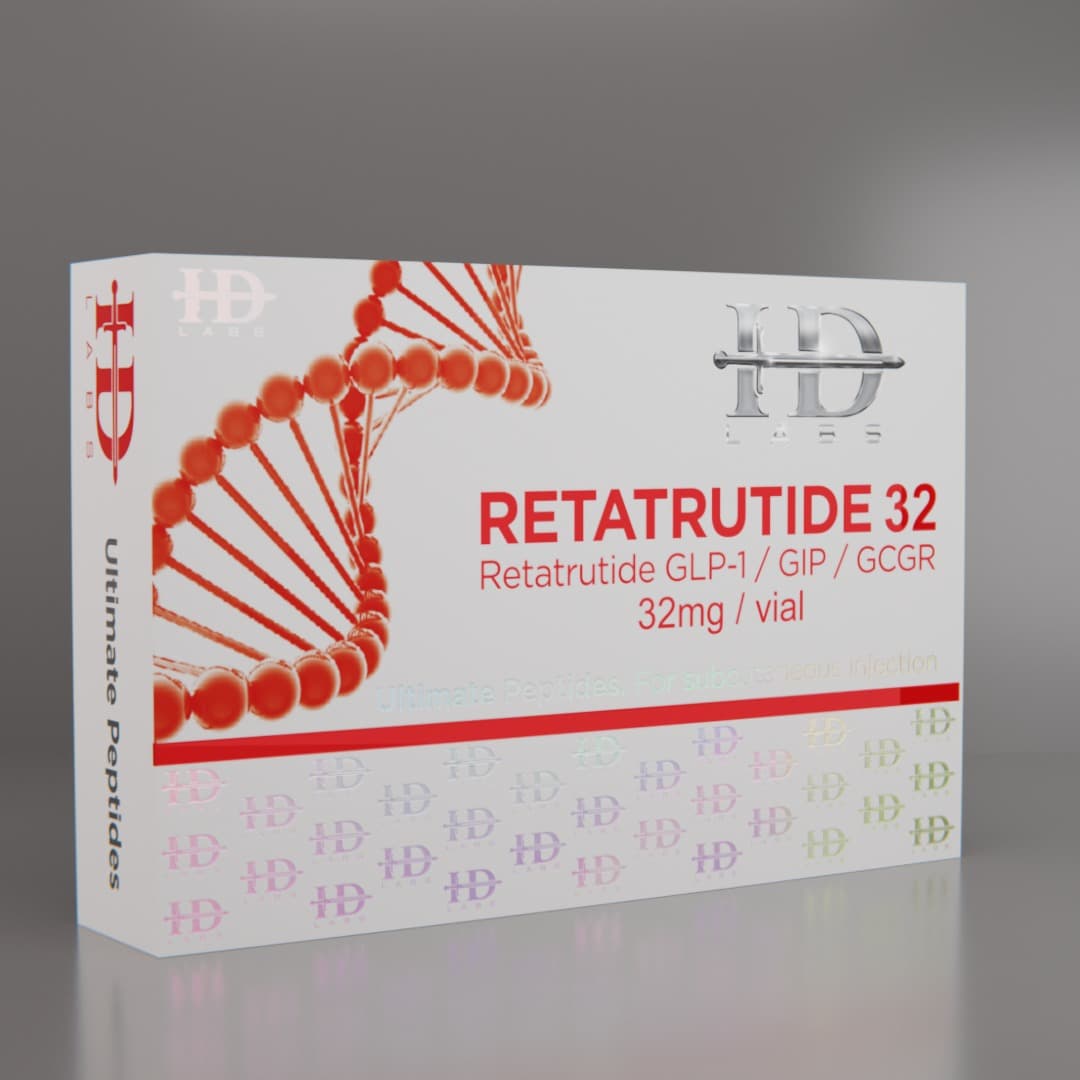
What you get
- 1× vial (product)
- 1× bacteriostatic water (2 ml)
What you need
- Syringe + needle to reconstitute (reconstitution calculator)
- Alcohol swabs
- Needle + syringe to inject
HD Labs Retatrutide 32 Vial
R2 300.00
SKU hdreta32
5.0(4 reviews)Compare & learn
HD Labs Retatrutide 32mg is a triple-agonist research peptide (GLP-1/GIP/glucagon) supplied as a single 32mg lyophilised vial for reconstitution. In a phase 2 obesity trial retatrutide reached roughly 24% mean body-weight reduction at 48 weeks. It is supplied as a research compound — use only under a licensed South African prescriber.
Who it's for
- ›Adults researching next-generation weight management
What it's used for
- ›Triple agonist (GIP, GLP-1, glucagon) studied for weight loss
- ›Researched for appetite and metabolic regulation
General research information, not medical advice.
Please note
Prescription-class compound supplied for research use. You must be 18 or older. Consult a qualified healthcare professional before use, this is not medical advice.
Card · EFT · Discreet delivery
Complete your kit
The supplies you need to store and use your order — add yours in one tap.
 BEARE Insulin Syringes 10 PackR35.00
- BEARE Insulin Syringes 20 PackR60.00
 Alcohol Swabs 50 PackR25.00
HD Labs Retatrutide 32mg: Dosage, Effects & Buying Guide
Key Takeaways
- Retatrutide is an unregistered triple-agonist peptide (GLP-1/GIP/glucagon) sold in South Africa as a 32mg lyophilised vial requiring reconstitution with bacteriostatic water.
- A 2023 phase 2 trial reported 24.2% mean weight loss at 48 weeks on the 12mg weekly dose — among the highest figures published for an incretin therapy in a phase 2 obesity trial, though phase 3 data are now reading out.
- A conservative real-world titration uses four-week stepwise increases (for example 2mg, then 4mg, then 6mg); the phase 2 trial itself escalated in four-week steps up to 12mg weekly. Any escalation should be prescriber-supervised.
- Vial format costs less per milligram than the pre-filled pen but requires sterile reconstitution technique.
- GI side effects (nausea, vomiting, diarrhoea) peak during dose escalation and typically settle within 1–2 weeks at a stable dose.
What Is HD Labs Retatrutide 32mg?
HD Labs Retatrutide 32mg is a South African-compounded vial of retatrutide (Eli Lilly and Company investigational code LY3437943), a single peptide molecule that simultaneously activates three metabolic receptors: GLP-1 (Glucagon-Like Peptide-1), GIP (Glucose-dependent Insulinotropic Polypeptide), and glucagon. HD Labs sells it in 32mg lyophilised vials for reconstitution, and it is notThe triple-agonist mechanism separates it from earlier injectables because each receptor pathway controls a distinct metabolic lever:
- GLP-1 receptor agonist activity — slows gastric emptying and suppresses appetite, the same axis semaglutide acts on to reduce caloric intake.
- GIP receptor agonist activity — improves insulin sensitivity and reduces insulin resistance, the second axis tirzepatide adds to enhance glucose handling and reduce hepatic fat.
- Glucagon receptor agonist activity — increases resting energy expenditure via thermogenesis, a third lever neither semaglutide nor tirzepatide pulls, which raises baseline calorie burn independent of appetite suppression.
That third receptor is why the 2023 phase 2 trial (Jastreboff et al., NEJM) recorded a mean 24.2% body weight reduction at 48 weeks on the 12mg weekly dose — among the highest figures published for an incretin therapy in a phase 2 obesity trial to date.
HD Labs distributes the compound in two formats in South Africa: a 32mg multi-dose vial requiring bacteriostatic water reconstitution, and a prefilled pen variant for subcutaneous injection. Buyers comparing formats often cross-shop the Body Pharm Retatrutide 32 Pen, or browse the full retatrutide category on Beskinny.storebefore deciding.
Triple Agonist vs Dual vs Single: Clinical Outcomes Compared
Retatrutide produced the largest mean weight loss of the three leading obesity peptides in phase 2 trials, but no head-to-head RCT (Randomized Controlled Trial) exists as of 2026, so the figures below come from separate trials with different durations and populations.
| Drug | Receptor targets | Trial | Duration | Mean % body weight loss | Year |
|---|---|---|---|---|---|
| Retatrutide (LY3437943) | GLP-1 / GIP / glucagon | Jastreboff et al. Phase 2 (NEJM) | 48 weeks | 24.2% (12mg dose) | 2023 |
| Tirzepatide | GLP-1 / GIP | SURMOUNT-1 (NEJM) | 72 weeks | 22.5% (15mg dose) | 2022 |
| Semaglutide 2.4mg | GLP-1 | STEP 1 (NEJM) | 68 weeks | 14.9% | 2021 |
Why the third receptor matters
Glucagon receptor agonism raises resting energy expenditure by stimulating hepatic glucose output and mitochondrial activity — a thermogenesis effect that semaglutide does not produce because it lacks glucagon signalling. Tirzepatide’s GIP arm improves insulin sensitivity and adipocyte lipid handling, but neither GLP-1 nor GIP directly increases calorie burn at rest. Adding glucagon agonism is the mechanistic reason retatrutide’s phase 2 curve was still trending downward at week 48 without a clear plateau, suggesting continued weight loss beyond the trial endpoint.
Why these numbers are not a clean comparison
The 24.2% vs 22.5% vs 14.9% framing is cross-trial, and the durations diverge meaningfully. Retatrutide’s 48-week figure was measured 20 to 24 weeks earlier in the treatment arc than the SURMOUNT-1 and STEP 1 endpoints. Weight-loss curves for incretin therapies typically continue downward past week 48. A fair retatrutide-vs-tirzepatide comparison at matched 72-week timepoints does not exist in the peer-reviewed literature as of mid-2026 because the phase 2 trial stopped at 48 weeks. The phase 3 TRIUMPH-1 obesity trial completed its primary phase in April 2026, with topline results reported during 2026, but full peer-reviewed publication is still pending.
Baseline populations also differ: STEP 1 enrolled BMI ≥30 (or ≥27 with comorbidity) non-diabetics, SURMOUNT-1 used similar criteria, and the 2023 Jastreboff retatrutide trial enrolled adults with BMI ≥30 or ≥27 with weight-related comorbidity. Subgroup sizes, ethnic composition, and run-in protocols all vary, so the trial cohorts are not directly comparable.
When you cross-shop formats while weighing the data, the Body Pharm Retatrutide 32 Pen and other retatrutide products on Beskinny.store sit in the same triple-agonist class, so the efficacy expectations above apply across vial and pen presentations.
Retatrutide Dosage Instructions: Full Titration Schedule
A conservative real-world titration for HD Labs Retatrutide 32mg applies the same four-week stepwise principle used in the 2023 phase 2 trial: start at 2mg subcutaneously once weekly for four weeks, escalate to 4mg weekly for weeks 5–8, then move to 6mg weekly from week 9 onward if tolerance allows. Note that the trial itself escalated in four-week steps to higher doses (up to 12mg weekly) and did not use a defined 6mg maintenance step — the 6mg target here is a conservative practical dose, not a trial-defined figure. Retatrutide’s approximate 6-day half-life supports once-weekly dosing because steady-state plasma concentrations remain stable across the injection interval.
Weeks 1–4: 2mg subcutaneous injection once weekly. Most GI side effects (nausea, mild reflux, transient appetite suppression overshoot) emerge in this window because the GLP-1 and GIP receptors are newly activated.
Weeks 5–8: 4mg SC once weekly if week 4 was tolerated without persistent vomiting or volume depletion. Hold the dose another two weeks if side effects are still active — receptor downregulation takes time.
Weeks 9–12: 6mg SC once weekly based on weight-loss response and tolerability. Some users hold at 4mg if appetite suppression is already adequate and further escalation risks unmanageable nausea.
Week 13+: Continue at the lowest effective dose. The phase 2 trial (Jastreboff et al., 2023) used up to 12mg weekly, but escalation beyond 6mg should only happen under prescriber supervision because real-world safety data at higher doses remain limited.
Why slow titration matters
Stepwise dose increases allow GLP-1, GIP, and glucagon receptors to downregulate progressively. This is why gradual escalation cuts nausea and vomiting rates compared with starting at therapeutic doses, and it is why the phase 2 trial used four-week dose steps. Skipping steps and escalating too quickly is a common reason people abandon incretin therapy, because it drives severe nausea and vomiting.
Injection site rotation
Inject subcutaneously into the abdomen (avoiding a 5cm radius around the navel), outer thigh, or back of the upper arm. Rotate sites each week to prevent lipohypertrophy and erratic absorption — repeated injections in the same spot can create scar tissue that alters drug uptake. A 32mg vial yields roughly 16 weeks at 2mg, 8 weeks at 4mg, or 5 weeks at 6mg weekly, before accounting for reconstitution losses.
Buyers comparing formats can review the Body Pharm Retatrutide 32 Pen or the broader retatrutide products on Beskinny.store before committing to a vial protocol.
Vial vs Pen: Which HD Labs Format Should You Choose?
The vial suits buyers who want lower cost per milligram and accept reconstitution handling; the pen suits buyers who prioritise convenience and dose accuracy without mixing. HD Labs supplies retatrutide as both a 32mg lyophilised powder vial (self-mix) and a pre-filled dial-a-dose pen, and the choice comes down to your tolerance for sterile technique versus the premium you’ll pay for ready-to-inject convenience.
Vial format: what you’re handling
The lyophilised vial ships as dry powder and requires bacteriostatic water plus a 0.5ml or 1ml insulin syringe (29–31G) for both drawing and injecting. The trade-off is a lower cost per mg than the pen. Indicative 2026 market pricing for the 32mg vial across South African suppliers runs roughly R2,049–R2,850 depending on supplier and exchange-rate movement. Note that, as an There is no HD Labs-official reconstitution volume on the vial insert that we have been able to verify. Clinic protocols typically use 8ml (4mg/ml), 10ml (3.2mg/ml), or 16ml (2mg/ml) bacteriostatic water depending on intended dose granularity. Follow the written protocol from your prescriber or compounding pharmacy rather than an online calculator, because individual pharmacokinetics and injection comfort vary.
Step-by-step reconstitution
- Wipe the vial stopper with a fresh alcohol swab and let it air-dry for 10 seconds to eliminate surface bacteria.
- Draw the prescribed volume of bacteriostatic water into the insulin syringe.
- Insert the needle at an angle and inject the water slowly down the inside wall of the vial, not directly onto the powder — direct impact can denature the peptide.
- Swirl the vial gently in a circular motion. Do not shake, because agitation can denature the peptide through mechanical stress.
- Allow 2–5 minutes for full dissolution. The solution should be clear and colourless; discard if cloudy or particulate, as cloudiness signals contamination or incomplete reconstitution.
- Draw the weekly dose into a fresh insulin syringe.
- Inject subcutaneously into abdomen, outer thigh, or upper arm, rotating sites weekly to prevent lipohypertrophy.
- Re-cap, label with the reconstitution date, and return to refrigeration immediately to preserve peptide stability.
As a general guide for peptides reconstituted with bacteriostatic water, store the mixed vial at 2–8°C and use within about 28 days; unmixed powder generally remains stable at the same refrigerated range until the printed expiry. Confirm the exact figures against your supplier’s batch documentation.
Pen format: when it’s worth the premium
The pre-filled pen removes reconstitution, syringe drawing, and dose-calculation arithmetic. You dial the dose, attach a pen needle, and inject. The convenience premium is roughly R400–R700 over the vial at current 2026 retail, because manufacturers absorb the cost of sterile filling and quality assurance. For first-time peptide users, anyone uncomfortable with sterile mixing, or travellers who can’t carry bacteriostatic water reliably, the Body Pharm Retatrutide 32 Pen is the lower-friction option. Browse the full retatrutide products on Beskinny.store to compare live pricing across both formats.
Retatrutide Side Effects: What to Expect and When
The most common retatrutide side effects are gastrointestinal: nausea, vomiting, diarrhoea, and constipation. These concentrate during the dose-escalation weeks and typically settle within 1–2 weeks of a stable dose as receptor adaptation reduces signal intensity. This mirrors the GLP-1 class profile reported in the 2023 Jastreboff et al. phase 2 trial (NEJM).
Week 1–2 after each titration step: Nausea peaks 24–72 hours post-injection, often with reduced appetite and mild fatigue, because the GLP-1 and GIP receptors are newly activated at higher doses.
Week 2–4: GI symptoms taper as the gut adapts to sustained receptor signalling. Transient dizziness or lightheadedness can appear, particularly if fluid intake drops, because dehydration amplifies nausea.
Week 4+ on a stable dose: Most users report tolerable steady-state. Symptoms typically return briefly at the next dose increase because each escalation re-triggers acute receptor activation.
Anytime during therapy: Resting heart rate may rise modestly because glucagon receptor activation increases hepatic glucose output and metabolic rate. This distinguishes retatrutide from semaglutide and tirzepatide and was associated with dose-dependent heart-rate increases that peaked around week 24 in the 2023 phase 2 cohort.
Rare but serious: Pancreatitis (persistent severe upper abdominal pain radiating to the back, with or without vomiting) and hypersensitivity reactions (rash, swelling, breathing difficulty) require immediate cessation and medical review.
Risk flags before you start
As with the approved GLP-1/GIP incretins, class prescribing information contraindicates use in anyone with a personal or family history of medullary thyroid carcinoma (MTC) or MEN2 (Multiple Endocrine Neoplasia type 2). Retatrutide has no approved label of its own, so these class-based cautions — along with prior pancreatitis, gallbladder disease, or significant arrhythmia — are applied by extension, and anyone in these groups should not self-prescribe. The 2023 phase 2 trial enrolled a screened population, and retatrutide-specific real-world adverse event rates outside clinical trials are not yet published as of 2026. Practical mitigation: start at the lowest titration step your prescriber sets, hydrate aggressively, eat smaller protein-led meals, and hold the next dose if vomiting prevents fluid intake.
When to stop and seek care
Stop dosing and contact a healthcare professional for persistent severe abdominal pain, repeated vomiting beyond 48 hours, signs of dehydration, chest pain, sustained tachycardia, or any allergic reaction. If you’re still weighing format against tolerability, the Body Pharm Retatrutide 32 Pen allows finer micro-dose adjustments than a vial draw, which some users find helpful for managing GI symptoms during escalation. Full options are on the retatrutide products on Beskinny.store page.
Who Is Retatrutide Best Suited For in 2026?
Retatrutide is best suited for adults with obesity (BMI ≥30) or BMI ≥27 with metabolic comorbidities who have plateaued on semaglutide or tirzepatide and who have access to medical supervision. The triple-agonist mechanism offers a different pathway when dual-agonist therapy stalls. The 2023 phase 2 trial showed mean weight loss of up to 24.2% at 48 weeks on the highest dose, with the strongest absolute reductions in participants with higher baseline BMI.
Strongest candidate profile
You are likely a good candidate if you tick most of these:
- BMI ≥30, or ≥27 with insulin resistance, type 2 diabetes, hypertension, dyslipidaemia, or NAFLD (Non-Alcoholic Fatty Liver Disease), because these conditions respond to multi-receptor activation.
- Stalled response on semaglutide or tirzepatide after 6+ months at maintenance dose, because the glucagon arm offers a new mechanistic pathway.
- Type 2 diabetes where glucagon receptor agonist activity may help hepatic fat and glycaemic control, based on 2023 phase 2 metabolic subgroup data.
- Willingness to titrate slowly over 16–20 weeks and tolerate GI side effects during escalation, because rapid escalation causes dropout.
If you have never used an incretin before, starting with semaglutide or tirzepatide is the more defensible sequence — retatrutide’s triple-agonist profile carries higher side-effect risk in naive users. Many users who plateau around 10–15% body weight loss on a tirzepatide product then consider retatrutide as the next step.
Who should not self-prescribe
Retatrutide is not appropriate without specialist input for anyone with a personal or family history of medullary thyroid carcinoma, MEN2 syndrome, prior pancreatitis, severe gastroparesis, active gallbladder disease, or pregnancy. Real-world safety data outside the trial cohort is not yet published as of 2026, so the screened-population caveats from the 2023 phase 2 trial still apply. If a vial format feels clinically risky for you, the Body Pharm Retatrutide 32 Pen allows tighter dose increments. Compare formats on the retatrutide products on Beskinny.store page.
Frequently Asked Questions
How long does one HD Labs Retatrutide 32mg vial last?
A single 32mg vial lasts up to 16 weeks at a 2mg weekly starter dose (32 ÷ 2 = 16 weeks), around 8 weeks at 4mg/week, and roughly 5 weeks at a 6mg weekly dose. Plan your reorder cadence around your titration schedule, not the vial label alone.
Can retatrutide be stacked with other peptides?
No. There are no indexed real-world or observational studies on retatrutide combinations as of 2026, and all human safety data come from sponsor-run monotherapy trials. Any stacking decision should go through a licensed prescriber, not a forum protocol, because drug interactions remain unmapped.
How does retatrutide’s half-life affect dosing?
Retatrutide’s approximate 6-day half-life supports once-weekly subcutaneous injection and produces stable plasma concentrations across the dosing interval, reaching steady state within about 4–5 weeks at each dose level. Splitting weekly doses into smaller injections offers no published pharmacokinetic advantage.
What is the difference between retatrutide and tirzepatide?
Tirzepatide is a dual GLP-1 and GIP receptor agonist. Retatrutide adds glucagon receptor agonist activity as a third target, which is associated with increased thermogenesis and 24.2% mean weight loss at the 12mg dose at 48 weeks in the 2023 phase 2 trial. The glucagon arm raises resting energy expenditure, which tirzepatide does not do.
Next Steps
If the vial workflow suits your budget and you have prescriber support in place, order HD Labs Retatrutide 32mg directly. If you’d rather skip reconstitution, the Body Pharm Retatrutide 32 Pen is the lower-friction option, and the full retatrutide products on Beskinny.storerange lets you compare live ZAR pricing across vials and pens before checkout.
References
- Triple–Hormone-Receptor Agonist Retatrutide for Obesity — A Phase 2 Trial (Jastreboff et al.). New England Journal of Medicine / PubMed, 2023.
- Tirzepatide Once Weekly for the Treatment of Obesity (SURMOUNT-1, Jastreboff et al.). New England Journal of Medicine / PubMed, 2022.
- Once-Weekly Semaglutide in Adults with Overweight or Obesity (STEP 1, Wilding et al.). New England Journal of Medicine / PubMed, 2021.
- LY3437943, a novel triple GIP, GLP-1, and glucagon receptor agonist: a phase 1b multiple-ascending-dose trial (Urva et al.). The Lancet / PubMed, 2022.
- MOUNJARO (tirzepatide) Prescribing Information. DailyMed, U.S. National Library of Medicine, 2025.
- A Study of Retatrutide (LY3437943) in Participants Who Have Obesity or Overweight (TRIUMPH-1, NCT05929066). ClinicalTrials.gov, U.S. National Library of Medicine, 2026.