
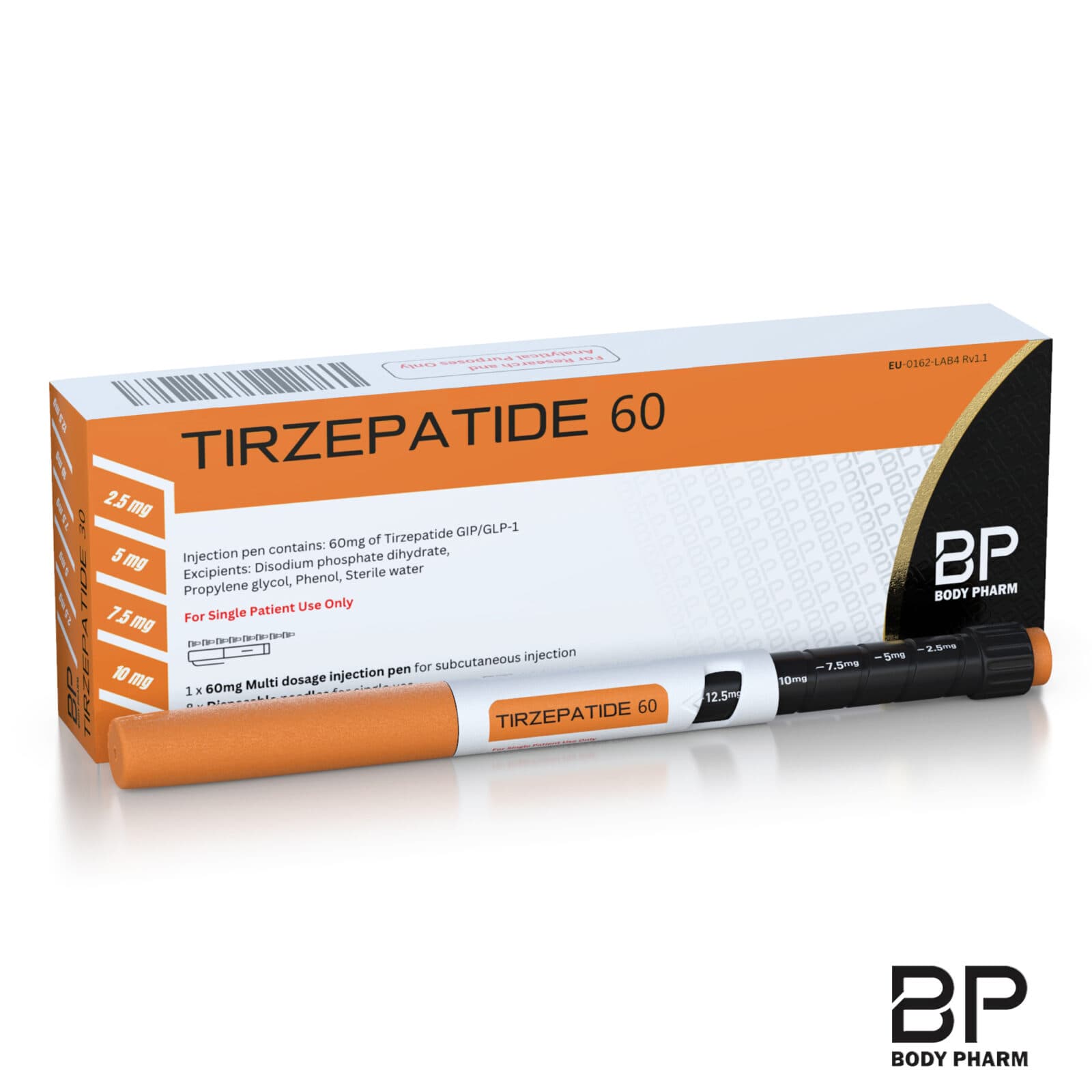
What you get
- 1× pen
- 8× needles
What you need
- Alcohol swabs
Body Pharm Tirzepatide 60 Pen
R3 500.00
SKU peptir60
4.7(40 reviews)Compare & learn
BP Tirzepatide 60 Pen (60 mg tirzepatide, 3.0 ml cartridge) is a Body Pharm multi-dose injector of tirzepatide — the dual GIP/GLP-1 receptor co-agonist studied for type 2 diabetes and weight management. One pen holds four weekly 15 mg maintenance doses. Use only under a registered prescriber.
Who it's for
- ›Adults researching dual-agonist weight management
What it's used for
- ›GIP + GLP-1 dual agonist studied for weight loss
- ›Researched for appetite control and glucose regulation
- ›Associated with greater average loss than GLP-1 alone
General research information, not medical advice.
Please note
Prescription-class compound supplied for research use. You must be 18 or older. Consult a qualified healthcare professional before use, this is not medical advice.
Card · EFT · Bitcoin · Discreet delivery
Complete your kit
The supplies you need to store and use your order — add yours in one tap.
 BEARE Insulin 1mL + 30G Needle Syringes 30 PackR90.00
 Body Pharm Pen Needles 6mm x 31G (Box of 30)R120.00
Body Pharm Tirzepatide 60 Pen: SA Buyer’s Guide 2026
The Body Pharm Tirzepatide 60 Pen is a multi-dose injector containing 60 mg of tirzepatide. Its published certificate of analysis lists a 3.0 ml cartridge at roughly 20 mg/ml(batch assay 21.8 mg/ml, purity 99.3%). It delivers four weekly 15 mg doses per pen when administered at standard titration steps. It is sold in South Africa through beskinny.store.. That distinction matters: regulatory registration determines which safety data, contraindications, and monitoring protocols apply to the product you’re buying.
Key Takeaways
- The 60 mg pen delivers four 15 mg doses and works out cheaper per dose than the 30 mg pen at maintenance level (about R875 versus R1,150 per 15 mg dose on current beskinny.store pricing)
- The 60 mg pen is designed for users already titrated to 15 mg weekly, not for those starting at 2.5 mg
- Common side effects are gastrointestinal and dose-dependent; slow titration (2.5 mg weekly, stepping up every four weeks) allows adaptation
What Is the Body Pharm Tirzepatide 60mg Pen?
The Body Pharm Tirzepatide 60 Pen is a pre-filled multi-dose injector containing 60 mg of tirzepatide. Its certificate of analysis states a 3.0 ml cartridge at a nominal 20 mg/ml (batch assay 21.8 mg/ml). It delivers four weekly 15 mg doses per pen.
Tirzepatide is the first dual GIP/GLP-1 receptor agonist approved for type 2 diabetes and, separately, for chronic weight management. The dual-receptor design activates two separate incretin pathways at once, and in a head-to-head trial it produced larger glucose and weight reductions than once-weekly semaglutide, a first-generation GLP-1-only drug.
The active ingredient is tirzepatide, the same molecule found in Eli Lilly’s Mounjaro (initial U.S. approval 2022) and Zepbound (FDA-approved 8 November 2023). Body Pharm is a separate manufacturer, and the BP pen is not the Lilly KwikPen. Lilly sells fixed single-strength pens (2.5, 5, 7.5, 10, 12.5, or 15 mg per 0.5 ml), each delivering four once-weekly doses. The Body Pharm 60 mg pen compresses the same15 mg-per-week ceiling dose into one multi-use cartridge, positioning it at the maintenance end of a titration plan rather than the starter end. That design reduces the number of pens a maintenance-dose user needs to purchase over a month.
Quick spec sheet
- Active ingredient: tirzepatide (dual GIP/GLP-1 agonist)
- Total drug content: 60 mg (label spec 60 mg / 3.0 ml)
- Cartridge concentration: ~20 mg/ml nominal; batch assay 21.8 mg/ml, purity 99.3% (CoA)
- Doses per pen: 4 × 15 mg, once weekly
- Route: subcutaneous injection
- Storage: 2–8 °C, protected from light, sealed; do not freeze (CoA)
For earlier titration steps, the Body Pharm Tirzepatide 30 Pen covers the lower weekly steps. The broader weight loss injections category lists alternatives available in South Africa.
How Tirzepatide Works: GIP + GLP-1 Dual Action
Tirzepatide is a single molecule that activates two incretin receptors at once: glucose-dependent insulinotropic polypeptide (GIP) and glucagon-like peptide-1 (GLP-1). That dual action pairs two pathways that a single GLP-1 agonist cannot match on its own.
The GLP-1 side performs three functions. It tells the pancreas to release insulin when blood glucose is elevated (so it does not drop sugar in a fasted state the way older insulins can). It suppresses glucagon, the hormone that tells the liver to dump more glucose into the blood. It slows gastric emptying so food leaves the stomach more gradually. Slower emptying is what most users feel as early satiety and reduced appetite, and it’s broadly comparable to what a single GLP-1 agonist delivers on its own.
The GIP side is what makes tirzepatide different. GIP agonism enhances insulin secretion in response to nutrients and appears to improve how peripheral tissues handle glucose, layering an additional incretin effect on top of GLP-1. The dual mechanism is documented in the Lilly label, which identifies 15 mg once weekly as the adult maximum dose for type 2 diabetes.
Head-to-head efficacy was tested in the SURPASS trial programme. In SURPASS-2, tirzepatide produced greater reductions in HbA1c and body weight than once-weekly semaglutide 1 mg in adults with type 2 diabetes on metformin. Check the original SURPASS publications for the specific comparator doses and effect sizes before relying on any cross-drug numbers.
For titration up to the 15 mg ceiling that the 60 pen is built around, the lower steps sit in the Body Pharm Tirzepatide 30 Pen. The wider weight loss injections category shows where tirzepatide sits relative to semaglutide-based alternatives in SA.
Tirzepatide for Weight Loss vs Type 2 Diabetes: Key Differences
Tirzepatide is the same molecule in both Mounjaro and Zepbound, but the two brands carry separate FDA approvals for separate indications. Mounjaro is approved for type 2 diabetes (adjunct to diet and exercise). Zepbound is approved for chronic weight management in adults with a BMI of 30 or greater, or 27 or greater with at least one weight-related condition, effective 8 November 2023. The regulatory separation exists because the clinical trials, safety monitoring, and labelled outcomes differ between the two indications.
The dosing ladder is identical across both brands: 2.5 mg, 5 mg, 7.5 mg, 10 mg, 12.5 mg, or 15 mg once weekly subcutaneously, with 15 mg as the adult maximum. What differs is the labelled outcome the prescriber is treating toward. For type 2 diabetes, the goal is HbA1c reduction and glycaemic control. For obesity, the goal is percentage body-weight reduction. In the SURMOUNT-1 trial, the 15 mg dose produced roughly a 20.9% mean reduction in body weight over 72 weeks — the data underpinning the obesity indication.
Where the Body Pharm pen sits
The Body Pharm Tirzepatide 60 Pen is not Mounjaro and not Zepbound. That matters because the FDA-approved indications, contraindications, and safety monitoring requirements attach to the registered brand, not to the active ingredient in isolation. A prescriber working from your medical history decides whether your clinical picture (T2DM, obesity with comorbidity, or neither) justifies tirzepatide at all, and at which titration step. For starting titration, the lower steps live on theBody Pharm Tirzepatide 30 Pen. The full weight loss injections range shows how tirzepatide compares with semaglutide options for either indication.
Body Pharm 30mg vs 60mg Pen: Cost-Per-Dose Comparison (2026)
On current beskinny.store pricing, the 60 mg pen works out to roughly R875 per 15 mg dose versus about R1,150 per dose for the 30 mg pen. If you’re already titrated to the 15 mg maximum, that’s a saving of about R275 each week.
The maths is straightforward once you use the CoA-confirmed cartridge: 60 mg of tirzepatide in 3.0 ml. A 60 mg pen delivers four 15 mg doses; a 30 mg pen delivers two. The 60 mg pen spreads its fixed cost across twice as many doses, lowering the per-dose burden.
Here is the side-by-side at the 15 mg titration step, using prices verified at time of writing.
| Spec | Body Pharm 30mg Pen | Body Pharm 60mg Pen |
|---|---|---|
| Total tirzepatide | 30 mg | 60 mg |
| 15 mg doses per pen | 2 | 4 |
| Listed price (ZAR, 2026) | R2,300 | R3,500 |
| Cost per 15 mg dose | R1,150 | R875 |
| Weeks of supply at 15 mg | 2 | 4 |
The 60mg pen is the better rand-per-milligram buy at every titration step where you’d otherwise burn through a 30mg pen in two weeks. At lower steps (2.5 mg, 5 mg, 7.5 mg, 10 mg, 12.5 mg) the calculation shifts because you’re drawing smaller volumes and a single pen lasts longer regardless of total fill. A user at 5 mg weekly would draw about 0.25 ml per injection, meaning a 60 mg pen would last 12 weeks instead of four — and the cost advantage disappears.
How we calculated this
We took the 60 mg total content and 3.0 ml cartridge (roughly 20 mg/ml, batch assay 21.8 mg/ml) from the product’s published certificate of analysis, and cross-checked the four-dose-per-pen breakdown against the four-dose multi-dose presentation of Lilly’s Mounjaro KwikPen. Listed prices are taken from the beskinny.store product pages at the time of writing. Ecommerce prices shift, so confirm the live figure on the 60mg product page and across the broader weight loss injections range before you order.
Dosing Schedule: How to Use the 60mg Pen
The Body Pharm tirzepatide 60 pen delivers four weekly 15 mg doses from a 3.0 ml cartridge (about 20 mg/ml). Each 15 mg dose is roughly 0.75 ml subcutaneously once a week. That dose size matches the maximum maintenance dose on the Lilly Mounjaro label, so the 60mg pen is built for people already titrated up, not for first-time users starting at 2.5 mg. Starting at the highest dose carries a higher risk of gastrointestinal side effects and is not supported by the registered titration protocol.
Standard titration before you reach 15 mg
The Mounjaro label sets a four-week titration ladder: 2.5 mg once weekly for the first four weeks, then 5 mg, then step up by 2.5 mg every four weeks as tolerated, to a maximum of 15 mg once weekly. This gradual escalation lets your body adapt to the drug and gives your prescriber a chance to monitor for side effects before moving to the next dose.
For those at the start of that ladder, the Body Pharm 30 Pen or a lower-strength option from the broader weight loss injections range is the more sensible buy. Drawing small early doses from a 60 mg cartridge wastes the volume. At the 2.5 mg titration step, a 60 mg pen would last 24 weeks, tying up capital and increasing the risk of needle or solution degradation over time.
Injection steps
- Wash hands and remove the pen from the fridge 15–30 minutes before injecting. The CoA specifies storage at 2–8 °C, protected from light, and warns against freezing.
- Inspect the solution: the CoA describes it as a colourless to light-yellow solution. Discard if cloudy or containing particles.
- Attach a fresh pen needle and prime per the manufacturer’s instructions.
- Pinch a clean site on the abdomen, front of the thigh, or back of the upper arm and inject subcutaneously, rotating sites weekly.
- Hold for the count specified on the device, withdraw, and dispose of the needle in a sharps container.
Diabetes and obesity prescribing can call for different titration speeds and ceiling doses, so follow your prescribing practitioner’s written instructions, not generic guidance. This section is not medical advice. Tirzepatide is a and dosing must be supervised by a registered healthcare practitioner.
Side Effects and Safety Considerations
Tirzepatide’s most common adverse effects are gastrointestinal: nausea, vomiting, diarrhoea, constipation, and decreased appetite, according to the Mounjaro prescribing information. These effects are typically dose-dependent and most pronounced during the first weeks after a dose escalation. The registered titration starts at 2.5 mg weekly and steps up no faster than every four weeks, giving your gastrointestinal system time to adapt to the drug’s effects on gastric emptying.
The Mounjaro label carries a boxed warning for thyroid C-cell tumours, based on rodent studies, with the drug contraindicated in anyone with a personal or family history of medullary thyroid carcinoma (MTC) or Multiple Endocrine Neoplasia syndrome type 2 (MEN 2). The human relevance of the rodent finding has not been determined.
Other serious risks listed in the prescribing information include acute pancreatitis, acute kidney injury (usually secondary to dehydration from vomiting or diarrhoea), gallbladder disease, and severe hypersensitivity reactions. These are less common but require medical supervision to detect early.
Hypoglycaemia and drug interactions
Tirzepatide on its own carries a low hypoglycaemia risk. The risk rises when it is combined with insulin or a sulfonylurea, and the label recommends reducing the dose of the insulin or sulfonylurea at initiation.
Tirzepatide can also reduce the effectiveness of oral contraceptives, so the label advises switching to a non-oral method or adding a barrier method for four weeks after starting and after each dose increase. These interactions occur because tirzepatide alters glucose handling and slows gastric emptying, which can affect the absorption of other drugs.
None of this replaces a proper consultation. A prescriber needs your full medical history, current medication list, and ideally recent bloods before signing off on either the Body Pharm Tirzepatide 30 Pen or the 60 pen, or any other product in the broader weight loss injections category.
How the 60mg Pen Compares to Other Tirzepatide Options in SA
For buyers already stabilised at 15 mg weekly, the Body Pharm Tirzepatide 60 Pen is the lowest cost-per-dose tirzepatide option on beskinny.store. Its four 15 mg doses spread the pen price across a full month of maintenance therapy.
For anyone still titrating up from 2.5 mg or 5 mg, the Body Pharm Tirzepatide 30 Pen makes more sense. Drawing small early doses from a 60 mg cartridge wastes volume, and at the 2.5 mg step the pen would last 24 weeks, tying up capital and raising the risk of degradation over time.
Two other in-house options are worth considering. The HD Labs Tirzepatide 30 Vial is a same-molecule alternative in a self-mix vial format, useful if you prefer a second-source brand during titration. The HD Tirsema 44 Pendosed identically at 2.5–15 mg once weekly. The broaderweight loss injections category page lists the full range if you want to cross-shop GLP-1 monotherapy against dual-agonist options before committing.
Frequently Asked Questions
How many injections are in the Body Pharm Tirzepatide 60mg pen?
The Body Pharm Tirzepatide 60 Pen contains four 15 mg doses, derived from its 60 mg total drug content in a 3.0 ml cartridge. That matches the four-dose multi-dose pen architecture in the Lilly reference product, where each KwikPen delivers four weekly doses. One pen covers a full four-week cycle at the 15 mg maintenance dose.
What is the cost per dose of the 60mg pen vs the 30mg pen?
At current pricing the 60 mg pen produces a lower cost-per-dose than the Body Pharm Tirzepatide 30 Pen for buyers already at the 15 mg maintenance level — roughly R875 per dose versus about R1,150, because the pen price is divided across four 15 mg doses rather than two. Live rand pricing should be confirmed on the product pages at purchase, since ecommerce pricing changes. At lower titration steps, the cost advantage disappears because you draw smaller volumes and the 60 mg pen lasts longer.
Do I need a prescription to buy tirzepatide in South Africa?
Yes. Tirzepatide is a , meaning a valid prescription from a registered medical practitioner is legally required before dispensing. A legitimate prescriber will always require a consultation and will not dispense without a documented medical assessment.
What is the difference between Mounjaro and the Body Pharm tirzepatide pen?
The two are not regulatory equivalents even though the active ingredient andweekly dosing range (2.5–15 mg)are the same.
How long will one 60mg pen last at the standard weekly dose?
One 60 mg pen lasts four weeks at the 15 mg once-weekly maintenance dose, since each pen delivers four 15 mg injections. For users still titrating at 2.5, 5, 7.5, 10, or 12.5 mg, the 60 mg pen is not the efficient choice; the 30 mg pen or a category cross-shop on weight loss injections is more appropriate. At 5 mg weekly, a 60 mg pen would last 12 weeks and tie up capital unnecessarily.
Can tirzepatide be used for weight loss if I don’t have type 2 diabetes?
Yes, internationally. Tirzepatide is FDA-approved as Zepbound for chronic weight management in adults with obesity, or overweight plus at least one weight-related condition, effective 8 November 2023. Off-label weight-loss prescribing is a clinical decision your prescriber must make and document, weighing the evidence against your individual medical history.
Next Steps
Confirm your current tirzepatide dose with your prescriber before ordering. If you’re at 15 mg weekly maintenance, request a written script and compare the Body Pharm Tirzepatide 60 Pen against the 30 mg option on cost-per-dose. If you’re still titrating, start with the 30 mg pen or browse the full weight loss injections range to find the right entry point for your stage. Keep your prescriber’s contact details and a copy of your script on file.
References
- Mounjaro (tirzepatide) injection — full prescribing information. DailyMed, U.S. National Library of Medicine, 2024.
- FDA Approves New Medication for Chronic Weight Management (Zepbound / tirzepatide). U.S. Food and Drug Administration, 2023.
- Frías JP, et al. Tirzepatide versus Semaglutide Once Weekly in Patients with Type 2 Diabetes (SURPASS-2). New England Journal of Medicine, 2021.
- Jastreboff AM, et al. Tirzepatide Once Weekly for the Treatment of Obesity (SURMOUNT-1). New England Journal of Medicine, 2022.
- Body Pharm Tirzepatide 60 Pen — Certificate of Analysis (batch C-Ti60-3.0-20251010). Body Pharm, 2025.