
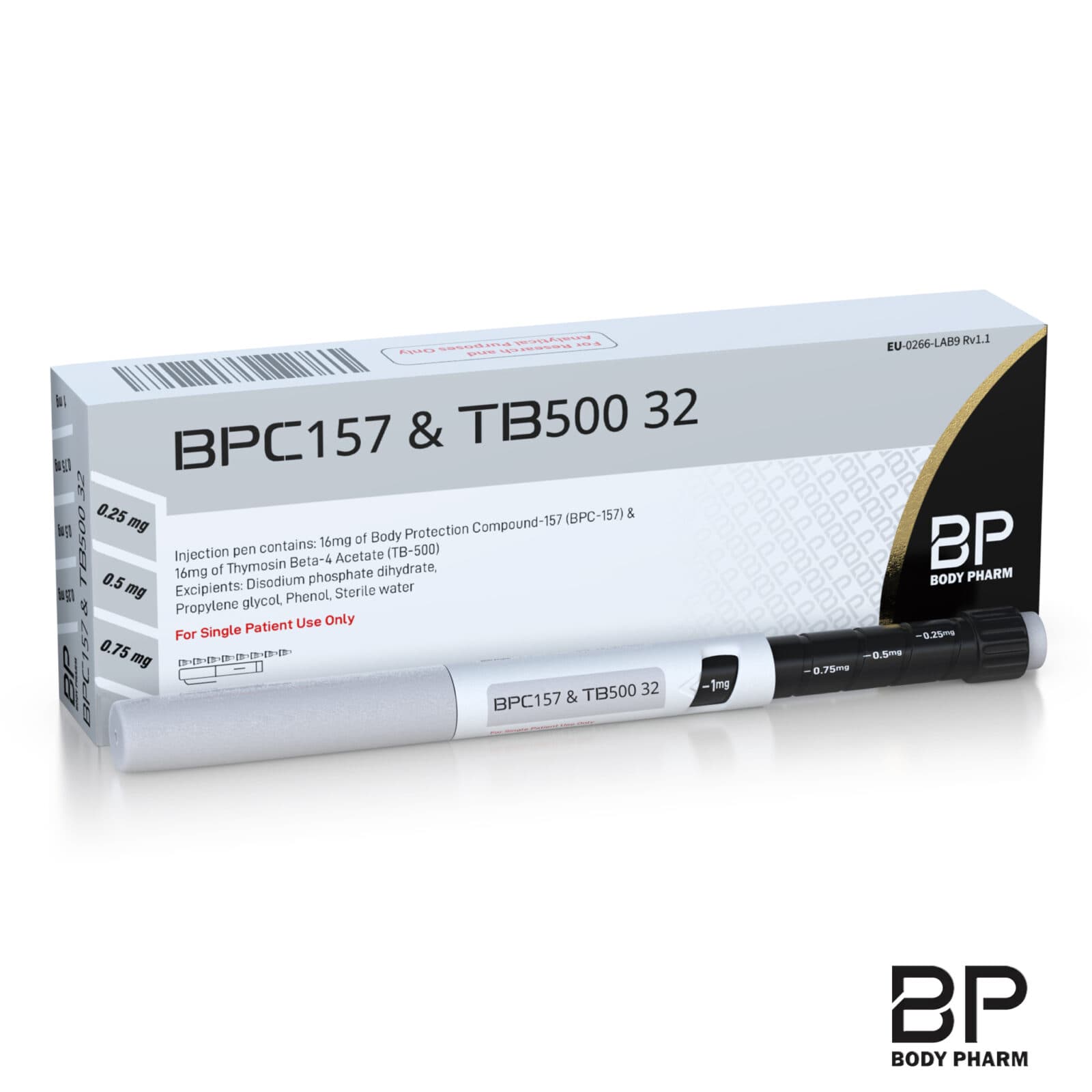
What you get
- 1× pen
- 8× needles
What you need
- Alcohol swabs
Body Pharm BPC 157 & TB500 32 pen
R2 100.00
SKU bpbpctb500
5.0(4 reviews)The Body Pharm BPC-157 & TB-500 32 Pen is a pre-filled, dual-peptide injector holding 32 mg of combined research peptide — 16 mg BPC-157 and 16 mg TB-500 in a fixed 1:1 ratio, dialled at 0.25 mg, 0.5 mg or 0.75 mg per injection. It is sold as a research compound.
Who it's for
- ›Active adults & athletes recovering from injury
- ›Anyone researching a tissue-repair stack
What it's used for
- ›Recovery stack combining BPC-157 and TB-500
- ›Researched for tendon, ligament and muscle repair
- ›Associated with reduced inflammation and faster healing
General research information, not medical advice.
Card · EFT · Bitcoin · Discreet delivery
Complete your kit
The supplies you need to store and use your order — add yours in one tap.
 BEARE Insulin 1mL + 30G Needle Syringes 30 PackR90.00
 Body Pharm Pen Needles 6mm x 31G (Box of 30)R120.00
Body Pharm BPC-157 & TB500 32 Pen: Full Guide 2026
The Body Pharm BPC-157 TB500 32 pen is a pre-filled multi-dose injector containing 16 mg of BPC-157 and 16 mg of TB-500 in a fixed 1:1 ratio, with selectable doses of 0.25 mg, 0.5 mg, and 0.75 mg per injection. The pen delivers a 32 mg combined payload through a dial mechanism instead of two reconstituted vials. This removes the reconstitution step and eliminates the dosing drift that comes from manually drawing from separate syringes. A 2-unit miscount on a standard 100iu insulin syringe equates to a 20% dosing error at small volumes.
Key Takeaways
- The pen delivers both peptides in a fixed 1:1 ratio via dial mechanism, eliminating reconstitution and reducing user-dependent dosing error
- In preclinical research, BPC-157 and TB-500 repair tissue through non-overlapping pathways: local vascular growth (BPC-157) and systemic cell migration (TB-500)
- At its current R2,100 listing, the pen works out to roughly R33 per combined dose at the 0.25 mg setting, with no additional bacteriostatic water or syringe costs
- The pen suits intermediate users with localised soft-tissue injury who also want systemic recovery support; it is not ideal for gut-only or systemic-inflammation-only protocols
This guide addresses three questions South African buyers are weighing in 2026:
- Whether the 1:1 mechanistic pairing in the “Wolverine Stack” justifies stacking over solo BPC-157, given that both peptides repair tissue through non-overlapping pathways.
- Whether the pen’s dial accuracy and convenience beat vial-based dosing for an intermediate user, given the elimination of reconstitution steps.
- What the cost-per-dose looks like once you account for bacteriostatic water, syringes, and waste.
What Is the Body Pharm BPC-157 TB500 32 Pen?
The Body Pharm BPC-157 TB500 32 Pen is a pre-filled multi-dose injector containing 32 mg of total peptide payload, split 1:1 as 16 mg Body Protection Compound-157 (BPC-157) and 16 mg TB-500, with selectable doses of 0.25 mg, 0.5 mg, or 0.75 mg per click and 8 disposable needles included in the box. No bacteriostatic water, no reconstitution, no vial-to-syringe transfer.
It is also sold under the nickname “Wolverine Stack” or “Wolverine Peptide Pen” — a reference to the BPC-157 + TB-500 pairing targeting both local tissue repair and systemic cell migration. Beskinny stocks it alongside the Body Pharm TB500 5mg standalone vial for buyers who prefer vial-based dosing and need flexibility to adjust ratios, and the Body Pharm MOTS-C 32 Pen for those building a multi-pen recovery stack targeting mitochondrial function alongside tissue repair.
How BPC-157 and TB-500 Work Together
In preclinical (animal and cell) studies, BPC-157 and TB-500 repair tissue through two non-overlapping mechanisms. BPC-157 acts locally at the injury site to rebuild tissue and grow new blood vessels. TB-500 acts systemically to mobilise repair cells from elsewhere in the body toward that site. Stacking them is intended to cover both ends of the repair pathway because neither peptide duplicates the other’s function. Human trial data on either peptide is limited, so these mechanisms should be read as investigational rather than clinically established.
What BPC-157 Does
BPC-157 (Body Protection Compound-157) is a synthetic pentadecapeptide originally isolated from a protein in human gastric juice. Its primary mechanism is local: in laboratory studies it upregulates growth hormone receptor expression in tendon cells, and in animal models it promotes angiogenesis (new capillary formation around the damaged area) during muscle and tendon healing. It has also been studied for its effect on gut-lining integrity. The reported effect is faster local matrix rebuilding at tendon, ligament, muscle and gut tissue. Injection near the injury site is the common practitioner recommendation because proximity to the target tissue is thought to maximise the local growth-factor and vascular response.
What TB-500 Does
TB-500 is a synthetic version of Thymosin Beta-4, a naturally occurring 43-amino-acid actin-sequestering protein. Its primary mechanism is systemic actin regulation and cell migration: it binds G-actin inside cells to enable cell movement, and in preclinical models it accelerates wound healing and cell migration toward sites of injury. It has also been studied for dampening inflammation and supporting muscle-fibre repair across the body rather than at one injection point. Buyers running TB-500 in isolation for whole-body recovery typically use the Body Pharm TB500 5mg standalone vial at lower weekly volumes than the stacked pen delivers, because TB-500’s systemic half-life is longer and it accumulates across the week.
Why Buyers Combine the Two Peptides
The rationale is mechanical: TB-500 is intended to recruit repair cells systemically through actin regulation, and BPC-157 to provide the local vascular and growth-factor environment those cells need to rebuild tissue.
TB-500 alone mobilises repair cells but provides no local vascular scaffolding. BPC-157 alone builds local tissue but does not recruit systemic repair resources efficiently. That is also the rationale buyers cite for combining the pen with the Body Pharm MOTS-C 32 Pen when mitochondrial recovery is the bottleneck rather than tissue repair, because MOTS-C targets metabolic function while BPC-157 and TB-500 target structural repair. Peer-reviewed studies testing the specific combined BPC-157 + TB-500 protocol in humans remain limited as of 2026.
Why the 1:1 Ratio (16mg:16mg)
The 1:1 split exists because BPC-157 and TB-500 are understood to work on complementary pathways rather than competing for the same receptors, so equal dosing avoids under-serving either mechanism. BPC-157 handles the local vascular and growth-factor side; TB-500 handles systemic cell migration and anti-inflammatory signalling. Drop either one below parity and you cap the slower half of the repair pipeline.
The equal split is a practical, community-derived convention rather than a clinically optimised ratio. Because the two peptides act on complementary pathways rather than competing for the same receptors, dosing them equally is a reasonable default — but it reflects protocol habit and vendor formulation, not trial evidence.
What the 1:1 ratio is not, as of 2026, is clinically validated. No peer-reviewed randomized controlled trial (RCT) has tested 1:1 against 2:1, 1:2, or any other split in humans. The convention reflects community protocols and vendor decisions, not trial data, and any buyer should price that uncertainty in.
The practical upside of an equal-ratio pre-fill is protocol simplicity: every click delivers identical mg of each peptide simultaneously, so you cannot accidentally drift one peptide ahead of the other the way you can when reconstituting two separate vials. Manual syringe draws from the Body Pharm TB500 5mg standalone vial alongside a BPC-157 vial introduce cumulative measurement error across weeks.
Pre-Filled Pen vs. Vial: Which Format Should You Choose?
The pen wins on dosing consistency and convenience. Vials win on ratio flexibility and bulk economics. The Body Pharm 32mg pen uses a dial mechanism with selectable 0.25mg, 0.5mg and 0.75mg settings per injection, removing the reconstitution step entirely. Vials require bacteriostatic water, a separate syringe draw, and manual unit counting — which is where most dosing drift happens in home protocols, because insulin syringes lack the precision needed for sub-milligram peptide volumes.
Dosing accuracy. The pen delivers three fixed dose settings via the dial, so each click corresponds to a calibrated mechanical stop rather than a visual reading on a U-100 insulin syringe. With a vial, a 2-unit miscount on a 100iu syringe equates to a 20% dosing error at small volumes. That margin matters more on TB-500 than on BPC-157 because TB-500’s systemic half-life is longer and it accumulates across the week, so a 20% underdose compounds over repeated injections.
Convenience. No mixing, no bacteriostatic water sourcing, no two-vial drawing sequence. The pen ships ready to dial and inject. For users running the Body Pharm TB500 5mg standalone vial alongside a separate BPC-157 vial, that’s two reconstitutions, two draws, and two injection sites per session unless you pre-mix — adding 5–10 minutes to each protocol day.
Cost-per-dose. At its R2,100 listing, the 32mg pen yields roughly 64 doses at the 0.25mg setting, working out to about R33 per combined BPC-157 + TB-500 dose. Standalone vial cost-per-dose depends on the live TB-500 5mg vial price plus a separate BPC-157 vial plus bacteriostatic water, so a like-for-like figure requires a current quote.
Shelf life and storage. Liquid peptide pens are conventionally stored in a sealed container at 2–8°C, kept out of light, and never frozen. Confirm the Body Pharm-specific shelf life and storage window on the product insert or batch certificate before extended storage. Reconstituted vials typically require refrigeration and have a finite use window once mixed, typically 14–30 days depending on the formulation.
| Dimension | Pre-Filled Pen | Vial + Syringe |
|---|---|---|
| Dose accuracy | Dial-set, 3 fixed increments | Manual draw, user-dependent |
| Prep required | None | Reconstitution + bacteriostatic water |
| Ratio control | Fixed 1:1 | Fully adjustable |
| Cost-per-dose (0.25mg) | ~R33 (2026) | Variable, quote-dependent |
| Needles included | 8 disposable pen needles | None — sourced separately |
Choose the pen if you want to remove user error from the equation, or if you’re also considering brand-matched options like the Body Pharm MOTS-C 32 Pen for a unified injection workflow. Choose vials if you want to run a non-1:1 ratio, scale doses above 0.75mg per session, or stack additional peptides into the same protocol.
Dosing Guide: How to Use the BPC-157 TB500 32 Pen
The standard vendor-stated protocol is 0.25mg–0.5mg daily, with each click delivering equal amounts of both peptides (a 0.25mg setting injects 0.25mg BPC-157 plus 0.25mg TB-500 simultaneously). The pen offers three fixed settings: 0.25mg, 0.5mg, and 0.75mg per injection. All dosing figures here are vendor-reported and community-derived; no clinical dosing standard exists for either peptide individually or in combination, so confirm any protocol with a qualified clinician.
How Long the Pen Lasts at Each Dose
At a fixed daily injection, the 32mg total payload (16mg BPC-157 + 16mg TB-500) gives the following duration:
| Daily Dose | Doses Per Pen | Supply Duration |
|---|---|---|
| 0.25mg | ~64 | 8–10 weeks |
| 0.5mg | ~32 | 5–6 weeks |
| 0.75mg | ~21 | 3 weeks |
Many community protocols front-load at 0.5mg daily for 4–6 weeks during acute recovery, then taper to 0.25mg for maintenance. If you want to extend the pen past 10 weeks, the 0.25mg setting is the longest-running option but may underdose larger users. That is where the Body Pharm TB500 5mg standalone vial becomes the better choice if you need flexibility above 0.75mg per session.
Injection Site and Needles
Community practice administers BPC-157 subcutaneously near the injury site for localised effect, while TB-500 is given subcutaneously or intramuscularly for systemic distribution. Because the pen delivers both peptides in one shot, you’re choosing a single site. Subcutaneous in the lower abdomen is a common compromise because it lets TB-500 distribute systemically while BPC-157 can still reach nearby tissues via local diffusion.
The pen ships with 8 disposable pen needles. At daily dosing, that’s roughly one needle per week if you reuse within a sterile single-day window, or you’ll need to source standard pen needles (typically 4mm–8mm, 30G–32G) from a pharmacy once the included supply runs out.
Pricing and Value: Is the Body Pharm Pen Worth It in 2026?
At its current R2,100 listing, the pen is priced for the mid-market. Research-peptide prices shift frequently with stock and exchange rates, so treat any figure older than a month as a guide rather than a firm quote — check the live product page before you buy.
At the 0.25 mg minimum dial setting, the R2,100 pen works out to roughly R33 per combined dose across 64 administrations from the 32 mg fill. That figure improves in real-world terms once ancillary costs disappear: the pen format eliminates bacteriostatic water (typically R80–120 per bottle), insulin syringes (R5–10 per unit), alcohol swabs, and the mixing time that vial-based reconstitution demands. Buyers comparing the pen against the Body Pharm TB500 5mg standalone vial or stacking it with the Body Pharm MOTS-C 32 Pen should factor those consumables into any honest per-dose figure.
The Body Pharm 32 pen is priced competitively for the SA market in 2026. Its value case rests on dosing precision and convenience rather than raw rand-per-milligram.
Who Should Consider the BPC-157 TB500 Combo Pen?
The combo pen is aimed at intermediate users with a specific localised soft-tissue injury who also want systemic recovery support during high-frequency training. Reported use cases in practitioner and retailer literature centre on acute tendon, ligament and muscle tears, chronic joint inflammation, post-surgical tissue repair, and recovery for athletes running back-to-back hard training blocks. Note that competitive athletes subject to anti-doping testing should not use either peptide, as both are prohibited in sport at all times.
The pen is a poor fit for two groups. Users running a gut-focused protocol (IBD flares, gastric ulceration, leaky-gut work) typically prefer BPC-157 in isolation because TB-500 adds little to the GI mechanism and inflates cost per dose. Users targeting systemic inflammation without a localised structural injury often run TB-500 alone, in which case the Body Pharm TB500 5mg standalone vial is the more rational buy because you avoid paying for local tissue-repair capacity you don’t need.
If you’ve already addressed acute injury and want to layer mitochondrial and metabolic recovery on top, the Body Pharm MOTS-C 32 Pen is the more logical next pen rather than a second BPC/TB-500 cycle, because MOTS-C targets a different recovery bottleneck. Buyers without a clear localised injury target should reconsider whether a 32 mg combined fill matches their actual protocol.
Frequently Asked Questions
The Body Pharm BPC-157 TB500 32 pen is a pre-filled, ready-to-inject device containing 16mg of each peptide at a 1:1 ratio, eliminating reconstitution and reducing dosing error compared with vial-based protocols. The answers below address the queries that come up most often at the decision stage.
Can I use the pen without mixing?
Yes. The pen ships pre-filled and pre-reconstituted, so there is no bacteriostatic water step, no swirling, and no syringe transfer. Dial, inject, cap.
How many doses are in one pen?
A single 32mg pen delivers roughly 64 doses at the 0.25mg setting, 32 doses at the 0.5mg setting, or 21 doses at the 0.75mg setting, based on the selectable dose increments documented on the product page. Each click delivers both peptides simultaneously in the 1:1 ratio, so one “dose” is a combined BPC-157 + TB-500 administration.
Does the pen need to be refrigerated?
Liquid peptide pens are conventionally stored at 2–8°C and never frozen, because freezing can denature the peptide chains. The Body Pharm-specific shelf life and temperature window should be confirmed against the product leaflet or batch certificate before extended storage.
Pen versus vial — what actually changes?
The pen fixes the ratio at 1:1 and the increments at 0.25/0.5/0.75mg. A vial protocol using the Body Pharm TB500 5mg standalone vial plus a separate BPC-157 vial lets you run uneven ratios (for example 2:1 BPC:TB) but requires reconstitution, two injections, and accurate insulin-syringe measurement, which introduces cumulative error. Buyers who want pen-format convenience for a different recovery mechanism can compare against the Body Pharm MOTS-C 32 Pen.
Next Steps
References
- Stable Gastric Pentadecapeptide BPC 157 and Wound Healing. Frontiers in Pharmacology, 2021.
- Pentadecapeptide BPC 157 Enhances the Growth Hormone Receptor Expression in Tendon Fibroblasts. Molecules, 2014.
- Modulatory effect of gastric pentadecapeptide BPC 157 on angiogenesis in muscle and tendon healing. Journal of Physiology and Pharmacology, 2009.
- Thymosin beta4: actin-sequestering protein moonlights to repair injured tissues. Trends in Molecular Medicine, 2005.
- Thymosin beta4 accelerates wound healing. Journal of Investigative Dermatology, 1999.
- Bulk Drug Substances Used in Compounding Under Section 503A of the FD&C Act. U.S. Food and Drug Administration, 2026.
- The Prohibited List. World Anti-Doping Agency (WADA), 2026.