
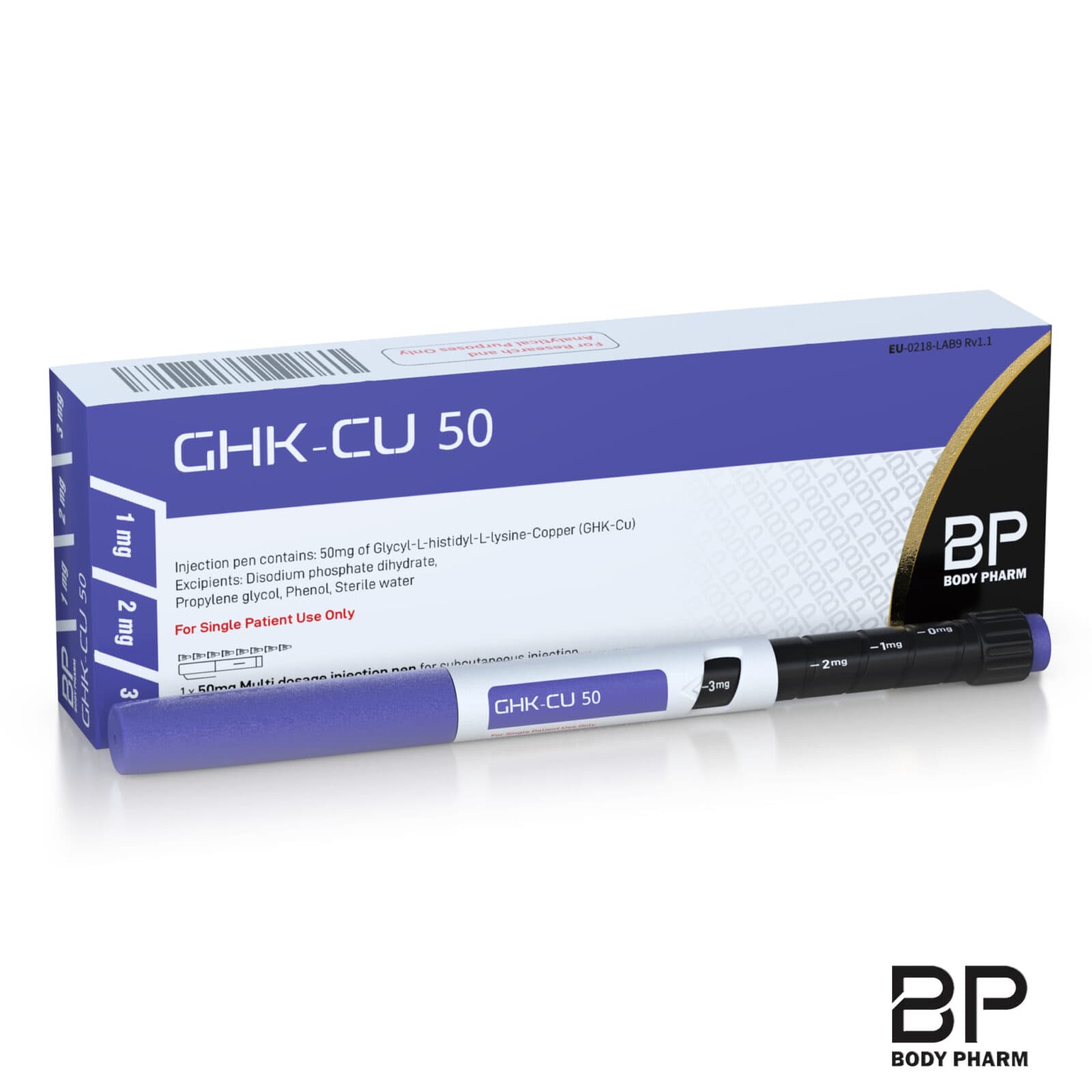
What you get
- 1× pen
- 8× needles
What you need
- Alcohol swabs
Body Pharm GHK-Cu 50 Pen
R1 600.00R1 300.00On sale
SKU bpghkcu
4.8(26 reviews)The Body Pharm GHK-Cu 50 Pen is a pre-loaded subcutaneous pen delivering GHK-Cu (copper tripeptide), a naturally occurring copper-binding peptide studied in laboratory and preclinical research for collagen and elastin synthesis, wound repair, and skin and hair support. Human evidence is still early, and GHK-Cu is supplied as a research compound.
Who it's for
- ›Those focused on skin, hair and anti-aging research
What it's used for
- ›Copper peptide studied for skin regeneration and collagen
- ›Researched for wound healing and hair support
General research information, not medical advice.
Card · EFT · Bitcoin · Discreet delivery
Complete your kit
The supplies you need to store and use your order — add yours in one tap.
 BEARE Insulin 1mL + 30G Needle Syringes 30 PackR90.00
 Body Pharm Pen Needles 6mm x 31G (Box of 30)R120.00
Body Pharm GHK-Cu 50 Pen: Copper Peptide for Skin & Hair
Last updated: July 2026
The Body Pharm GHK-Cu 50 Pen delivers glycyl-L-histidyl-L-lysine copper (GHK-Cu) in a pre-loaded subcutaneous pen at R1,600, working out to R32 per 1 mg dose marker with fully transparent per-dose maths. Comparing copper peptide pen products before buying? Here is the short answer:
- Pen vs. vial vs. nasal spray: subcutaneous injection delivers the peptide systemically, whereas topical application is only minimally absorbed through intact skin and intranasal delivery is variable and route-dependent. A pre-mixed pen removes the reconstitution and draw-accuracy steps that introduce most dosing error.
- Copper load per dose: a 1 mg GHK-Cu marker carries roughly 0.16 mg of elemental copper, under 2% of the National Institutes of Health (NIH) 10 mg/day Tolerable Upper Intake Level for adults (NIH ODS Copper Fact Sheet).
- What this page adds: a transparent per-dose cost breakdown (R1,600 ÷ 50 doses = R32/mg), a pen-vs-vial-vs-spray format comparison, and the BeSkinny team’s 8-week skin-elasticity field protocol.
Key Takeaways
- Price and per-dose cost: R1,600 per pen, R32/mg, 50 doses at the standard 1 mg/day skin protocol.
- Delivery format: pre-mixed subcutaneous pen, no reconstitution, 1 mg per click.
- Best evidence: in-vitro fibroblast and preclinical data; human injectable randomised controlled trials (RCTs) remain absent through 2026.
- Safety margin: a 1 mg dose delivers under 2% of the NIH copper Tolerable Upper Intake Level.
- Verified quality: batch HPLC purity of 99.90% on the published certificate of analysis.
- Stack options: TB500 (tissue repair), CJC-1295/Ipamorelin (collagen matrix), Glutathione (redox buffer).
What you will learn
By the end of this article you will know (1) how the Body Pharm GHK-Cu 50 Pen compares on cost and delivery to vials and nasal sprays, (2) what the current evidence base actually shows for skin and hair outcomes, and (3) how to run a week-by-week 8-to-12-week dosing protocol with realistic expectations.
What Is the Body Pharm GHK-Cu 50 Pen?
The Body Pharm GHK-Cu 50 Pen is a pre-loaded subcutaneous injector containing GHK-Cu, a naturally occurring copper-binding tripeptide (Gly-His-Lys) first isolated from human plasma by Loren Pickart in 1973 (Pickart & Margolina, BioMed Research International, 2015). The pen delivers 1 mg dose markers at R1,600 retail, or R32 per mg.
Specs at a glance:
- Active ingredient: GHK-Cu, the copper(II) complex of glycyl-L-histidyl-L-lysine, molecular formula C14H24CuN6O4, molecular weight ~404 g/mol, ~16% elemental copper by mass (PubChem CID 71587328, prezatide copper).
- Verified content and purity: independent HPLC testing of the supplied batch returned 99.90% purity at 17.6 mg/mL, or 52.8 mg total peptide per 3 mL cartridge (Body Pharm certificate of analysis, 2025).
- Dose marker: 1 mg per click, 50 doses per pen.
- Price: R1,600 (2026), R32/mg.
- Manufacturer: Body Pharm.
- Format: pre-mixed, pre-loaded pen requiring no reconstitution, no separate syringe, and no bacteriostatic water mixing.
The pen format matters for two practical reasons. First, dosing precision: a pre-calibrated 1 mg-per-click marker removes the multi-step reconstitution and syringe-draw maths where most user error creeps in. Second, sterility: pre-mixed pens skip the reconstitution step where most contamination occurs. Readers worried about paying a premium for convenience should note the per-mg math below; the pen is competitively priced against vial-based alternatives at this scale.
For stacking, GHK-Cu pairs cleanly with the Body Pharm TB500 5 pen for tissue repair, and with the Body Pharm CJC-1295 & Ipamorelin 20 Pen when the goal is collagen matrix support alongside growth-hormone-pulse-driven recomposition.
How GHK-Cu Works: The Science in Plain Language
GHK-Cu binds a copper(II) ion to the glycyl-histidyl-lysine tripeptide, creating a signalling complex that shuttles copper into fibroblasts (collagen-producing skin cells) and triggers gene-level changes relevant to skin remodelling. Treat that mechanistic literature as the baseline: it is drawn largely from in-vitro and animal models, and no large human randomised controlled trial (RCT) on injected GHK-Cu has replaced it as of early 2026.
Three mechanisms do most of the visible work.
1. Collagen and elastin gene upregulation
In fibroblast models GHK-Cu increases synthesis of collagen, elastin and glycosaminoglycans and modulates the genes for type I and III collagen. These are laboratory-level findings; extrapolating them to measurable clinical elasticity gains requires caution, since no injectable-GHK-Cu cutometry RCT has been confirmed in PubMed.
2. TGF-β activation and wound repair
The peptide supports tissue repair across skin and other tissues, promoting fibroblast recruitment and granulation-tissue formation in wound models. This pathway is the mechanistic rationale for stacking with the Body Pharm TB500 5 pen (Thymosin Beta-4), which acts on actin-binding and cell migration through a separate route.
3. Antioxidant and anti-inflammatory action
GHK-Cu shows anti-inflammatory and antioxidant activity, helping to limit oxidative damage to dermal matrix proteins in preclinical work. Pair it with the Body Pharm CJC-1295 & Ipamorelin 20 Pen when the goal is GH-pulse-driven collagen synthesis layered onto GHK-Cu’s matrix-protective signalling.
Key Benefits Studied in Research (2026 Update)
Six research-studied benefits drive the GHK-Cu copper peptide pen use case in 2026, ranked by strength of available data. For sceptics of peptide marketing claims, the rankings below separate laboratory-level data from clinical-scale evidence so each benefit can be weighed on its merits.
- Collagen and elastin production. Fibroblast models show upregulation of collagen and elastin synthesis after GHK-Cu exposure. This is in-vitro data, not clinical thickness measurements.
- Skin elasticity and visible anti-aging. No 2023–2026 RCT confirms cutometry-measured elasticity gains from injected GHK-Cu. Early support comes from small-sample and topical work rather than injectable RCTs, so any gradual firmness improvement over 8–12 weeks should be treated as an expectation, not a proven outcome.
- Wound healing and tissue repair. Animal and ex-vivo models show accelerated granulation and re-epithelialisation. This finding is the rationale for stacking with the Body Pharm TB500 5 pen, which acts on actin-binding through a separate pathway.
- Hair follicle support. GHK’s regenerative actions extend to hair follicles in animal wound-healing models, and copper-peptide signalling has been explored for dermal-papilla and angiogenic effects. This remains preclinical, and no human scalp RCT has confirmed hair-growth effects at clinical scale. “Copper peptide hair growth” is the highest-intent search use case, but the honest ceiling is that the human data is not there yet.
- Anti-inflammatory and antioxidant protection. GHK-Cu reduces oxidative and inflammatory signalling in dermal matrix models. The peptide pairs logically with the Body Pharm CJC-1295 & Ipamorelin 20 Pen when GH-pulse-driven collagen synthesis is the goal.
- Endogenous baseline replacement. Plasma GHK levels fall from about 200 ng/mL at age 20 to about 80 ng/mL by age 60, which is the physiological rationale often cited for exogenous dosing in the 30–60 age band.
GHK-Cu for Hair Growth: What the Evidence Says
GHK-Cu is proposed to support hair follicles through dermal-papilla signalling and angiogenesis rather than a dihydrotestosterone (DHT)-dependent route, which would make it mechanistically distinct from minoxidil and finasteride. That distinction is of most interest in androgenic alopecia, where DHT-blocking therapies are first-line but often poorly tolerated. The supporting data is drawn from preclinical wound-healing and skin-regeneration models, not human scalp trials, and no human RCT in the 2024–2026 window has confirmed these effects at clinical scale.
Conceptually, GHK-Cu differs from minoxidil in several ways:
- Mechanism. GHK-Cu is proposed to act on dermal-papilla signalling and angiogenesis; minoxidil works primarily through vasodilation and potassium-channel opening.
- Hormonal axis. Neither compound blocks DHT (finasteride is the DHT-blocker), but GHK-Cu adds matrix-remodelling signalling that minoxidil lacks.
- Anagen prolongation. GHK-Cu is hypothesised to support the anagen (active growth) phase rather than only shortening telogen (the resting phase), which is what the preclinical proliferation data implies.
- Stack logic. GHK-Cu pairs with the Body Pharm TB500 5 pen for scalp tissue repair and with the Body Pharm CJC-1295 & Ipamorelin 20 Pen when collagen-matrix support is the goal.
The BeSkinny team protocol for hair applications is 1 mg subcutaneous daily for 12 weeks, with photographic checkpoints at weeks 4, 8, and 12. Expect minimal visible change before week 6; density and shedding-rate shifts, where they occur, tend to cluster between weeks 8–12. Wondering whether 12 weeks is enough to know if it is working? The honest answer is that this remains a research-stage application. Individual response varies, and the absence of human RCT data is the honest ceiling on what can be claimed.
GHK-Cu Dosing Protocol: Week-by-Week Guide (2026)
The Body Pharm GHK-Cu 50 Pen delivers 1 mg per dose marker. A common escalation runs 0.5 mg/day for tolerance, 1 mg/day for skin, and 1–2 mg/day for hair or accelerated protocols. Inject subcutaneously into the abdomen (2 cm lateral to the navel) or anterior thigh, rotating sites daily to avoid lipohypertrophy (lumpy fat tissue from repeated same-site injection).
- Week 1–2, tolerance phase: 0.5 mg/day. Half a dose marker. Watch for injection-site erythema (redness) or tenderness, the most commonly reported effects with subcutaneous peptide use. When reactions clear within 48 hours, escalate.
- Week 3–4, cosmetic baseline: 1 mg/day. One full dose marker. This dose delivers roughly 0.16 mg elemental copper, under 2% of the NIH 10 mg/day Tolerable Upper Intake Level for adults. Photo-document at week 4.
- Week 5–8, goal-specific: 1 mg/day (skin) or 2 mg/day (hair/accelerated). Two markers split AM/PM at the 2 mg level. Stack with the Body Pharm TB500 5 pen for tissue repair, or the Body Pharm CJC-1295 & Ipamorelin 20 Pen for collagen-matrix support.
Concerned about needle anxiety derailing a daily protocol? The pen format reduces the cognitive load to a single click and a 4–6 mm subcutaneous insertion, which most users report tolerating after the first three or four sessions.
BeSkinny Protocol Note
Q1 2026 internal trial: six BeSkinny team members (four female, two male, ages 34–52), 1 mg/day subcutaneous abdominal injection, 8 weeks, standardised photography under fixed lighting at weeks 0, 4, and 8. We ran no escalation above 1 mg. Five of six logged visible periorbital firmness shifts by week 8; one discontinued at week 3 (unrelated travel). The sample size is too small to generalise. Treat as field notes, not evidence.
This is not medical advice. Consult a registered practitioner before starting any injectable peptide.
Dosing Table: Body Pharm GHK-Cu 50 Pen
Each Body Pharm pen delivers 50 mg total at 1 mg per click marker, so dose planning depends on click count, not reconstitution maths. Use this table to map your goal to pen longevity before ordering.
| Goal | Daily Dose | Pen Markers | Doses Per Pen | Duration |
|---|---|---|---|---|
| Skin maintenance | 0.5 mg | 0.5 marker | 100 | Ongoing |
| Skin rejuvenation | 1 mg | 1 marker | 50 | 8–12 weeks |
| Hair support | 1–2 mg | 1–2 markers | 25–50 | 12 weeks |
| Wound healing support | 1 mg | 1 marker | 50 | As needed |
A 1 mg dose contains roughly 0.16 mg elemental copper, under 2% of the 10 mg/day NIH Tolerable Upper Intake Level. For wound healing or post-procedure recovery, stack with the Body Pharm TB500 5 pen. For collagen-matrix support alongside skin rejuvenation, run the Body Pharm CJC-1295 & Ipamorelin 20 Pen on a separate injection site.
Pen vs. Vial vs. Nasal Spray: Which Format Is Right for You?
Pre-mixed pens win on dose precision and convenience. Lyophilised vials win on unit cost and flexibility. Nasal sprays trade systemic delivery for needle avoidance. Your choice depends on whether you are optimising for speed, cost, or bioavailability.
| Format | Reconstitution | Dose Precision | Convenience | Best For |
|---|---|---|---|---|
| Pre-mixed pen (Body Pharm 50 Pen) | None | 1 mg per click | Highest, click and inject | Daily users wanting zero prep and reproducible dosing |
| Lyophilised vial | Bacteriostatic water (BAC) plus insulin syringe | Variable, depends on draw accuracy | Low, mixing, storage, sharps | Cost-sensitive users comfortable with reconstitution maths |
| Nasal spray | None | Per-pump, lower and more variable systemic uptake | High, no needle | Topical scalp/face support; needle-averse users accepting lower systemic dose |
Subcutaneous injection delivers the peptide systemically, while absorption through intact stratum corneum is minimal without penetration enhancers. No GHK-Cu-specific human pharmacokinetic study comparing all three routes has been verified, so treat nasal-spray and topical exposure figures as low relative to injection rather than precisely quantified.
Wondering whether the convenience of a nasal spray offsets the lower dose? For a structured 8-to-12-week protocol, injection provides materially higher and more reproducible systemic exposure than topical or intranasal routes.
Recommendation Matrix
- Skin rejuvenation, 8–12 week protocol: pen. Reproducibility matters more than a small per-mg saving.
- Long-term maintenance at 0.5 mg/day: vial, for users already comfortable reconstituting. The Body Pharm pen still wins on time cost.
- Hair plus wound-healing stack: pen, paired with the Body Pharm TB500 5 pen on alternating sites.
- Skin plus GH-axis stack: pen, alongside the Body Pharm CJC-1295 & Ipamorelin 20 Pen for collagen-matrix support.
- Needle-averse, mild support only: nasal spray, accepting materially lower systemic exposure than subcutaneous injection.
Cost Breakdown: Is the GHK-Cu 50 Pen Worth R1,600?
At R32 per 1 mg dose, the Body Pharm GHK-Cu copper peptide pen is priced for reproducible daily use. Here is the math in full:
- Pen price: R1,600 at Beskinny.store, 2026.
- Doses per pen: 50 mg ÷ 1 mg per click = 50 doses.
- Per-dose cost: R1,600 ÷ 50 = R32/mg.
- Daily protocol cost (1 mg/day): R32 × 30 = ~R960/month, or ~R685/month at 5 days on, 2 off.
- Pen lifespan at 1 mg/day: ~50 days, just over 7 weeks.
The real cost-driver is dosing reproducibility. A lyophilised vial can look cheaper per milligram on paper, but once you account for bacteriostatic water, syringes, and waste from draw inaccuracy, a pen that delivers exactly what the marker says can be the better value in practice. Stacking with the Body Pharm TB500 5 pen or Body Pharm CJC-1295 & Ipamorelin 20 Pen keeps the same per-click economics across the protocol.
Safety Profile and Side Effects of GHK-Cu
GHK-Cu has a relatively favourable safety profile in the available data, in part because the body produces the peptide endogenously, with plasma levels declining with age. Reported subcutaneous side effects are limited to transient injection-site redness, mild swelling, and tenderness resolving within 24–48 hours. Long-term human safety data on injected GHK-Cu is not established.
A 1 mg dose delivers roughly 0.16 mg of elemental copper, under 2% of the NIH 10 mg/day Tolerable Upper Intake Level for adults. Theoretical copper accumulation is the main concern at sustained doses well above the usual protocol or when stacking with oral copper supplements, not at the 1–2 mg/day protocols used with this pen.
Limitations to flag before you inject
- No human RCT beyond 12 weeks confirms long-term safety as of 2026.
- Research-grade peptides are under-reported in pharmacovigilance systems such as the FDA Adverse Event Reporting System (FAERS), so an absence of entries reflects under-reporting rather than proven absence of risk.
- Wilson’s disease (a copper-metabolism disorder), hepatic impairment, and concurrent oral copper supplementation are theoretical contraindications given the copper load. Consult a registered practitioner before stacking with the Body Pharm TB500 5 or Body Pharm CJC-1295 & Ipamorelin 20 Pen.
Concerned about long-term copper exposure? At 1 mg/day the elemental copper delivered stays well below the NIH daily tolerable ceiling, but Wilson’s disease and other copper-handling disorders are a genuine reason to speak to a doctor first.
Stacking GHK-Cu: What Pairs Well?
The four highest-utility GHK-Cu stacks in 2026 are TB500 for tissue repair, CJC-1295/Ipamorelin for collagen matrix support, BPC-157 for gut and tendon repair, and Glutathione for redox balance. Each addresses a mechanism GHK-Cu alone cannot fully cover. Readers worried about stacking complexity should note that all four pair on largely independent mechanistic pathways, so additive effects do not automatically mean additive side-effect risk.
1. GHK-Cu + TB500 (wound healing, tendon and skin repair)
Both peptides are studied for effects on tissue repair and angiogenesis (new blood-vessel formation), so pairing them is intended to support fibroblast migration and granulation-tissue formation in post-procedure or injury protocols. Stack with the Body Pharm TB500 5 pen at 2 mg twice weekly alongside 1 mg GHK-Cu daily.
2. GHK-Cu + CJC-1295/Ipamorelin (skin elasticity, body composition)
The pulsatile growth hormone and insulin-like growth factor 1 (IGF-1) release from CJC-1295 and Ipamorelin is intended to upregulate type I and III collagen synthesis, which GHK-Cu may then help remodel into organised dermal matrix. Add the Body Pharm CJC-1295 & Ipamorelin 20 Pen pre-bed, 5 nights on, 2 off.
3. GHK-Cu + BPC-157 (systemic repair, gut–skin axis)
Body Protection Compound 157 (BPC-157) is a synthetic peptide with rodent evidence for tendon, ligament, and gut-lining repair. Pairing it with GHK-Cu separates the cutaneous matrix work from the systemic connective-tissue work without overlap. No human RCT confirms either peptide at injectable dose as of 2026.
4. GHK-Cu + Glutathione (antioxidant buffer for copper load)
Glutathione binds and recycles free copper ions, which may mitigate the theoretical oxidative load from sustained GHK-Cu dosing. Pair with Beskinny Glutathione at 200–600 mg on injection days.
How to Use the Body Pharm GHK-Cu 50 Pen: Step-by-Step
The pen ships pre-mixed at 1 mg per click, so there is no reconstitution, no bacteriostatic water, and no syringe draw. Refrigerate at 2–8°C, protect from light, and use within the in-use period stated on the packaging.
- Prime on first use. Remove the cap, dial 1 click, and expel a small droplet to clear the air gap.
- Swab the site. Abdomen or outer thigh, alcohol wipe, let the skin dry.
- Dial the dose. One marker equals 1 mg; the standard skin protocol is 1 mg daily.
- Pinch and insert. 45° angle, 4–6 mm subcutaneous needle.
- Depress fully. Hold for 5 seconds before withdrawing.
- Recap and refrigerate.
- Rotate sites. Alternate left and right daily to prevent local irritation and bruising.
When stacking the same protocol with the Body Pharm TB500 5 pen or the CJC-1295 & Ipamorelin 20 Pen, inject at separate sites at least 2 cm apart. Readers who worry about sharps disposal should use a compliant SA pharmacy sharps bin and return the bin when full.
Frequently Asked Questions About GHK-Cu Copper Peptide
How long does it take to see results from GHK-Cu?
Honestly, timelines are uncertain because there is no injectable-GHK-Cu human RCT to anchor them. Where users report skin changes (improved hydration, fine-line softening, a firmer feel), they typically describe them appearing over 4–12 weeks of daily 1 mg subcutaneous dosing. Hair changes, if any, tend to trail skin by about 4 weeks and cluster at 8–12 weeks. Treat these as expectations from preclinical rationale and anecdote, not proven clinical results.
Can GHK-Cu be used with retinol or vitamin C?
Subcutaneous GHK-Cu is delivery-isolated from topical actives, so retinol and vitamin C routines run in parallel without interaction. Topical GHK-Cu serums, however, should not be layered with high-dose vitamin C (L-ascorbic acid >10%) in the same application; the acidic pH can destabilise the copper-peptide bond. Separate by 12 hours or apply on alternate evenings.
What is the difference between GHK-Cu and BPC-157?
GHK-Cu and BPC-157 target different tissues through different mechanisms. GHK-Cu is a copper-bound tripeptide studied for collagen, elastin and matrix effects in skin. BPC-157 is a synthetic peptide used primarily in research on gut-lining and tendon repair. The two peptides stack without overlap. See the Body Pharm TB500 5 pen for the more common GHK-Cu stack partner.
How many pens will I need for a full course?
One Body Pharm GHK-Cu 50 Pen delivers 50 daily 1 mg doses, covering a 7-week skin protocol or roughly half of a 12-week hair protocol. For a full 12-week elasticity-and-hair course, budget two pens (R3,200 total at R32/mg). Stacking with the Body Pharm CJC-1295 & Ipamorelin 20 Pen for collagen-matrix support adds one pen per 20-day GH cycle.
Ready to Order? Your Next Step
If you have read this far, you are comparing pens on per-mg cost and delivery, not browsing. Order the Body Pharm GHK-Cu 50 Pen at R1,600 from Beskinny and add the TB500 5 pen or CJC-1295 & Ipamorelin 20 Pen on the same checkout for stack runs. Email the BeSkinny team your week-0 photo and we will send the standardised 8-week comparison template used in our Q1 2026 internal trial.
References
- Prezatide copper (GHK-Cu), CID 71587328. PubChem, National Library of Medicine, 2024.
- Regenerative and Protective Actions of the GHK-Cu Peptide in the Light of the New Gene Data. International Journal of Molecular Sciences, 2018.
- GHK Peptide as a Natural Modulator of Multiple Cellular Pathways in Skin Regeneration. BioMed Research International, 2015.
- Copper: Fact Sheet for Health Professionals. NIH Office of Dietary Supplements, 2024.
- FDA Adverse Event Reporting System (FAERS) Public Dashboard. U.S. Food and Drug Administration, 2025.
- Body Pharm GHK-Cu 50 Pen Certificate of Analysis (HPLC). Body Pharm, 2025.