
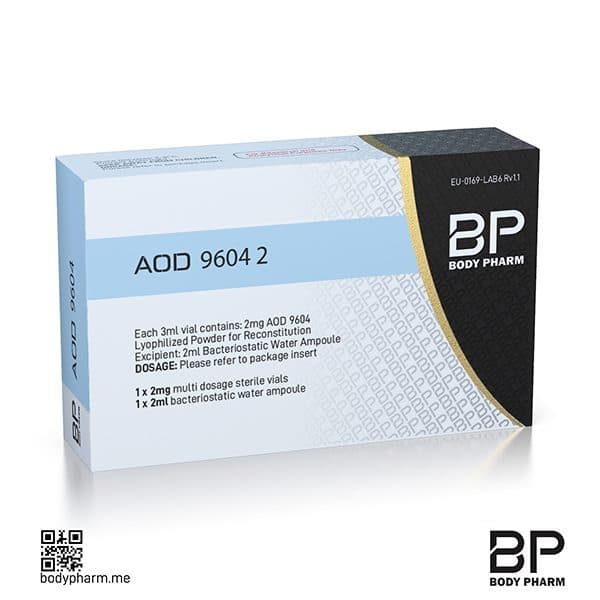
What you get
- 1× vial (product)
- 1× bacteriostatic water (2 ml)
What you need
- Syringe + needle to reconstitute (reconstitution calculator)
- Alcohol swabs
- Needle + syringe to inject
Body Pharm AOD 9604 2 Vial
R350.00
SKU bpaod9604
4.2(5 reviews)BP AOD 9604 2mg is a synthetic human growth hormone fragment (residues 176–191) supplied as a research-grade lyophilised peptide, studied for its role in fat metabolism without raising blood sugar or IGF-1. Sold for research use only.
Who it's for
- ›Adults researching targeted fat-loss support
What it's used for
- ›HGH fragment studied for fat metabolism
- ›Researched for fat loss without affecting blood sugar
General research information, not medical advice.
Please note
Prescription-class compound supplied for research use. You must be 18 or older. Consult a qualified healthcare professional before use, this is not medical advice.
Card · EFT · Bitcoin · Discreet delivery
Complete your kit
The supplies you need to store and use your order — add yours in one tap.
 BEARE Insulin Syringes 10 PackR35.00
- BEARE Insulin Syringes 20 PackR60.00
 Alcohol Swabs 50 PackR25.00
Body Pharm AOD 9604 2mg: Benefits, Dosage & Fat Loss
Body Pharm AOD 9604 2mg is a synthetic 16-amino-acid fragment of human growth hormone (hGH) (residues 176–191), sold in South Africa as a research-grade lyophilised peptide investigated for targeted lipolysis (fat breakdown) without the insulin-like growth factor 1 (IGF-1) rise or appetite suppression associated with glucagon-like peptide-1 (GLP-1) agonists like semaglutide.
What you’ll learn in this article:
- How AOD 9604 is thought to influence fat loss, and why that mechanism differs from GLP-1s and full hGH.
- A practical reconstitution and research-dosing protocol for the Body Pharm 2mg vial.
- The current South African regulatory position, the human safety profile, and where AOD 9604 sits against semaglutide and retatrutide.
Key Takeaways
- Active: AOD 9604, 2mg lyophilised vial, Body Pharm-branded.
- Mechanism: in mice it increases beta-3 adrenergic receptor (β3-AR) expression and reduces body fat, and in human trials it did not raise blood glucose or serum IGF-1.
- Typical research dose: around 300mcg subcutaneous, fasted, is the most common community protocol — not a clinically validated regimen.
- Reconstitution: 1ml bacteriostatic water yields 2000mcg/ml; 2ml yields 1000mcg/ml.
- Human data: company-sponsored trials used oral and intravenous formulations and found AOD 9604 safe and well tolerated, but weight-loss effects were modest and were not confirmed in larger trials; there is no controlled human efficacy data for the subcutaneous research form.
What Is Body Pharm AOD 9604 2mg?
Body Pharm AOD 9604 2mg is a 16-amino-acid synthetic peptide replicating residues 176–191 of the hGH C-terminus, supplied as a lyophilised powder in a single 2mg vial for subcutaneous use after reconstitution. Metabolic Pharmaceuticals (Melbourne) engineered the fragment in the late 1990s to isolate hGH’s lipolytic tail while avoiding the IGF-1 rise, hyperglycaemia, and tissue-growth signalling of the full 191-residue molecule (Heffernan et al., Endocrinology, 2001). The literature also calls the molecule hGH fragment 176–191.
The Body Pharm label is a South African–distributed research peptide brand carrying the standard underground-lab format buyers will recognise from adjacent products like the Body Pharm CJC1295 & Ipamorelin 20 Pen. Practical specs:
- Format: lyophilised white powder, 2mg per vial.
- Reconstitution: 1ml bacteriostatic water yields 2000mcg/ml; 2ml yields 1000mcg/ml.
- Route: subcutaneous injection, insulin syringe.
- Storage pre-mix: room temperature, dry.
- Storage post-mix: refrigerated, used within about 28 days.
- Status: research compound; sits alongside other weight loss injections available in South Africa but in a separate regulatory category from prescription GLP-1s.
A common buyer concern: “Is this the same molecule as the AOD discussed in older Australian trials?” Yes. The Body Pharm vial reproduces the same 176–191 sequence used in the Metabolic Pharmaceuticals studies; the difference is regulatory grade and manufacturer, not chemistry.
How AOD 9604 Works: The Fat-Loss Mechanism
AOD 9604 is a fragment of the lipolytic C-terminus of hGH. In an obese-mouse model it reduced body fat and increased fat oxidation without binding the GH receptor or elevating IGF-1, and it raised the expression of the beta-3 adrenergic receptor (β3-AR), the major lipolytic receptor in fat cells (Heffernan et al., Endocrinology, 2001).
That receptor is central to how the fragment is thought to work. The 2001 study used obese and β3-AR knockout mice: chronic treatment reduced body weight and increased lipolytic sensitivity in wild-type animals, but those effects were absent in the knockouts. Importantly, the authors concluded that the lipolytic action is not mediated directly through the β3-AR — rather, AOD 9604 increases β3-AR expression, which in turn appears to support lipolysis. Glucose tolerance and insulin sensitivity were unaffected (Heffernan et al., 2001).
Practical implications for a buyer comparing AOD 9604 against the full GH cascade or a Body Pharm CJC1295 & Ipamorelin 20 Pen protocol:
- No IGF-1 elevation in human trials, distinguishing the fragment from somatropin and from growth hormone-releasing hormone (GHRH) and growth hormone-releasing peptide (GHRP) secretagogues such as CJC1295 and ipamorelin (Stier et al., 2013).
- No adverse effect on carbohydrate metabolism across the human trial programme (Stier et al., 2013).
- β3-AR-associated lipolysis in adipose tissue, characterised largely in animal models, not systemic anabolism.
- No muscle, bone, or cartilage growth signal, a narrower profile than full hGH and than CJC1295 plus ipamorelin.
A reasonable objection here: “If the human data is this old, why use it at all?” The mechanism is reasonably characterised in animal models; what remains modest and dated is the magnitude of clinical fat loss measured in human trials. Buyers should treat the mechanism as investigational and the human effect size as, at best, moderate.
AOD 9604 Benefits for Weight Management
AOD 9604 is studied for targeted lipolysis without the IGF-1 elevation, hyperglycaemia, or muscle and cartilage hypertrophy associated with full somatropin. The benefit profile is narrow by design. That narrowness is the point for buyers who want fat-metabolism support without the broader endocrine footprint of hGH or a Body Pharm CJC1295 & Ipamorelin 20 Pen stack.
What the evidence base supports:
- Reduction of adipose tissue via a β3-AR-linked lipolytic pathway, demonstrated in obese-mouse studies (Heffernan et al., Endocrinology, 2001).
- No IGF-1 spike and no adverse glucose signal in the human programme, separating the fragment cleanly from hGH and GH secretagogue protocols (Stier et al., 2013).
- Safe and well tolerated in human trials, with adverse events comparable to placebo across the company’s six human studies (Stier et al., 2013).
- Investigated for joint and cartilage indications — osteoarthritis and osteoporosis were among the uses for which it was nominated (unsuccessfully) as a compounding substance to the U.S. FDA — but joint repair is not an approved or established indication.
A common reader objection: “Is this going to match what semaglutide does on the scale?” No. The human weight-loss trials used oral and intravenous formulations and produced only modest effects that were not confirmed in the larger studies, and clinical development was discontinued in the late 2000s. AOD 9604 is best understood as an experimental adjunct to a sustained caloric deficit and resistance training, not a replacement for either, and it sits alongside the broader weight loss injections available in South Africa rather than competing with GLP-1s on magnitude.
AOD 9604 Dosage Instructions (Research Protocol)
Community research protocols place AOD 9604 dosing at roughly 300–600 mcg per day via subcutaneous injection into the abdomen, thigh, or upper arm in a fasted state. There is no clinically validated subcutaneous dose — the human trials used oral milligram doses and intravenous dosing — so the figures below reflect common research-use practice, not a medical recommendation. Most users dose first thing in the morning or pre-workout, on the rationale that elevated insulin promotes storage rather than fat mobilisation.
Body Pharm AOD 9604 2mg reconstitution and dosing at a glance:
- Reconstitution: Add 2 mL bacteriostatic water (0.9% benzyl alcohol) to the 2mg vial. Final concentration: 1000 mcg/mL.
- 300 mcg dose: Draw 0.3 mL (30 units on a U-100 insulin syringe).
- 500 mcg dose: Draw 0.5 mL (50 units).
- 600 mcg dose: Draw 0.6 mL (60 units), or split as 2 × 300 mcg (AM fasted, pre-second meal).
- Frequency: Commonly once daily at 300 mcg; some users split higher amounts across the day. Note that AOD 9604 has a very short plasma half-life in animal studies (roughly 3–4 minutes), and its subcutaneous pharmacokinetics in humans are not well characterised (Moré et al., 2014).
- Cycle: Community protocols run 8–12 weeks on, 4 weeks off, reassessing body composition before re-running.
- Storage: Reconstituted vial refrigerated at 2–8°C, used within about 28 days.
- Site rotation: rotate week to week to avoid lipoatrophy at any single pinch.
A frequent concern: “Will I feel anything from a 300 mcg dose?” Most users report no acute sensation. AOD 9604 does not produce the rush of a stimulant or the satiety shift of a GLP-1; the readout is body composition over weeks, not subjective feedback within hours.
Stack discussions, including pairing with a Body Pharm CJC1295 & Ipamorelin 20 Pen or other weight loss injections available in South Africa, belong in a conversation with a registered practitioner, not a self-prescribed protocol.
AOD 9604 Side Effects and Safety Profile
Across the human trial programme, AOD 9604’s tolerability was described as very good and largely indistinguishable from placebo, with most reported adverse events limited to transient injection-site reactions. The pooled human data showed no measurable IGF-1 elevation and no adverse effect on carbohydrate metabolism (Stier et al., Journal of Endocrinology and Metabolism, 2013).
What the trial database supports, and what shows up in practice:
- Injection-site redness, swelling, or mild bruising, usually resolving within 24 hours. Rotate sites weekly.
- Transient nausea or mild dizziness reported anecdotally in the first few days, typically at the higher end of community dosing.
- Hypoglycaemia risk is low but worth monitoring for diabetic users, fasted-training users, or anyone stacking with insulin-sensitising compounds. Monitor blood glucose for the first week.
- Very short plasma half-life in preclinical studies (approximately 3–4 minutes in animals); human subcutaneous kinetics are not well defined (Moré et al., 2014).
A reasonable user objection: “What about long-term safety?” Long-term human safety data beyond the trial windows remains limited, and no manufacturer-backed clinical trials have been published since development was discontinued in the late 2000s. Athletes in World Anti-Doping Agency (WADA)-tested sport should request a formal ruling from their national anti-doping body before use; “not explicitly listed” is not the same as “permitted.” For stacking context, the Body Pharm CJC1295 & Ipamorelin 20 Pen sits alongside other weight loss injections available in South Africa in the same risk-tier conversation.
AOD 9604 vs Semaglutide vs Retatrutide: Comparison
AOD 9604 occupies a narrower niche than the GLP-1 class. The fragment is thought to drive lipolysis without touching appetite, gastric emptying, or insulin secretion. The choice is less about “which is strongest” and more about which mechanism matches your physiology and tolerance profile.
| Peptide | Mechanism | Primary Use | Injection Frequency | Approx. Cost (ZAR, Beskinny) |
|---|---|---|---|---|
| AOD 9604 2mg | C-terminal hGH fragment 176–191; β3-AR-linked lipolysis without IGF-1 elevation | Investigational fat-loss support, no appetite effect | Daily (research protocols, often 5-on/2-off) | R350/vial |
| Semaglutide | GLP-1 receptor agonist; appetite suppression plus delayed gastric emptying | Significant weight loss via reduced intake | Weekly | See HD Semaglutide 10 Pen |
| Retatrutide | Triple GIP/GLP-1/glucagon agonist; appetite plus energy expenditure | Aggressive fat loss, metabolic restructuring | Weekly | See Body Pharm Retatrutide |
Who picks what
AOD 9604 appeals to users who eat well, train consistently, and want a lipolytic nudge without gastrointestinal side effects or satiety blunting — accepting that its human efficacy is unproven. In contrast, semaglutide and retatrutide suit users whose primary barrier is intake volume, not body recomposition, and both have robust clinical weight-loss data behind them. Tolerance also matters: GLP-1 nausea pushes a meaningful minority of users off semaglutide entirely.
A common objection: “Why not just take the strongest option?” Because the strongest appetite-suppressing option is not the right tool when your problem is not appetite. Mismatched mechanisms produce side effects without proportional benefit.
Stacking in practice
The most common community protocol pairs AOD 9604 with a GH secretagogue rather than a GLP-1, using the Body Pharm CJC1295 & Ipamorelin 20 Pen for the secretagogue arm and AOD 9604 for daytime lipolysis. AOD 9604 plus GLP-1 combinations circulate anecdotally to offset GLP-1 lean-mass loss; however, no controlled trial data supports the combination.
Why Buy Body Pharm AOD 9604 from Beskinny?
Body Pharm AOD 9604 2mg is stocked at Beskinny at R350 per vial, shipped from a South African warehouse with tracked courier delivery to all major metros within 2–4 business days.
- Product spec: 2mg lyophilised AOD 9604 per vial, Body Pharm branded, sealed with batch identifier. Reconstitute with 1–2 mL bacteriostatic water as covered earlier.
- Current stock: see the live count on the product page, which is the source of truth.
- Why Beskinny: a dedicated South African peptide and weight loss injections retailer, not a general supplement reseller. Narrower SKU range, faster turnover, fresher stock.
- Stack buyers: the Body Pharm CJC1295 & Ipamorelin 20 Pen is the most-paired SKU; MOTS-C and Somatropin hGH pens sit in the same category for users building a longer GH-axis protocol.
A frequent concern at this stage: “What if I receive a damaged or short-dated vial?” Beskinny’s product page lists batch identifiers and replaces compromised stock on receipt evidence; raise the issue before reconstituting.
Order Body Pharm AOD 9604 2mg now at R350/vial. Check live stock and add to cart on the Beskinny product page.
Frequently Asked Questions
Short answers to the questions buyers ask before checkout.
How long until results show with AOD 9604?
Community protocols run 8–12 weeks. Human trials of AOD 9604 (using oral and intravenous formulations) found it safe and well tolerated but produced only modest weight-loss effects that were not confirmed in larger studies, and no peer-reviewed trial has established a standardised timeline for the injectable research form. Results track diet adherence and training volume more than the peptide itself.
Can I stack AOD 9604 with other peptides?
Anecdotally, yes. The most commonly paired stack is a GH secretagogue like the Body Pharm CJC1295 & Ipamorelin 20 Pen, run alongside AOD 9604 for combined pulsatile GH release and direct lipolytic activity. No controlled human trial has tested the combination; protocols are community-derived.
Does AOD 9604 need refrigeration?
The lyophilised peptide stays stable at room temperature for shipping and short-term storage. Once reconstituted with bacteriostatic water, refrigerate the solution at 2–8°C and use within about 28 days, the usual working limit for benzyl-alcohol-preserved peptide solutions.
Is AOD 9604 detectable in drug tests?
AOD 9604 is not explicitly named on the current WADA Prohibited List. The compound may still fall under S2 (peptide hormones) or S0 (non-approved substances) catch-all clauses; competing athletes should obtain a written ruling from their national anti-doping body.
What is the half-life of AOD 9604?
In preclinical studies the plasma half-life is very short — approximately 3–4 minutes in animals (Moré et al., 2014). Its pharmacokinetics after subcutaneous injection in humans have not been well characterised, so day-to-day dosing schedules are community-derived rather than PK-validated.