
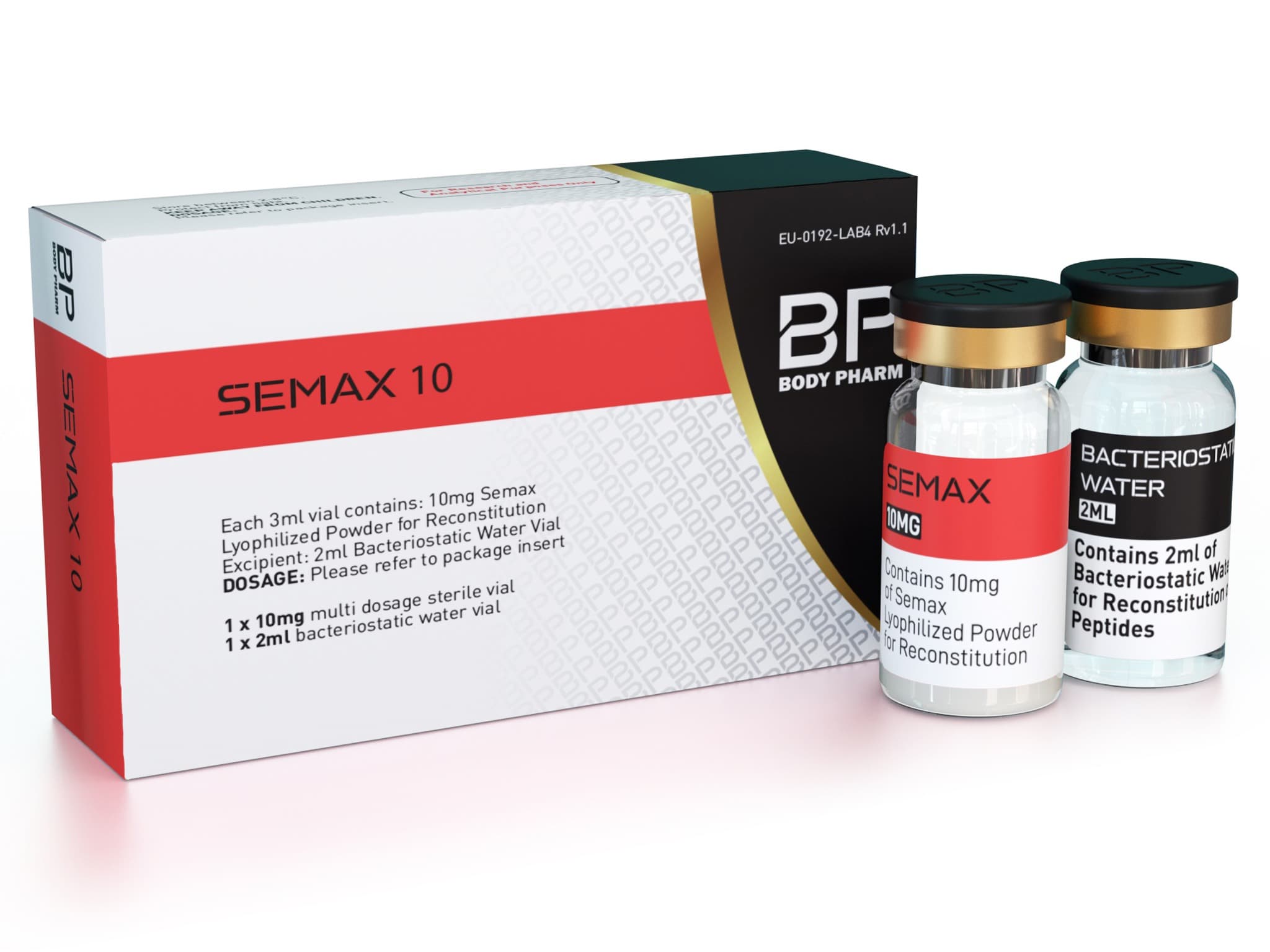
What you get
- 1× vial (product)
- 1× bacteriostatic water (2 ml)
What you need
- Syringe + needle to reconstitute (reconstitution calculator)
- Alcohol swabs
- Needle + syringe to inject
Body Pharm Semax 10 Vial
R550.00
SKU bpsemax10
5.0(4 reviews)Body Pharm Semax 10 Vial, supplied lyophilised and third-party assayed for purity and identity. Cold-chain handled and shipped discreetly from South Africa. Certificate of analysis available on request.
Who it's for
- ›Those researching focus and cognitive support
What it's used for
- ›Nootropic peptide studied for focus, memory and learning
- ›Researched for neuroprotection
General research information, not medical advice.
Card · EFT · Bitcoin · Discreet delivery
Complete your kit
The supplies you need to store and use your order — add yours in one tap.
 BEARE Insulin Syringes 10 PackR35.00
- BEARE Insulin Syringes 20 PackR60.00
 Alcohol Swabs 50 PackR25.00
Body Pharm Semax 10mg is a lyophilised heptapeptide (Ac-Met-Glu-His-Phe-Pro-Gly-Pro-NH2, C39H54N10O10S, reference mass ~855 g/mol per the PubChem entry for N-acetyl semax amidate) supplied in South Africa as a research-grade nootropic compound for laboratory use only.
Key Takeaways
- Body Pharm Semax 10mg meets the ≥98% HPLC purity level that the research-peptide sector treats as its working benchmark; verify this on the batch-matched Certificate of Analysis before use
- Cold-chain handling from import to your door is prudent because lyophilised peptides degrade faster above 8 °C or in humid conditions
- Semax is supplied here strictly for in-vitro research
- The human evidence base for Semax is anchored in Russian clinical work from the 1990s onward, with limited large-scale Western replication
- Reconstitute with bacteriostatic water using the Peptide Reconstitution Calculator to ensure accurate dose volumes
What Is Body Pharm Semax 10mg?
Body Pharm Semax 10mg is a lyophilised vial of synthetic heptapeptide Ac-Met-Glu-His-Phe-Pro-Gly-Pro-NH2, a structural analogue of the ACTH(4-10) fragment. It is supplied by Body Pharm for in-vitro research into cognitive performance, neuroprotection, attention, and memory pathways. The 10 mg format is the standard research presentation used across the published Semax literature, matching the dose volumes described in reported protocols.
The molecule originated from Russian Academy of Sciences work in the late 1980s and has been studied in Russian clinical and preclinical settings since the 1990s. Later reviews position Semax within the synthetic nootropic category alongside racetams and modafinil. Importantly, the human evidence base is drawn largely from that Russian literature, with limited large-scale Western replication, so researchers should treat cognitive and clinical findings as preliminary rather than established.
Format and presentation
Each vial contains 10 mg of Ac-Semax as a white-to-off-white lyophilised powder. For the N-acetylated, C-terminal amidated form supplied here, the reference formula is C39H54N10O10S with a molecular weight near 855 g/mol. Reconstitution with bacteriostatic or sterile water is required before any laboratory work. The Peptide Reconstitution Calculator handles the concentration maths for common syringe volumes, saving time and reducing calculation error.
Research-use-only status
Body Pharm supplies the 10 mg vial strictly for laboratory research. Researchers comparing the cognitive-peptide class often run Semax alongside Body Pharm Selank 10mg, the closest anxiolytic-nootropic analogue from the same manufacturer, because the two peptides target different research endpoints.
Semax Mechanism: How It Works in Research
Semax is a synthetic heptapeptide analogue of ACTH(4-10), modified by adding a Pro-Gly-Pro tail to the C-terminus. In the research literature this modification is described as improving resistance to enzymatic cleavage relative to the native fragment; the Pro-Gly-Pro moiety is itself an active metabolite that activates neurotrophin and receptor gene transcription after experimental cerebral ischemia. That structural change was intended to convert a short, rapidly degraded melanocortin fragment into a more research-stable nootropic candidate suitable for repeated dosing in animal models.
The proposed mechanisms reported across the preclinical literature cluster around three pathways:
- Semax upregulates brain-derived neurotrophic factor (BDNF) and its TrkB receptor, an effect characterised in rat hippocampal tissue
- It modulates dopaminergic and serotonergic neurotransmission in rodent brain studies
- It shows neuroprotective activity in experimental cerebral-ischemia models
The third pathway underpinned the original Russian stroke and transient ischaemic attack (TIA) research programme. Modern narrative reviews still lean heavily on that 1990s-onward dataset, which indicates that large, contemporary Western replications remain sparse and the evidence base has not substantially expanded in recent decades.
Reviews commonly group Semax with piracetam and modafinil in the synthetic nootropic category. That is structural shorthand, not equivalence. Piracetam is a small-molecule racetam acting on AMPA-receptor modulation. Modafinil is a wakefulness-promoting agent with dopaminergic activity. Semax is a peptide typically delivered intranasally in research protocols, a fundamentally different delivery mechanism, and the comparison should be read as categorical rather than pharmacologically equivalent.
None of the above constitutes a validated human indication. The findings summarised here are research observations, not therapeutic claims. Researchers benchmarking the cognitive-peptide class against an anxiolytic-leaning analogue often run parallel preparations of Body Pharm Selank 10mg, reconstituting both with the same diluent volume calculated via the Peptide Reconstitution Calculator to keep concentrations comparable.
Research Applications Studied in the Literature
Semax has been studied as a heptapeptide with reported activity across cognitive, neuroprotective, and stress-related models. The strongest historical dataset comes from Russian stroke and TIA work from the 1990s onward, and modern reviews still rely on that evidence base.
Documented research areas in the literature include:
- Attention and cognitive performance. Early Russian clinical and preclinical work examined attention and short-term memory, and the peptide's cognitive framing is reflected in the same rodent study that links its cognitive effects to hippocampal BDNF and TrkB expression. Robust independent human replication remains limited.
- Memory consolidation and learning under stress. Preclinical models describe BDNF upregulation in hippocampal tissue as the proposed mechanism. BDNF is a well-established marker of neuroplasticity, which is why this pathway attracts research interest.
- Neuroprotection in ischaemic models. Animal studies report neuroprotective and antiamnesic effects during experimental ischemic infarction of the cerebral cortex, which underpinned the original stroke programme.
- Acute ischaemic stroke and TIA recovery. Russian clinical work reports stroke-severity benefit at different stages of ischaemic stroke, but no large Western replication was located in 2020-2026 searches. That gap is a significant limitation for clinical translation.
- Optic nerve and retinal research. Explored as an area of interest in the Russian neuroprotection literature, though the mechanism for optic-nerve effects remains unclear.
- Mood, anxiety, and stress resilience. Investigated as a comparator to anxiolytic-leaning analogues, which is why researchers often run parallel preparations of Body Pharm Selank 10mg reconstituted with matched diluent volumes from the Peptide Reconstitution Calculator.
Every item above reflects published research observations, not clinical recommendations. The Alzheimer's Drug Discovery Foundation's Cognitive Vitality profile flagged that human safety evidence for Semax remains limited, a critical constraint on any extrapolation to human use.
How to Evaluate Semax Quality: COA Explained
A valid Certificate of Analysis (COA) for research-grade Semax must confirm five things:
- HPLC purity (≥98% is the working threshold used across the research-peptide sector)
- Mass-spectrometry identity matching the theoretical molecular weight
- A traceable batch number
- The name of the independent testing laboratory
- The test date
Without all five, the document is marketing collateral, not verification.
What each COA field actually proves
Purity by HPLC. The percentage tells you what fraction of the lyophilised mass is target peptide versus truncations, deletions, and synthesis by-products. ≥98% by HPLC is the de facto research benchmark for Semax 10mg preparations. A purity figure with no method stated ("99% pure") is a red flag, because it lacks the analytical rigour that HPLC provides.
Identity by mass spectrometry. For the standard N-acetylated, C-terminal amidated Semax (Ac-Met-Glu-His-Phe-Pro-Gly-Pro-NH2), the reference formula is C39H54N10O10S with a molecular weight near 855 g/mol. Liquid chromatography-mass spectrometry (LC-MS) on the assayed batch should return that mass within instrument tolerance. A COA without an MS trace or theoretical-vs-observed mass comparison cannot confirm you have Semax rather than a similar-looking heptapeptide. This field is non-negotiable.
Batch number, lab name, test date. The batch number on the COA must match the number printed on the vial label. The lab name must be a real, independent facility, ideally ISO/IEC 17025-accredited. The test date should be recent enough that the assayed lot is the lot in the box. "Tested in-house" is not third-party verification and does not meet research-grade standards.
BeSkinny Quality Verification Methodology (reviewed February 2026)
We sample one vial per inbound batch (typical lot size 200-500 vials). We confirm the vial-label batch matches the COA batch field and spot-check the third-party laboratory's accreditation status before stock is released for sale. Cold-chain handling is maintained from import to dispatch because lyophilised peptides degrade when exposed to ambient humidity and heat cycles. Generic peptide-handling norms specify −20 °C unreconstituted storage and 2-8 °C post-reconstitution use within roughly 30 days.
Before reconstituting, confirm the batch on your vial matches the COA. Then work out your dose volume with the Peptide Reconstitution Calculator. Researchers running parallel preparations can apply the same COA checks to Body Pharm Selank 10mg.
Why Cold-Chain Handling Matters for Lyophilised Peptides
Lyophilised Semax is stable only within a narrow temperature and humidity window. Break that window and the peptide bonds that define research-grade purity start to degrade. Lyophilisation (freeze-drying) removes water under vacuum, leaving a dry amorphous powder that resists hydrolysis far better than a peptide in solution. That is why suppliers ship Semax as a white lyophilised powder in a sealed glass vial rather than as a ready-to-use liquid.
The dry powder is more forgiving than reconstituted material, but it is not inert. Heat exposure accelerates oxidation of the methionine residue in the Met-Glu-His-Phe-Pro-Gly-Pro backbone. Humidity ingress restarts hydrolysis. Repeated freeze-thaw cycling causes micro-condensation inside the vial. Each of these mechanisms chips away at HPLC purity. A vial that started at ≥98% can fall below the research-grade threshold after a single uncontrolled transit leg. South African summer transit conditions, where road-courier vehicles can reach interior temperatures above 40 °C in Gauteng and the Western Cape, make insulated handling sensible.
Storage guidance based on comparable 10 mg Semax research products:
- −20 °C for unreconstituted long-term storage
- 2-8 °C refrigerated after reconstitution, with use inside roughly 30 days
- Short-term refrigeration of the sealed lyophilised vial at 2-8 °C is acceptable while you prepare to use it
How BeSkinny handles the cold chain
We hold Body Pharm Semax 10mg at refrigerated temperatures from import through to dispatch. We ship in insulated packaging with gel packs sized to the courier's published transit window and include a batch-matched COA reference in every order. Once your vial arrives, move it to a refrigerator (2-8 °C) immediately if you plan to reconstitute within days, or to a −20 °C freezer for a longer hold. When you are ready to prepare your working solution, the Peptide Reconstitution Calculator will give you the exact bacteriostatic water volume for your target concentration. Researchers stocking adjacent nootropic peptides can apply the same handling protocol to Body Pharm Selank 10mg.
Body Pharm Semax 10mg vs Research-Grade Specifications
Body Pharm Semax 10mg meets the ≥98% HPLC purity threshold that the research-peptide sector treats as its working benchmark, and its 10 mg lyophilised vial format matches the standard cited across the Semax literature. That benchmark is a sector convention rather than a clinical protocol number. Published Semax human trials describe the peptide as "highly purified" without printing an explicit HPLC figure, so the ≥98% line is an evidence-informed convention that aligns with purity standards used in modern peptide research generally.
Identity confirmation uses the N-acetylated, C-terminal amidated sequence Ac-Met-Glu-His-Phe-Pro-Gly-Pro-NH2, formula C39H54N10O10S, reference mass near 855 g/mol for LC-MS. Body Pharm's batch-matched COA, supplied with every BeSkinny order, reports HPLC purity and mass confirmation against this reference value.
Vial format matters for dose-planning consistency. The 10 mg lyophilised vial is the dominant research format in the Semax literature. Some presentations offer 5 mg or 30 mg vials, but the 10 mg vial is the comparator most published handling protocols assume, which is why the Peptide Reconstitution Calculator defaults align to it. Researchers cross-referencing with Body Pharm Selank 10mg will find the same 10 mg lyophilised configuration, simplifying parallel handling.
| Specification | Research-Grade Benchmark | Body Pharm Semax 10mg |
|---|---|---|
| HPLC purity | ≥98% | ≥98% per batch COA |
| Sequence | Ac-Met-Glu-His-Phe-Pro-Gly-Pro-NH2 | Confirmed by LC-MS |
| Reference mass | ~855 g/mol (C39H54N10O10S) | Confirmed by LC-MS |
| Format | 10 mg lyophilised vial | 10 mg lyophilised vial |
| Storage (unreconstituted) | −20 °C | −20 °C |
| Storage (post-reconstitution) | 2-8 °C, use within ~30 days | 2-8 °C, use within ~30 days |
Reconstitution and Research Protocol Formats in 2026
Body Pharm Semax 10mg ships as a lyophilised powder and must be reconstituted with bacteriostatic or sterile water before any research use. Volume selection determines the concentration per measured unit, and that calculation should be set against your protocol's intended research dose. The Peptide Reconstitution Calculator handles this conversion for the 10 mg vial directly. The same workflow applies to parallel handling of Body Pharm Selank 10mg.
Intranasal administration is the delivery route that dominates the published Semax literature, including the Russian stroke and cognitive-impairment studies. This route is favoured because it may bypass the blood-brain-barrier limitations that affect systemic peptide delivery. Specific volumes, concentrations, and frequencies belong to the source publications and to each researcher's own approved protocol, not to a product page. All dosing references in the cited literature are research-context only and are not clinical guidance.
Once reconstituted, store the solution at 2-8 °C and use within 30 days to maintain peptide integrity. Avoid repeated temperature cycling, and keep the vial shielded from light between draws, because light exposure can accelerate oxidation of the methionine residue.
Nothing on this page constitutes medical advice, a therapeutic claim, or a recommendation for human administration.
How Body Pharm Semax 10mg Compares to Related Peptides
Semax sits in the cognitive and neuroprotective research category, distinct from the recovery, metabolic, and growth-hormone-axis peptides that make up most of the broader Body Pharm range. The reference Semax sequence Ac-Met-Glu-His-Phe-Pro-Gly-Pro-NH2 is studied primarily for cognition, attention, and ischaemic neuroprotection in Russian clinical and preclinical literature. That is a different research question from the angiogenic and tissue-repair work around BPC-157 and TB-500, or the growth-hormone-secretagogue pharmacology of Ipamorelin.
The closest sibling is Body Pharm Selank 10mg, a heptapeptide derived from tuftsin and researched mainly for anxiolytic and immunomodulatory effects in anxiety-asthenic disorders. Researchers running parallel cognitive protocols sometimes use Selank and Semax together precisely because their primary investigated mechanisms differ, allowing direct comparison of mechanism-specific effects.
Compared with the broader nootropic literature, Semax is most often benchmarked against piracetam and modafinil. Piracetam represents the racetam class with a longer Western evidence base. Modafinil sits in the regulated wakefulness-promoter category in South Africa. Semax is a peptide studied predominantly in Russian neuroprotection research, with a much narrower modern Western trial footprint. That difference in evidence geography matters when researchers are evaluating the strength of the literature.
For reconstitution maths across any of these, use the Peptide Reconstitution Calculator.
Buying Body Pharm Semax 10mg in South Africa
Body Pharm Semax 10mg is available to order directly from BeSkinny, with the current price listed on the product page rather than hard-coded here. Peptide pricing shifts frequently because raw-material costs and import duties fluctuate, so it is worth checking the live BeSkinny listing before you commit.
Payment is accepted via card and EFT, and orders ship discreetly with cold-chain handling appropriate for lyophilised peptide vials. A batch-specific COA is available on request, and orders are backed by a satisfaction guarantee. For more on sourcing standards and dispatch logistics, see the About BeSkinny page, and use the Peptide Reconstitution Calculator to plan your bacteriostatic water volumes before the vial arrives.
Frequently Asked Questions
What does a COA for Semax include?
A valid Semax Certificate of Analysis covers five core fields: batch number, HPLC purity (research-grade benchmark is ≥98%), mass-spectrometry identity confirmation against the reference formula C39H54N10O10S (mass near 855 g/mol) for Ac-Met-Glu-His-Phe-Pro-Gly-Pro-NH2, residual solvents, and endotoxin/water content. Request the batch-specific COA from BeSkinny before opening the vial.
How should I store Semax after delivery?
Store lyophilised Semax vials at −20 °C until reconstitution. Once reconstituted with bacteriostatic water, keep the solution at 2-8 °C and use within roughly 30 days. Avoid repeated freeze-thaw cycles, which degrade peptide bonds. This storage protocol is consistent with published research-grade handling guidance for 10 mg Semax preparations.
What is the difference between Semax and Selank?
Semax (Ac-Met-Glu-His-Phe-Pro-Gly-Pro-NH2) is an ACTH(4-10) analogue studied primarily for cognitive and neuroprotective endpoints. Selank is a tuftsin analogue researched for anxiolytic-type endpoints. Both are heptapeptides from the same Russian research lineage and are often compared in parallel protocols because their mechanisms differ. See Body Pharm Selank 10mg for the molecule-by-molecule comparison.
How does Semax compare to piracetam and modafinil?
All three appear in modern nootropic reviews, but the mechanisms differ substantially. Piracetam is a small-molecule racetam modulating AMPA receptors. Modafinil is a wakefulness-promoting agent with dopaminergic activity. Semax is a heptapeptide studied predominantly in Russian neuroprotection literature and typically delivered intranasally in research protocols. Each compound suits different research questions.
How do I reconstitute Semax for research use?
Reconstitute the 10 mg lyophilised vial by slowly injecting bacteriostatic water down the inside wall of the vial, then swirl gently until the powder dissolves. Do not shake, because shaking introduces air bubbles that can oxidise the peptide. The exact volume depends on your target concentration per measured dose. Use the Peptide Reconstitution Calculator to work out millilitres of diluent before the vial arrives.
Next Steps
Order Body Pharm Semax 10mg on the BeSkinny product page. Request the batch-matched COA before opening the vial, and use the Peptide Reconstitution Calculator to set your diluent volume. If you are scoping a parallel cognitive research protocol, add Body Pharm Selank 10mg to the same order to keep handling consistent.
References
- N-acetyl semax amidate, CID 172638603 (C39H54N10O10S). PubChem, National Library of Medicine.
- Semax, an analog of ACTH(4-10) with cognitive effects, regulates BDNF and trkB expression in the rat hippocampus. Brain Research, 2006.
- Effects of Semax on dopaminergic and serotoninergic systems of the brain. Doklady Biological Sciences, 2004.
- Neuroprotective and antiamnesic effects of Semax during experimental ischemic infarction of the cerebral cortex. Bulletin of Experimental Biology and Medicine, 2006.
- Semax and Pro-Gly-Pro activate the transcription of neurotrophins and their receptor genes after cerebral ischemia. Cellular and Molecular Neurobiology, 2010.
- The efficacy of semax in the treatment of patients at different stages of ischemic stroke. Zhurnal Nevrologii i Psikhiatrii imeni S.S. Korsakova, 2018.
- Immunomodulatory effects of selank in patients with anxiety-asthenic disorders. Zhurnal Nevrologii i Psikhiatrii imeni S.S. Korsakova, 2008.
- Semax. Cognitive Vitality, Alzheimer's Drug Discovery Foundation.