
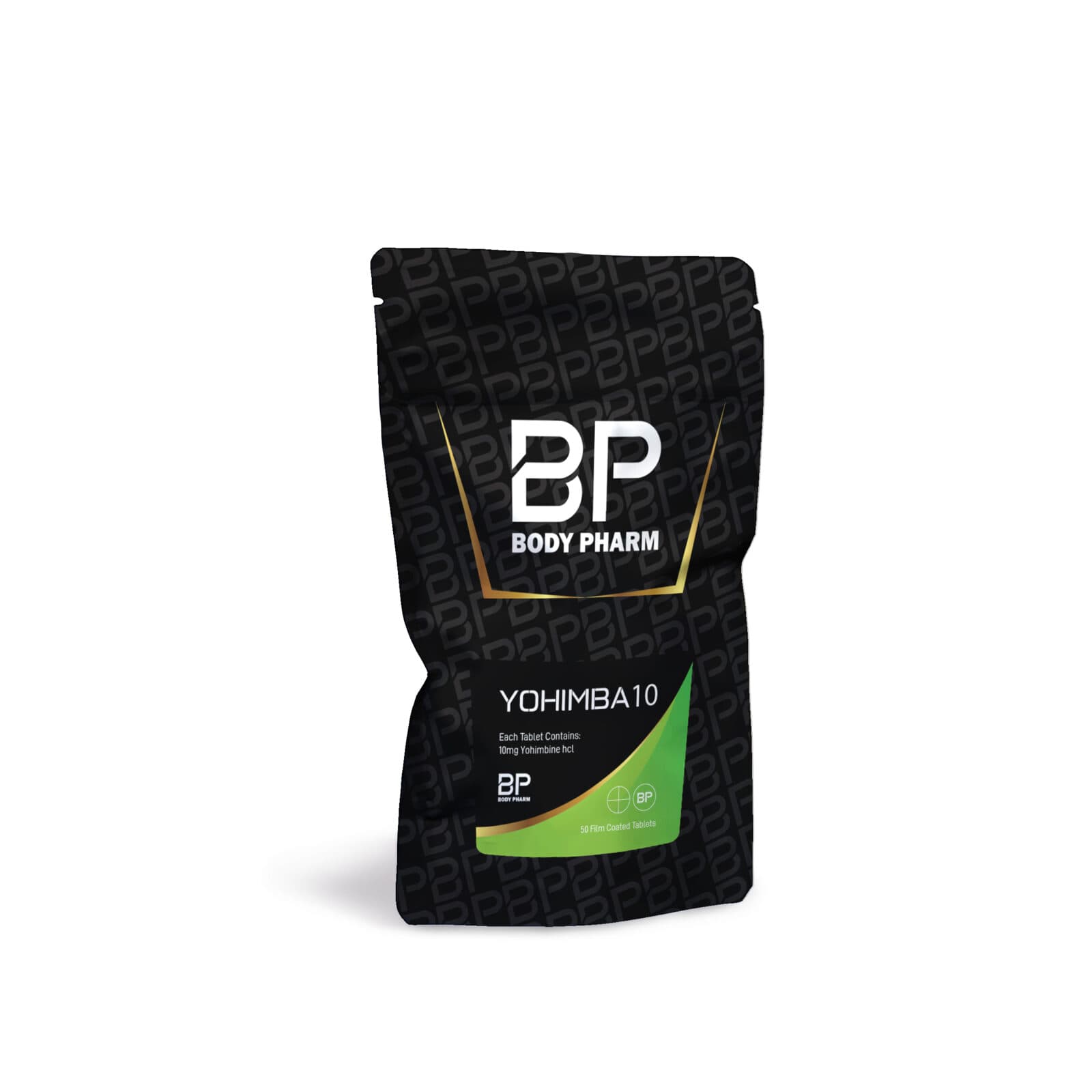
BP Yohimba 10
R220.00
SKU bpyoh10
4.0(4 reviews)BP Yohimba 10 (Yohimbine HCl 10mg) is an oral fat-loss tablet from the Body Pharm range. Yohimbine is an alkaloid from the bark of the yohimbe tree (Pausinystalia johimbe) that acts as an alpha-2 adrenergic antagonist, studied in small human trials for stubborn-fat loss and for erectile function. It is sold for research purposes only.
Who it's for
- ›Adults researching stubborn-fat loss
What it's used for
- ›Alpha-2 antagonist studied for fat loss
- ›Researched for energy and libido
General research information, not medical advice.
Please note
Prescription-class compound supplied for research use. You must be 18 or older. Consult a qualified healthcare professional before use, this is not medical advice.
Card · EFT · Bitcoin · Discreet delivery
BP Yohimba 10 delivers a standardised 10 mg dose of yohimbine hydrochloride per capsule. That matters because raw yohimbe bark alkaloid content shifts between batches and suppliers, sometimes considerably.
| At a glance | Detail |
|---|---|
| Product | BP Yohimba 10 |
| Active ingredient | Yohimbine HCl |
| Dose per capsule | 10 mg |
| Supplier (SA) | BeSkinny |
| Price indication | See the live product page; confirm at checkout |
What This Review Covers
This article covers three things: how BP Yohimba 10's standardised yohimbine HCl formulation differs from raw bark extract and why that affects dosing accuracy; what the human trial evidence actually says about yohimbine's effectiveness for fat loss; and the safety profile and practical decision framework for buying in South Africa.
What Is BP Yohimba 10 and How Does It Work?
BP Yohimba 10 is a standardised yohimbine hydrochloride supplement delivering 10 mg of purified alkaloid per capsule, extracted and isolated from the bark of Pausinystalia yohimbe, a West African tree whose bark has been used in traditional contexts for centuries.
The Active Ingredient: Yohimbine HCl vs. Bark Extract
Yohimbine is a naturally occurring indole alkaloid found in Pausinystalia yohimbe bark. The hydrochloride salt form, yohimbine HCl, is a chemically isolated, water-soluble compound with a defined molecular weight, which is why it can be dosed precisely at 10 mg per capsule. Raw bark extract contains yohimbine alongside dozens of other alkaloids in proportions that shift between harvests, suppliers, and processing batches. No verified 2024–2026 analytical study in the available sources quantifies that variation with a fixed percentage range, so any specific number here would be speculative. The practical consequence is straightforward: a capsule labelled "10 mg yohimbine HCl" tells you what you are taking; a capsule labelled "yohimbe bark extract 500 mg" does not.
| Feature | Yohimbine HCl | Raw Yohimbe Bark Extract |
|---|---|---|
| Alkaloid content | Defined (e.g., 10 mg per capsule) | Variable; batch-dependent |
| Dosing precision | High | Low |
| Other alkaloids present | Minimal | Multiple, including corynanthine |
| Standardisation | Yes | Rarely verified |
The Alpha-2 Antagonist Mechanism
Yohimbine HCl is a selective alpha-2 adrenergic receptor antagonist. Alpha-2 receptors act as a brake on fat-cell lipolysis: when activated, they suppress the release of stored fatty acids. Yohimbine blocks these receptors, releasing that brake. Alpha-2 receptors are found in higher density in so-called stubborn fat depots, the lower abdomen, hips, and thighs, which is the mechanistic basis for targeted fat-loss claims, though human trial evidence confirming meaningful spot-reduction remains limited.
By blocking alpha-2 receptors, yohimbine also stimulates the sympathetic nervous system, triggering the release of catecholamines (adrenaline and noradrenaline). That catecholamine surge can raise heart rate and blood pressure, which is why cardiovascular side effects are the primary safety concern with this compound.
The 10 mg dose in BP Yohimba 10 sits at the lower end of the range used in research contexts, relevant for first-time users assessing tolerance, though no 2023–2026 peer-reviewed human trial in the available sources confirms an optimal dose for fat loss in fasted versus fed states. If you are building a broader protocol, the Advanced Lean Stack contextualises where yohimbine HCl fits alongside complementary compounds. Users weighing a different fat-loss mechanism entirely may find the Semaglutide in South Africa: 2026 Buyer's Guide a useful reference point for comparison.
Yohimbine HCl vs. Yohimbe Bark Extract: Which Is More Effective?
Yohimbine HCl is the more reliable choice for fat-loss supplementation because it delivers a known, standardised dose of the active alkaloid. Raw yohimbe bark extract contains variable alkaloid concentrations that make accurate dosing difficult.
| Factor | Yohimbine HCl | Raw Yohimbe Bark Extract |
|---|---|---|
| Active alkaloid content | Standardised (e.g., exactly 10 mg per unit) | Typically 2–3% yohimbine by weight |
| Dose accuracy | Precise | Approximate, varies by batch |
| Batch-to-batch consistency | High (purified salt form) | Low, alkaloid % shifts between harvests |
| Other alkaloids present | Minimal | Yes, corynanthine, rauwolscine, others |
| Shelf stability | Improved by HCl salt form | Shorter; degrades with heat and moisture |
| Typical capsule example | 10 mg yohimbine HCl = 10 mg delivered | 500 mg bark capsule ≈ 10–15 mg yohimbine |
Why the Salt Form Matters
The hydrochloride salt binds the yohimbine alkaloid into a more chemically stable structure. A product that degrades on a warehouse shelf before it reaches you delivers less than its label states. Shelf-life figures for yohimbine HCl versus raw bark are formulation- and packaging-specific, so the only reliable reference point is the expiry date and storage conditions on a product's Certificate of Analysis rather than a generic industry number.
Raw bark extract also contains co-occurring alkaloids, rauwolscine and corynanthine among them, whose combined cardiovascular effects are not well characterised in human trials. That unpredictability is a safety consideration, not just a potency one.
Dose Accuracy in Practice
A 500 mg raw bark capsule at 2–3% yohimbine content delivers roughly 10–15 mg of yohimbine, but that range assumes the batch tested at the labelled percentage. BP Yohimba 10 states 10 mg yohimbine HCl per unit, which removes that variable entirely. For a compound where the therapeutic and adverse-effect windows sit close together, knowing exactly what you are taking is not a minor convenience.
Cost-per-milligram comparisons between HCl products and bark-extract products are complicated by this variability: a cheaper bark capsule that delivers 8 mg instead of 12 mg is not the bargain it appears. Verified live pricing for South African competitors was not available at time of writing, so calculate any direct rand-per-milligram comparison against current retail prices at point of purchase.
If you are considering yohimbine HCl as part of a broader protocol, the Advanced Lean Stack shows how it sits alongside complementary compounds. Those comparing a different fat-loss mechanism entirely will find the Semaglutide in South Africa: 2026 Buyer's Guide a useful reference for how GLP-1 agonists approach the same problem from a different angle.
Does Yohimbine HCl Actually Work for Fat Loss? What Does the Research Say?
The honest answer: the mechanism is plausible, but clinical proof in humans remains limited. The National Centre for Complementary and Integrative Health (NCCIH) states there is insufficient high-quality clinical evidence to confirm yohimbe's effectiveness for weight loss or athletic performance in humans. Most supporting trials are small, short in duration, and were conducted before 2015.
What the Mechanism Predicts vs. What Trials Confirm
Yohimbine is a selective alpha-2 adrenergic receptor antagonist. By blocking alpha-2 receptors (which normally suppress noradrenaline release and inhibit lipolysis), it theoretically allows fat cells to release stored fatty acids more readily. The logic is sound at a receptor level. Human trial data confirming meaningful fat loss at practical doses is a different matter.
The widely repeated protocol of taking yohimbine in a fasted state before cardio is mechanistically grounded: elevated insulin activates alpha-2 receptors, which would blunt yohimbine's effect. That reasoning is plausible, but dedicated human trials testing fasted versus fed administration are sparse and have not been replicated at scale.
Adverse Events Are Not Theoretical
The FDA has issued warnings about yohimbe-containing supplements based on reported serious adverse events, including heart attacks, seizures, and death. Yohimbine is not FDA-approved as a drug for weight loss. Drugs.com (updated June 2025) lists body-fat reduction among yohimbine's primary studied uses alongside sexual dysfunction and xerostomia, but studied does not mean proven effective.
For those weighing yohimbine against a pharmacologically distinct approach, the Semaglutide in South Africa: 2026 Buyer's Guide covers how GLP-1 agonists address fat loss through an entirely different mechanism, with a substantially larger human trial base behind them.
BP Yohimba 10 Dosing: How Much, When, and How to Use It Safely
Each BP Yohimba 10 tablet delivers 10 mg of yohimbine HCl, sitting in the middle of the 5–20 mg per day range examined in clinical literature (Drugs.com, June 2025). That single-tablet dose is a practical starting point, not a universal prescription.
Timing and Administration
The commonly cited protocol is one 10 mg tablet taken approximately 30 minutes before fasted cardio. The rationale is mechanistic: lower circulating insulin means alpha-2 receptors are less activated, so yohimbine's antagonism is less likely to be blunted. That logic is sound, but fasted timing is not a hard requirement backed by replicated human trials. If fasted training causes dizziness or nausea, taking the tablet with a small, low-carbohydrate meal is a reasonable adjustment.
Contraindications and Drug Interactions
Yohimbine raises both heart rate and blood pressure (WebMD, June 2025), which makes the following contraindications non-negotiable:
- Diagnosed anxiety disorders or panic disorder
- Any cardiovascular condition, including hypertension, arrhythmia, or a history of heart attack
- Kidney or liver disease
- Current use of monoamine oxidase inhibitors (MAOIs), antidepressants (particularly selective serotonin reuptake inhibitors (SSRIs) and serotonin-noradrenaline reuptake inhibitors (SNRIs)), stimulants, or antihypertensive medications
Combining yohimbine with MAOIs carries a serious risk of hypertensive crisis. Stacking it with other stimulants compounds cardiovascular strain in ways that are difficult to predict individually.
Consult a Healthcare Professional First
Always consult a GP or pharmacist before using yohimbine, especially if you have any pre-existing condition. Anyone with a pre-existing condition listed above should treat that conversation as mandatory rather than optional.
For buyers considering yohimbine as part of a broader protocol, the Advanced Lean Stack outlines how BP Yohimba 10 fits alongside complementary compounds. Those who want a fat-loss approach with a larger human trial base behind it can compare yohimbine's mechanism against GLP-1 agonists in the Semaglutide in South Africa: 2026 Buyer's Guide.
Side Effects and Safety: What You Need to Know Before Buying
Yohimbine's sympathomimetic action means its side-effect profile is real and dose-dependent. This is not a compound to trial casually.
Common Side Effects
Most users encounter at least one of the following, particularly during the first week or when the dose is too high:
- Elevated heart rate and palpitations
- Raised blood pressure
- Anxiety, restlessness, or panic-like episodes
- Tremor or shakiness
- Insomnia, especially when dosed after midday
- Nausea or gastrointestinal discomfort
These effects are direct consequences of alpha-2 adrenoceptor blockade and the resulting surge in noradrenaline. They tend to be worse in a fasted state, which is precisely when many users take yohimbine for fat-loss purposes.
Serious Adverse Events
The FDA has received reports of serious adverse events linked to yohimbe-containing supplements, including heart attacks, seizures, and deaths. Buyers should check the FDA's current adverse-event database directly before purchase. The NCCIH's evidence summary on yohimbine similarly flags these risks.
BP Yohimba 10 in South Africa: Pricing and How to Buy
BP Yohimba 10 is supplied for research use only; see the product page for the current price. Buyers must be 18 or older and are advised to consult a qualified healthcare professional before use.
Third-Party Testing and Certificate of Analysis
BeSkinny supplies BP Yohimba 10 with a Certificate of Analysis (COA) available on request. The COA documents the stated 10 mg yohimbine HCl content per unit. Specific testing standards, including any ISO 17025 accreditation, microbial panel, or heavy-metals panel, should be confirmed directly with BeSkinny at the time of order, as these details are not independently verifiable from public sources at the time of writing.
Cold-Chain Shipping
BP Yohimba 10 is shipped under cold-chain conditions to preserve alkaloid stability during transit. Shelf life is formulation- and packaging-specific; confirm the labelled expiry date on receipt and store as directed.
Pricing and Purchase Details
| Detail | Specification |
|---|---|
| Price per unit | See the live product page |
| Payment methods | Card, EFT |
| Delivery | Discreet packaging |
| Satisfaction guarantee | Yes |
| Age requirement | 18+ |
| Supplied as | Research use only |
For buyers who want to contextualise BP Yohimba 10 within a broader protocol, the Advanced Lean Stack shows how it fits alongside complementary compounds. Those weighing yohimbine against a mechanism with a larger human trial base can review the Semaglutide in South Africa: 2026 Buyer's Guide.
What Is a Certificate of Analysis and Why Does BP Yohimba 10 Include Third-Party Testing?
A Certificate of Analysis (COA) is a laboratory report that independently verifies a supplement's potency, purity, and freedom from contaminants. It is the primary document separating a standardised compound from an unverified raw material.
What a COA Actually Tells You
When you receive a COA for a yohimbine HCl product, four columns matter most:
- Stated vs. found potency, does the measured yohimbine HCl content match the label claim of 10 mg per unit?
- Identity confirmation, is the alkaloid actually yohimbine HCl and not a cheaper substitute or adulterant?
- Microbial panel, total aerobic count, yeast, and mould limits confirm the product is safe for handling.
- Heavy-metals panel, lead, arsenic, cadmium, and mercury limits protect against contaminated raw material sources.
BeSkinny supplies a COA for BP Yohimba 10 on request. Specific accreditation details (including whether the testing laboratory holds ISO 17025 certification or runs a full heavy-metals panel) should be confirmed directly with BeSkinny at the time of order, as these details are not independently verifiable from public sources at the time of writing.
Why Cold-Chain Shipping Matters for Alkaloid Stability
Yohimbine HCl is a crystalline alkaloid salt that degrades when exposed to sustained heat or direct light, reducing measurable potency before the product even reaches you. Cold-chain shipping controls transit temperature to preserve the compound in the state documented on the COA. BP Yohimba 10 is dispatched under cold-chain conditions; confirm the labelled expiry date on receipt and store as directed on the packaging.
COA vs. Raw Bark Extract: The Quality Gap
Raw yohimbe bark extract carries no equivalent quality guarantee. Alkaloid content in unprocessed bark varies by harvest region, season, and processing method, and no standardised COA accompanies retail bark products. A buyer purchasing raw bark has no reliable way to know the yohimbine dose per serving, which makes titration impossible and adverse-event risk harder to manage. BP Yohimba 10's 10 mg HCl formulation, backed by a COA, removes that variable.
For buyers building a broader protocol around BP Yohimba 10, the Advanced Lean Stack shows how it fits alongside complementary compounds.
Is BP Yohimba 10 Right for You? Key Questions to Ask Before Buying
BP Yohimba 10 is not appropriate for everyone. The questions below form a practical decision framework before you place an order.
| Question | If YES | If NO |
|---|---|---|
| Do you have an anxiety disorder, panic disorder, or PTSD? | Do not use, yohimbine is contraindicated | Proceed to next question |
| Do you have hypertension, a heart condition, or arrhythmia? | Do not use, cardiovascular risk is documented | Proceed to next question |
| Do you have kidney or liver disease? | Do not use, clearance may be impaired | Proceed to next question |
| Are you taking MAOIs, antidepressants, stimulants, or antihypertensives? | Do not use, dangerous interactions are documented | Proceed to next question |
| Are you under 18 years of age? | Do not use, not suitable for minors | Proceed to next question |
| Have you consulted a registered healthcare professional? | Proceed with their guidance | Consult before ordering |
| Do you understand the evidence limitations? | Proceed with realistic expectations | Read the mechanism section above first |
| Are you purchasing for research purposes only? | Proceed | This product is not for you |
What the Evidence Actually Says
The NCCIH (2024) states there is insufficient high-quality clinical evidence to confirm yohimbe's effectiveness for weight loss in humans. No peer-reviewed human trial published between 2023 and 2026 was identifiable that changes that position. Buying BP Yohimba 10 with the expectation of guaranteed fat loss is not supported by the current evidence base.
A Note on Professional Consultation
This article is not medical advice, and nothing here substitutes for a consultation with a registered South African physician or pharmacist. If you are evaluating a broader fat-loss protocol, the Advanced Lean Stack contextualises where BP Yohimba 10 may fit alongside complementary compounds. If you are weighing a mechanistically different approach, the Semaglutide in South Africa: 2026 Buyer's Guide covers GLP-1 agonist options with a distinct evidence profile.
BP Yohimba 10 vs. Other Yohimbine Products: How to Compare
Standardised yohimbine HCl with a COA and cold-chain shipping is a materially different product from raw yohimbe bark extract or an unverified generic tablet. The comparison below shows where those differences sit.
| Product type | Yohimbine HCl per unit | Approx. price (2026) | Cost per mg | Third-party tested | Cold-chain shipped |
|---|---|---|---|---|---|
| BP Yohimba 10 (BeSkinny) | 10 mg (standardised HCl) | See live product page | — | COA available on request | Yes |
| Raw yohimbe bark extract (500 mg capsule) | ~10–15 mg (variable, unstandardised) | R80–R120 per bottle | Unquantifiable without assay | Typically no | No |
| Generic yohimbine HCl tablets (various SA brands) | Varies by label claim | Varies | R15–R40/mg (label-dependent) | Inconsistent | No |
Pricing is a 2026 snapshot; verify current retail prices before purchase. Generic competitor figures are unverified and should be treated as indicative only.
Why Standardisation Matters More Than Price Per Milligram
A raw bark capsule listing "500 mg yohimbe extract" tells you the mass of plant material, not the alkaloid dose. Yohimbine is only one of several alkaloids in Pausinystalia yohimbe bark, and without an assay, the actual yohimbine content per capsule is unknown. BP Yohimba 10 states 10 mg yohimbine HCl per unit, and BeSkinny provides a COA on request to support that claim. That traceability is the functional difference, not the headline price.
What BeSkinny's Fulfilment Adds
Cold-chain shipping reduces the risk of heat-related degradation during South Africa's summer months, when ambient temperatures in Gauteng and the Western Cape regularly exceed 30 °C. Discreet packaging and a satisfaction guarantee are additional differentiators that generic online listings rarely offer. Neither substitutes for independent lab verification, but both reduce the sourcing risk that comes with unregulated supplement channels.
If you are evaluating BP Yohimba 10 as part of a broader protocol, the Advanced Lean Stack shows how it sits alongside complementary compounds. If you are weighing a mechanistically different approach, the Semaglutide in South Africa: 2026 Buyer's Guide covers GLP-1 agonist options with a distinct evidence profile.
Frequently Asked Questions About BP Yohimba 10
| Question | Short answer |
|---|---|
| Can I take it with other supplements? | Not without professional guidance; dangerous interactions exist. |
| How long until I see results? | Sympathetic activation is acute; measurable fat loss takes weeks. |
| Is it safe for women? | No gender-specific ban, but cardiovascular and psychiatric risks apply equally. |
| What if I have anxiety? | Yohimbine is contraindicated in anxiety disorders, do not use. |
Can I take yohimbine with other supplements or medications?
Yohimbine interacts dangerously with MAOIs, antidepressants, stimulants, and antihypertensives. Combining it with caffeine or other adrenergic compounds amplifies cardiovascular stress. Consult a registered healthcare professional before adding it to any existing protocol, including a broader stack such as the Advanced Lean Stack.
How long does it take to work?
The sympathetic nervous system response, elevated heart rate, increased free fatty acid mobilisation, is acute and occurs within an hour of ingestion. Visible fat loss, however, depends on a sustained caloric deficit, consistent training, and weeks of adherence. No supplement overrides energy balance.
Is it safe for women?
There is no documented gender-specific contraindication, but the cardiovascular and psychiatric risks apply regardless of sex. Women who are pregnant, breastfeeding, or using hormonal medications should not use yohimbine without medical clearance.
What if I have anxiety or a heart condition?
Yohimbine is contraindicated in anxiety disorders, heart conditions, and kidney or liver disease. The FDA has documented serious adverse events linked to yohimbe-containing supplements, and the risk profile is not theoretical. If anxiety, hypertension, or cardiac arrhythmia is part of your history, a GLP-1 agonist approach (covered in the Semaglutide in South Africa: 2026 Buyer's Guide) carries a meaningfully different safety profile worth reviewing with your doctor.
Key Takeaways
- BP Yohimba 10 delivers a standardised 10 mg yohimbine HCl dose per capsule, backed by a Certificate of Analysis and cold-chain shipping, a material advantage over raw bark extract with variable alkaloid content.
- The mechanism (alpha-2 adrenergic receptor antagonism) is plausible, but human trial evidence confirming meaningful fat loss remains limited; the NCCIH states there is insufficient high-quality clinical evidence.
- Serious contraindications include anxiety disorders, cardiovascular conditions, kidney or liver disease, and concurrent use of MAOIs, antidepressants, stimulants, or antihypertensives; consult a registered healthcare professional before use.
- Common side effects (elevated heart rate, raised blood pressure, anxiety, tremor, insomnia) are dose-dependent and more pronounced in a fasted state, which is when many users take the product.
Next Steps
Before ordering BP Yohimba 10, book a consultation with a registered South African GP or pharmacist to confirm it is appropriate for your health profile and current medications. If you have any contraindications listed above, the Semaglutide in South Africa: 2026 Buyer's Guide covers an alternative fat-loss mechanism with a larger human trial base. If you are building a broader protocol, the Advanced Lean Stack shows how BP Yohimba 10 fits alongside complementary compounds. Request a Certificate of Analysis from BeSkinny before finalising your purchase.