
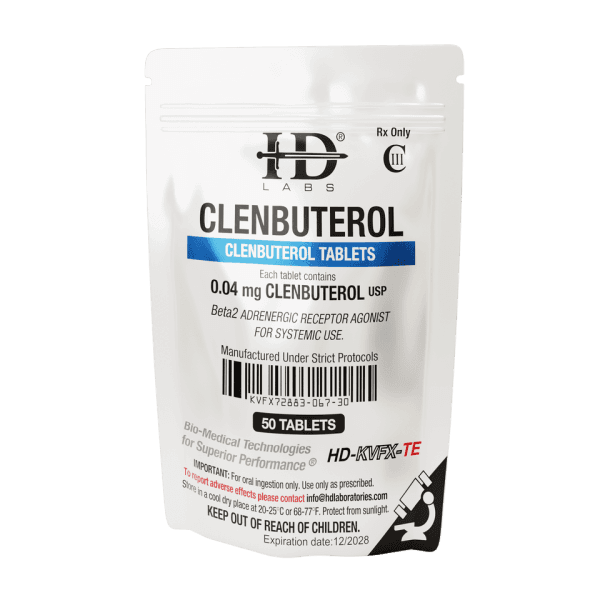
HD Labs Clenbuterol 40
R160.00
SKU hdclen40
4.3(6 reviews)HD Labs Clenbuterol 40 is an oral fat-loss compound supplied as 50 tablets, each labelled at 0.04 mg (40 mcg) of clenbuterol hydrochloride — a long-acting beta-2 adrenergic agonist. Its thermogenic and fat-loss effects are drawn almost entirely from animal research, with no controlled fat-loss trials in healthy adults. Clenbuterol is banned in sport at all times and carries documented cardiac risks. Supplied as a research compound — not medical advice.
Who it's for
- ›Adults researching fat loss and thermogenics
What it's used for
- ›Beta-2 agonist studied for fat loss and thermogenesis
- ›Researched for appetite suppression and energy
General research information, not medical advice.
Please note
Prescription-class compound supplied for research use. You must be 18 or older. Consult a qualified healthcare professional before use, this is not medical advice.
Card · EFT · Bitcoin · Discreet delivery
HD Labs Clenbuterol 40 (40mcg Tablets): SA Buyer’s Guide 2026
Key Takeaways
- Each tablet is labelled at 0.04 mg (40 mcg) clenbuterol hydrochloride; the pack contains 50 tablets. No certificate of analysis was supplied to us, so treat the strength and purity as label-stated rather than independently verified.
- Clenbuterol’s fat-loss and muscle-sparing effects are mediated by beta-2 adrenoceptor activation, but the strongest efficacy data come from animal studies, not controlled fat-loss trials in non-asthmatic adults.
- It has a documented cardiac risk profile. Reported adverse effects include tachycardia, palpitations, tremor, anxiety, headache and dangerously low blood potassium (hypokalemia), and no minimum safe dose has been established.
- Clenbuterol is prohibited at all times by the World Anti-Doping Agency — any tested athlete should not use it.
- This page is not medical advice. Do not start clenbuterol without review by a licensed South African prescriber who knows your cardiac and medical history.
What Is HD Labs Clenbuterol 40? (2026 Overview)
HD Labs Clenbuterol 40 is an oral tablet product from research-compound brand HD Labs, stocked by South African resellers including Beskinny in the weight-loss tablets category. Each tablet is labelled at 0.04 mg (40 mcg) of clenbuterol hydrochloride, the same unit strength used in most clenbuterol formulations worldwide.
Clenbuterol itself is a long-acting selective beta-2 adrenergic agonist. In countries where it is a registered human medicine, it is prescribed as a bronchodilator for asthma and other reversible airway obstruction. In the United States it is approved only for veterinary use (in horses), and it is not approved anywhere as a weight-loss drug. Its popularity in fitness circles comes from its ability, seen chiefly in animals, to shift body composition — reducing fat mass while preserving or increasing lean muscle — an effect that depends on activation of the beta-2 adrenoceptor.
Clenbuterol vs the injectable weight-loss options
Clenbuterol works nothing like the GLP-1-class injectables (semaglutide, tirzepatide) that dominate the current weight-loss conversation. The table below frames the difference so buyers understand what they are actually looking at.
| Attribute | Clenbuterol (this product) | GLP-1 / GIP injectables (Ozempic, Mounjaro, Wegovy class) |
|---|---|---|
| Drug class | Beta-2 adrenergic agonist (stimulant) | Incretin receptor agonist |
| Primary mechanism | Thermogenesis / lipolysis via beta-2 receptors | Appetite suppression, delayed gastric emptying |
| Human efficacy evidence for weight loss | Not established; largely animal data | Large phase 3 trials in humans |
| Main risk profile | Cardiac (tachycardia, arrhythmia), hypokalemia, tremor | Gastrointestinal; class-specific cautions |
| Some registered (e.g. Saxenda, Wegovy); others off-label |
Branded names such as Ozempic, Wegovy, Mounjaro and Saxenda appear here only as medical context to help buyers place clenbuterol among the options they may have read about — they are not equivalents, and clenbuterol is not an oral substitute for any of them.
What the Evidence Actually Shows
This is the correction that matters most. Marketing copy routinely describes clenbuterol as a proven fat-burner that “torches” body fat. The published evidence is far more limited. A 2025 review of clenbuterol misuse in bodybuilding and athletics found that no human studies have been conducted in non-asthmatic adults, and the fat-loss figures quoted online are extrapolations from animal work rather than controlled human trials.
The mechanism is real: beta-2 adrenoceptor stimulation raises resting energy expenditure and drives lipolysis, and in animal models this produces measurable fat loss and lean-mass retention. But translating an animal repartitioning effect into a predictable, safe human weight-loss outcome is exactly the step the evidence does not support. Any claim of a specific percentage of body-fat loss in humans should be treated as unverified.
Safety, Side Effects and Contraindications
Clenbuterol’s side effects follow directly from over-stimulating beta-adrenergic receptors throughout the body. Commonly reported effects include a fast or pounding heartbeat (tachycardia and palpitations), muscle tremor, anxiety and restlessness, headache, sweating, insomnia, raised blood sugar, and a drop in blood potassium (hypokalemia). Because the drug has a long half-life, these effects can persist for one to several days after a dose.
The more serious concern is cardiac. Case reports and reviews document supraventricular tachycardia, atrial fibrillation, chest pain, myocardial injury and myocardial infarction — and a review of clenbuterol toxicity emphasises that toxicity does not reliably track the dose ingested and no minimum safe dose has been identified. Serious cardiac events have been reported even at a standard or low dose in the region of 40 mcg per day — the strength of a single tablet in this pack. That is the single most important reason to involve a doctor before use.
Who should not use clenbuterol
- Anyone with heart disease, arrhythmia, a history of palpitations, or high blood pressure.
- Anyone with an overactive thyroid (hyperthyroidism), diabetes, or a seizure disorder.
- Anyone who is pregnant or breastfeeding.
- Anyone taking other stimulants, beta-agonists, or medicines that lower potassium.
- Competitive or drug-tested athletes — see the anti-doping section below.
Seek urgent medical care for chest pain, a persistently racing heart, fainting, severe tremor, or breathing difficulty after taking clenbuterol.
Labelled Strength and What We Can (and Can’t) Verify
Each tablet is labelled at 0.04 mg (40 mcg) of clenbuterol hydrochloride, with 50 tablets per pack. That 40 mcg unit is standard for clenbuterol, but no independent certificate of analysis was supplied to us for this batch. We therefore describe the strength as label-stated, not lab-verified, and we make no purity or content-uniformity claim. Buyers who want assurance on actual content should ask the supplier for batch testing documentation before use.
We are deliberately not publishing a “fat-loss dosing protocol” for clenbuterol. Because serious cardiac events have occurred at doses in the same range as a single tablet, and because individual reactions do not track predictably with the amount taken, any use decision belongs with a licensed prescriber rather than a product page.
Anti-Doping Status
Clenbuterol is prohibited at all times — both in and out of competition — by the World Anti-Doping Agency, listed among anabolic agents. There is no threshold below which it is permitted for tested athletes, and even trace exposure has caused adverse findings. If you compete under WADA rules or any federation that adopts them, do not use this product.
Frequently Asked Questions
| Question | Short Answer |
|---|---|
| What is in each tablet? | 0.04 mg (40 mcg) clenbuterol hydrochloride; 50 tablets per pack |
| Is it proven for weight loss in people? | No — human fat-loss efficacy is not established; evidence is largely animal |
| No — sold as a research compound, not an approved medicine | |
| Can athletes use it? | No — WADA-prohibited at all times |
| What are the main risks? | Cardiac effects, hypokalemia, tremor; no minimum safe dose established |
Does clenbuterol actually burn fat in humans?
The thermogenic mechanism is real, but a 2025 review found no controlled fat-loss studies in non-asthmatic adults. Fat-loss figures circulated online are extrapolated from animal data, so a specific human result cannot be promised.
How much clenbuterol is dangerous?
There is no established safe dose. Reviews of clenbuterol toxicity report that reactions do not track predictably with the amount taken, and serious cardiac events have been reported even around 40 mcg per day. This is why medical supervision matters.
Do I need a prescription to buy clenbuterol in South Africa?
Will clenbuterol fail a drug test?
Yes. It is prohibited at all times by WADA with no permitted threshold, so any tested athlete should avoid it entirely.
The Bottom Line
References
- Anabolic effects of clenbuterol on skeletal muscle are mediated by beta 2-adrenoceptor activation (Choo et al.). American Journal of Physiology / PubMed, 1992.
- Clenbuterol Abuse in Bodybuilding and Athletics: Unsupervised Use, Psychological Motivations, and Health Consequences. Cureus, 2025.
- Low Dose Clenbuterol Toxicity: Case Report and Review of Literature. HCA Healthcare Journal of Medicine, 2020.
- The Prohibited List. World Anti-Doping Agency, 2026.