
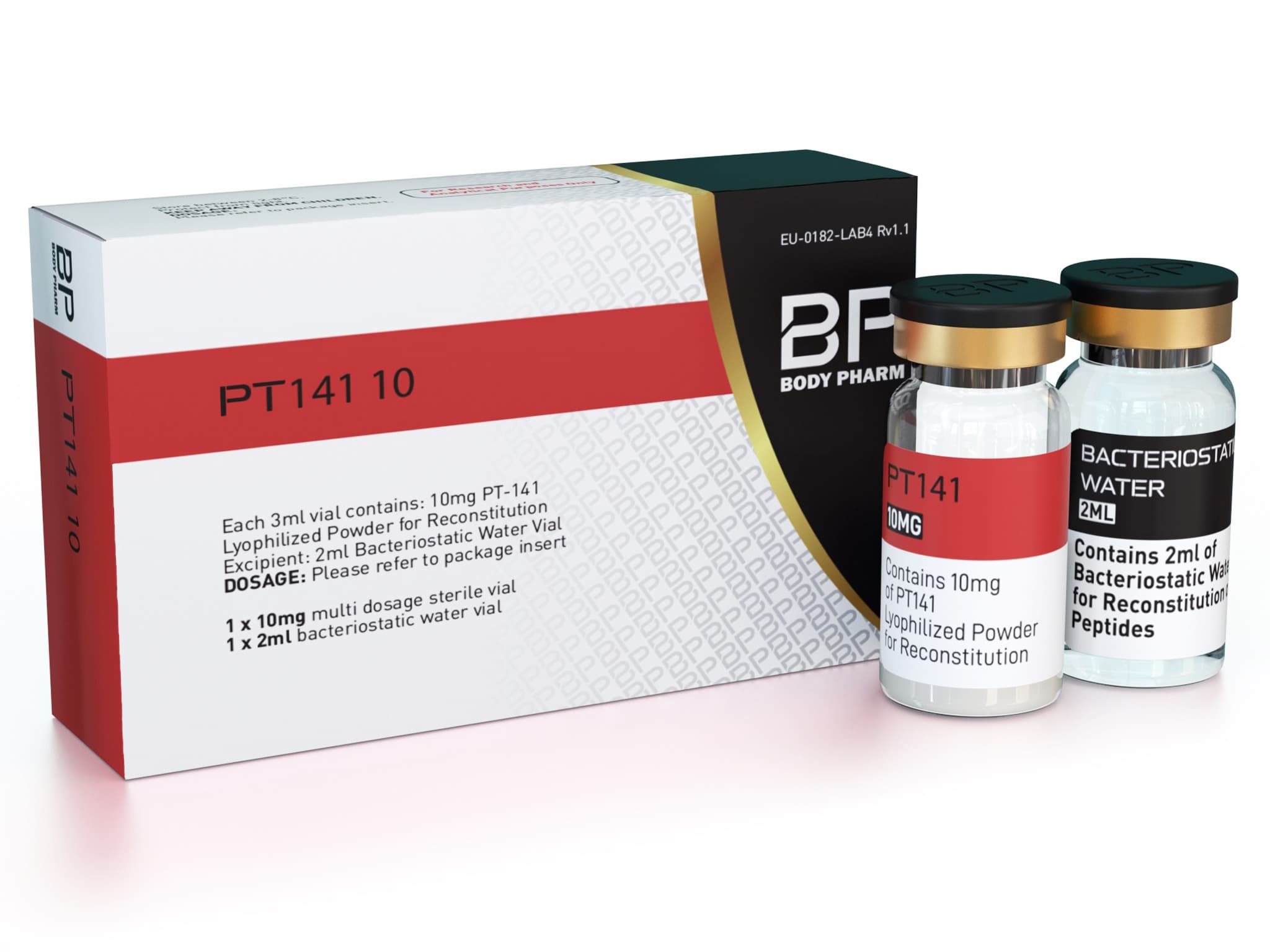
What you get
- 1× vial (product)
- 1× bacteriostatic water (2 ml)
What you need
- Syringe + needle to reconstitute (reconstitution calculator)
- Alcohol swabs
- Needle + syringe to inject
Body Pharm PT-141 10 Vial
R480.00
SKU bppt14110
4.5(4 reviews)Body Pharm PT-141 10mg (Bremelanotide) is a melanocortin-receptor-agonist peptide supplied as a research-grade lyophilised vial, studied for low sexual desire. It is the same molecule approved abroad as Vyleesi for premenopausal women with hypoactive sexual desire disorder, and is sold for research use only.
Who it's for
- ›Adults researching libido and sexual-health support
What it's used for
- ›Studied for libido and sexual arousal
- ›Researched for arousal and erectile support
General research information, not medical advice.
Card · EFT · Bitcoin · Discreet delivery
Complete your kit
The supplies you need to store and use your order — add yours in one tap.
 BEARE Insulin Syringes 10 PackR35.00
- BEARE Insulin Syringes 20 PackR60.00
 Alcohol Swabs 50 PackR25.00
Body Pharm PT-141 10mg (Bremelanotide): Uses, Dosage & Safety
What you’ll learn in this article:
- How PT-141 (bremelanotide) works on the brain’s melanocortin system, and why that differs from PDE5 inhibitors that act on blood flow.
- What the human trial evidence actually supports — and where it stops.
- The studied dose, a practical reconstitution reference for the Body Pharm 10mg vial, the documented safety profile, and the South African regulatory position.
Key Takeaways
- Active: bremelanotide, 10mg lyophilised vial, Body Pharm-branded.
- Mechanism: a melanocortin receptor agonist that binds MC1R and MC4R and acts centrally; the precise pathway by which it improves sexual desire is not fully established.
- Evidence: two phase 3 RECONNECT trials found bremelanotide 1.75mg significantly improved sexual desire and reduced associated distress in premenopausal women with HSDD.
- Studied dose: 1.75mg subcutaneously, at least 45 minutes before anticipated sexual activity, no more than one dose per 24 hours and no more than 8 doses per month.
- Not for men or performance: the approved label explicitly states it is not indicated in men or to enhance sexual performance; use outside premenopausal HSDD is investigational.
- Safety: the most common effects are nausea, flushing, injection-site reactions and headache, with transient blood-pressure increases; it is contraindicated in uncontrolled hypertension or known cardiovascular disease.
What Is Body Pharm PT-141 10mg?
Body Pharm PT-141 10mg is a vial of lyophilised bremelanotide, a synthetic cyclic seven-amino-acid peptide. Chemically it is a melanocortin receptor agonist derived from the earlier melanotan-II research line, developed specifically to influence sexual response through the brain rather than the vasculature. The subcutaneous 1.75mg formulation was approved by the U.S. FDA in 2019 (initial U.S. approval) under the brand Vyleesi for premenopausal women with acquired, generalised HSDD.
The Body Pharm label is a South African–distributed research peptide brand carrying the standard underground-lab format buyers will recognise from the rest of the wellness injections range. Practical specs:
- Format: lyophilised white powder, 10mg per vial, for subcutaneous use after reconstitution.
- Active: bremelanotide (the same molecule marketed as Vyleesi).
- Route: subcutaneous injection, insulin syringe.
- Studied dose: 1.75mg per administration — far less than the full 10mg vial, which is a multi-dose research quantity, not a single dose.
- Status: research compound; sits in the PT-141 category.
A common buyer question: “Is a 10mg vial a 10mg dose?” No. The vial holds 10mg of peptide in total; the dose studied in humans is 1.75mg. Reconstituting and drawing the correct fraction is essential — injecting the whole vial would be several times the studied amount.
How PT-141 Works: The Melanocortin Mechanism
Bremelanotide is a melanocortin receptor (MCR) agonist. It non-selectively activates several melanocortin receptor subtypes, with binding to MC1R and MC4R being the most relevant at therapeutic dose levels. MC4R is expressed in central-nervous-system pathways involved in sexual response, which is why the peptide is described as acting on desire centrally rather than on erectile or genital blood flow.
This is the key contrast with the drugs most people already know. Phosphodiesterase-5 (PDE5) inhibitors such as sildenafil (Viagra) and tadalafil (Cialis) work on the vascular side of arousal — they improve blood flow to enable an erection but do nothing for desire. Bremelanotide sits upstream of that, on the motivational/desire circuitry, which is why it was investigated for low libido rather than as an erectile aid.
An important honesty note: the manufacturer’s own label states that the exact mechanism by which it improves HSDD is unknown. The receptor pharmacology is well characterised; the downstream chain from MC4R activation to reported improvement in desire is not. Buyers should treat the mechanism as plausible and receptor-anchored, not fully mapped.
What the Evidence Shows
Unlike many research peptides, bremelanotide has a genuine controlled human evidence base — but only in one population. Two identically designed phase 3 trials, known together as RECONNECT, randomised premenopausal women with HSDD to bremelanotide 1.75mg or placebo, self-administered as needed. Across both studies the peptide significantly improved sexual desire and reduced the distress associated with low desire compared with placebo (Kingsberg et al., Obstetrics & Gynecology, 2019).
What the trial programme does and does not establish:
- Population: efficacy was shown in premenopausal women with acquired, generalised HSDD — not in postmenopausal women and not in men (approved indication and limitations of use).
- Design: dosing was on-demand (as needed) rather than daily, taken approximately 45 minutes before anticipated activity in the registration studies.
- Effect size: the improvements were statistically significant but modest in absolute terms; bremelanotide is a desire aid, not a guaranteed switch.
- Men and “performance”: the label is explicit that it is not indicated in men or to enhance sexual performance. Earlier PT-141 development in men did not reach approval, and no equivalent phase 3 efficacy data exists for male use.
A reasonable objection: “The product is sold to men and women here — doesn’t that mean it works for both?” No. Marketing reach is not evidence. The controlled data supports premenopausal women with HSDD; everything beyond that — male libido, erectile support, general “performance” — is investigational and should be framed that way.
PT-141 Dosage (Research Protocol)
The only dose with controlled human efficacy behind it is 1.75mg subcutaneously, taken at least 45 minutes before anticipated sexual activity, with no more than one dose in any 24-hour period and no more than 8 doses per month. There is no validated dose for men or for performance use, so the figures below reflect the studied regimen and the arithmetic of reconstituting a 10mg research vial — not a medical recommendation.
Body Pharm PT-141 10mg reconstitution and dosing reference:
- Reconstitution example: adding 2mL bacteriostatic water to the 10mg vial gives 5mg/mL (5000mcg/mL).
- 1.75mg studied dose: draw 0.35mL (35 units on a U-100 insulin syringe) from that dilution.
- Doses per vial: a 10mg vial contains roughly five to six 1.75mg doses.
- Frequency: on-demand, not daily — the label caps use at one dose per 24 hours and 8 doses per month.
- Timing: at least 45 minutes before anticipated activity, per the studied regimen.
- Storage: keep the lyophilised vial cool and dry before mixing; refrigerate the reconstituted solution and use it within a few weeks, the usual working practice for bacteriostatic-water-preserved peptides (no manufacturer stability figure is supplied with this research vial).
A frequent concern: “More must be better for a stronger effect, right?” No — going above 1.75mg or dosing more often is exactly what the label warns against, and the dose-limiting problems (nausea, blood-pressure rise) scale with the amount injected. The studied ceiling exists for safety reasons, not caution for its own sake.
PT-141 Side Effects and Safety Profile
Because bremelanotide is an approved drug in at least one market, its safety profile is unusually well documented for a peptide sold as research grade. In the controlled trials the most common adverse reactions were nausea (about 40%), flushing (about 20%), injection-site reactions (about 13%) and headache (about 11%).
What the label and trial database show:
- Nausea is the dominant side effect, affecting roughly four in ten users and occasionally requiring anti-nausea treatment (Vyleesi label).
- Transient blood-pressure rise and heart-rate drop occur after each dose — the label reports maximal increases of about 6 mmHg systolic and 3 mmHg diastolic, usually within 12 hours (Vyleesi label).
- Focal hyperpigmentation (darkening of skin on the face, gums or breasts) was reported in about 1% of patients taking up to 8 doses per month, and did not always resolve after stopping — a direct consequence of MC1R activation (Vyleesi label).
- Contraindicated in people with uncontrolled hypertension or known cardiovascular disease, because of the blood-pressure effect.
A reasonable user objection: “These sound manageable — is there a catch?” The catch is the combination of a high nausea rate and a real, if small, cardiovascular signal. Anyone with high blood pressure or heart disease should not use it, and the transient pressor effect is the reason for the once-per-24-hours limit. Long-term safety data beyond the trial windows is limited. This is not a compound to self-escalate.
PT-141 vs PDE5 Inhibitors: How They Differ
The most useful comparison is not against other peptides but against the erectile-dysfunction drugs buyers already know. They solve different problems: PDE5 inhibitors address the mechanics of an erection, while bremelanotide targets desire itself.
| Compound | Mechanism | Primary target | Timing | Approved use |
|---|---|---|---|---|
| PT-141 (bremelanotide) | Melanocortin (MC4R) agonist; central nervous system | Sexual desire / arousal | On-demand, ~45 min before | Premenopausal women with HSDD (as Vyleesi) |
| Sildenafil (Viagra) | PDE5 inhibitor; increases genital blood flow | Erection mechanics | On-demand, ~30–60 min before | Erectile dysfunction |
| Tadalafil (Cialis) | PDE5 inhibitor; longer-acting blood-flow effect | Erection mechanics | On-demand or daily | Erectile dysfunction |
Who picks what
Bremelanotide is aimed at low desire, where the barrier is motivation rather than blood flow — and its only controlled efficacy is in premenopausal women with HSDD. PDE5 inhibitors are the established, approved answer for erectile dysfunction in men. The two are not interchangeable, and a desire-side compound will not fix a mechanical erectile problem (or vice versa). Matching the mechanism to the actual complaint matters more than potency.
Why Buy Body Pharm PT-141 from Beskinny?
Body Pharm PT-141 10mg is stocked at Beskinny at R480 per vial, shipped from a South African warehouse with tracked courier delivery to all major metros.
- Product spec: 10mg lyophilised bremelanotide per vial, Body Pharm branded, sealed with batch identifier. Reconstitute with bacteriostatic water as covered earlier.
- Current stock: see the live count on the product page, which is the source of truth.
- Why Beskinny: a dedicated South African peptide and wellness injections retailer, not a general supplement reseller — narrower SKU range, faster turnover, fresher stock.
A frequent concern at this stage: “What if I receive a damaged or short-dated vial?” Beskinny’s product page lists batch identifiers and replaces compromised stock on receipt evidence; raise the issue before reconstituting.
Order Body Pharm PT-141 10mg at R480/vial. Check live stock and add to cart on the Beskinny product page.
Frequently Asked Questions
Short answers to the questions buyers ask before checkout.
Does PT-141 work for men?
There is no phase 3 efficacy data for male use, and the approved label states bremelanotide is not indicated in men or to enhance sexual performance. The controlled evidence is in premenopausal women with HSDD; male use is investigational and should be treated as such.
How much PT-141 do I inject?
The studied dose is 1.75mg subcutaneously, not the whole 10mg vial. From a 2mL/10mg dilution (5mg/mL) that is 0.35mL, and no more than one dose per 24 hours or 8 doses per month.
What are the main side effects?
Most commonly nausea, flushing, injection-site reactions and headache, plus a transient rise in blood pressure. Focal skin darkening can occur with repeated use. It should not be used by anyone with uncontrolled hypertension or known cardiovascular disease.
How is it different from Viagra?
Sildenafil (Viagra) is a PDE5 inhibitor that improves blood flow to enable an erection; it does nothing for desire. Bremelanotide acts on melanocortin receptors in the central nervous system and targets desire itself. They address different problems.