
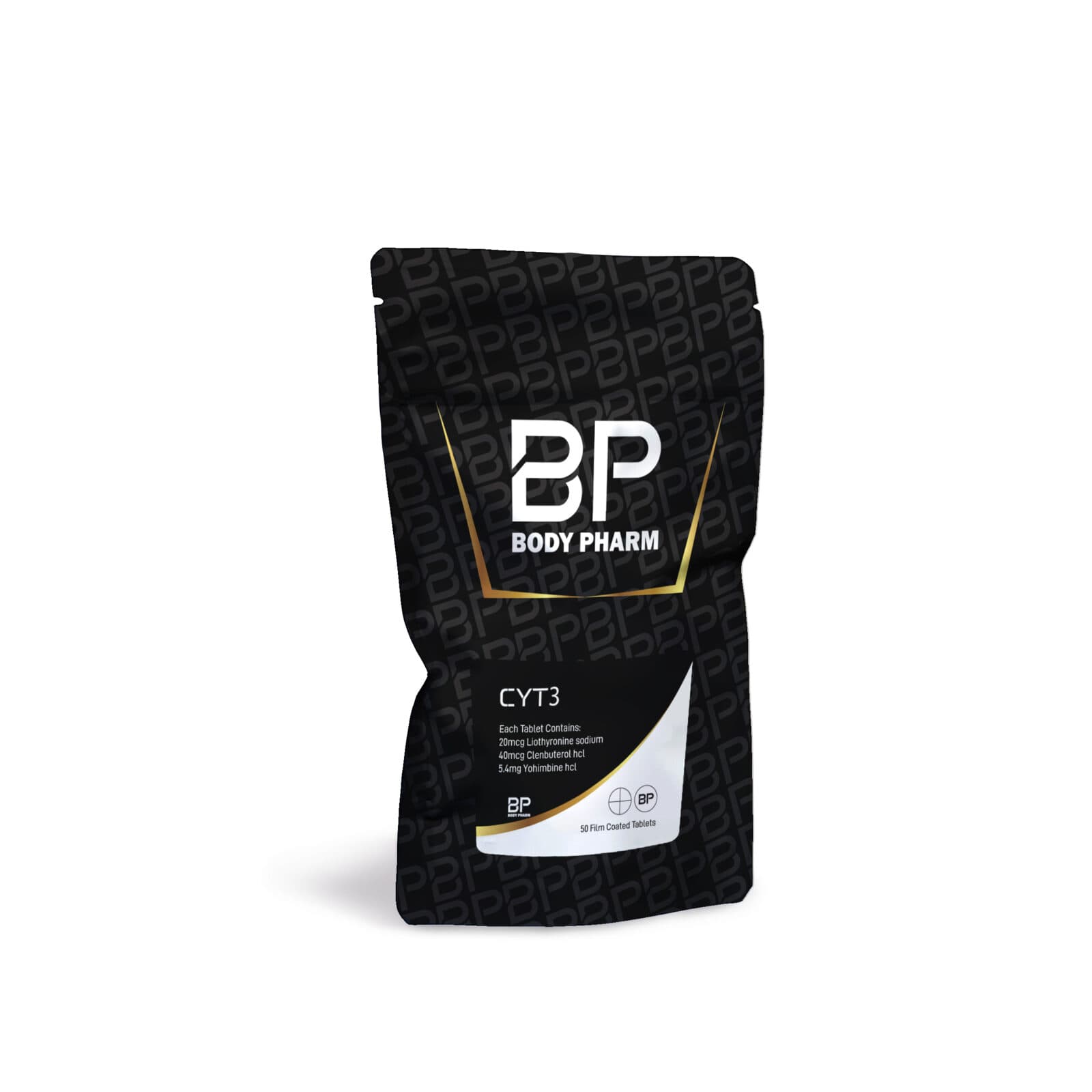
BP CYT3 (Clenbuterol, Yohimbine and T3 combo)
R280.00R200.00On sale
SKU bpcyt3
4.8(4 reviews)BP CYT3 is an effective fat-burning combination of Clenbuterol, Yohimbine, and T3, designed to enhance metabolism, promote thermogenesis, and accelerate weight loss.
Please note
Prescription-class compound supplied for research use. You must be 18 or older. Consult a qualified healthcare professional before use, this is not medical advice.
Card · EFT · Bitcoin · Discreet delivery
BP CYT3 is a triple-compound oral tablet stacking clenbuterol HCl (approximately 40 mcg), yohimbine HCl (approximately 5.4 mg) and liothyronine sodium/T3 (approximately 25 mcg) per tab, engineered to hit three fat-loss receptors at once: beta-2 agonism for thermogenesis, alpha-2 blockade to free stubborn lower-body fat, and T3-driven thyroid upregulation. The clenbuterol yohimbine T3 combo for fat loss exists because lower-body adipose carries a higher alpha-2:beta receptor ratio than abdominal fat, which is why beta-agonists alone tend to leave gluteofemoral stores relatively intact.
This page covers the mechanistic receptor interactions between the three actives, how combo-tablet dosing compares to single-compound titration, a Certificate of Analysis (COA) verification checklist, and what to demand from a South African vendor before payment. No randomised controlled trial has tested this exact triple stack in humans, so the pharmacology below is drawn from single-compound literature and should be read as research context, not medical advice.
What Is BP CYT3? Formulation at a Glance
BP CYT3 is a lyophilised oral tablet containing 40 mcg clenbuterol HCl, 5.4 mg yohimbine HCl and 25 mcg liothyronine sodium (T3) per tab, retailing in South Africa at R250.00 as of 2026 under SKU BP CYT3. The freeze-dried tablet format is intended to protect the T3 fraction, the most hygroscopic and heat-sensitive of the three actives, from potency loss during transit.
Liothyronine sodium degrades faster than clenbuterol or yohimbine under humidity and ambient heat above roughly 25 °C. BeSkinny ships BP CYT3 in light-protected, desiccated packaging from a South African dispatch point rather than relying on long international transit. Each batch carries a third-party assay; buyers should request the COA by batch number before paying (the full verification checklist sits further down this page).
Researchers who want an injectable beta-2 agonist instead of the oral combo can compare against BP Aqua Clen 80 injectable clenbuterol, and those building a broader cutting protocol often pair CYT3 with Body Pharm AOD 9604 for targeted lipolysis.
Triple-Receptor Synergy: Why Three Compounds Beat One
The clenbuterol yohimbine T3 combo is designed so that each compound targets a different receptor in the lipolytic cascade simultaneously, aiming for additive output rather than three overlapping signals. Clenbuterol triggers fatty acid release at the beta-2 site, yohimbine blocks the alpha-2 brake that normally shuts that release down, and T3 raises the metabolic floor so the mobilised fatty acids are more likely to be oxidised rather than re-esterified. This synergy is a mechanistic rationale, not a trial-proven outcome.
Pathway 1: Clenbuterol at the Beta-2 Receptor
Clenbuterol is a selective beta-2 adrenergic agonist that activates adenylyl cyclase, raises intracellular cAMP (cyclic adenosine monophosphate), and phosphorylates hormone-sensitive lipase (HSL) inside the adipocyte. Active HSL cleaves triglycerides into free fatty acids and glycerol, which exit the cell for oxidation. In healthy men, a single oral dose has been shown to raise resting energy expenditure and fat oxidation measurably. The catch: continuous beta-2 stimulation desensitises the receptor over repeated exposure through signalling uncoupling, which is why 2-on/2-off cycling is common practice. Researchers who prefer an injectable beta-2 agonist over the oral tablet format can compare against BP Aqua Clen 80.
Pathway 2: Yohimbine at the Alpha-2 Receptor
Yohimbine is a competitive alpha-2 adrenergic antagonist that blocks the presynaptic and adipocyte-membrane receptor responsible for terminating catecholamine-driven lipolysis, and oral dosing raises circulating glycerol and free fatty acids in fasting subjects. This matters most in "stubborn" depots: legacy biopsy and microdialysis work places gluteofemoral and lower-body subcutaneous fat at a higher alpha-2:beta receptor ratio than upper-body or visceral fat. In a Clen + T3 stack without yohimbine, that alpha-2 dominance in lower-body fat can counter the beta-2 signal clenbuterol is producing, which is the mechanistic argument for the triple over the dual.
Pathway 3: T3 at the Thyroid Hormone Receptor
Liothyronine binds nuclear thyroid hormone receptors and controls DNA transcription and protein synthesis, upregulating genes governing mitochondrial uncoupling proteins and Na+/K+-ATPase activity, which raises resting oxygen consumption and basal metabolic rate. Where clenbuterol and yohimbine create a transient lipolytic burst tied to sympathetic tone, T3 lifts 24-hour energy expenditure, so the fatty acids mobilised by the other two compounds are more likely to be oxidised rather than recycled back into triglyceride.
Why Additive, Not Redundant
The three pathways act at distinct molecular targets: a Gs-coupled beta-2 receptor driving cAMP, a Gi-coupled alpha-2 receptor whose blockade removes a negative brake, and a nuclear receptor altering gene transcription. Initiation (clenbuterol), sustainment (yohimbine), and oxidation capacity (T3) are sequential bottlenecks in fat loss, so on paper removing any one of them leaves a rate-limiting step intact. No randomised controlled trial (RCT) has tested this exact triple stack in humans, so the rationale is mechanistic rather than trial-proven, and the protocol section below treats it as such. Researchers building broader cutting protocols often layer a lipolytic peptide like Body Pharm AOD 9604 on top of the CYT3 base.
Single Compound vs Combo Tablet: Dosing Compared
The combo tablet wins on adherence; separate compounds win on titration flexibility. Running a fixed cutting protocol with no concurrent thyroid prescription means BP CYT3 collapses a 3-bottle, 3-timing regimen into one tablet. If you need to move one compound independently, buy them apart.
| Format | Dose per unit | Typical daily dose | Units/day to manage | Timing complexity |
|---|---|---|---|---|
| Clenbuterol alone | 40 mcg/tab | 40–120 mcg | 1–3 | Single AM dose, long half-life |
| Yohimbine HCl alone | 5 mg/cap | 10–20 mg, split | 2–4 | Fasted only, pre-cardio, twice daily |
| T3 (Liothyronine) alone | 25 mcg/tab | 25–75 mcg, split | 1–3 | Split AM/midday to flatten peaks |
| BP CYT3 combo | 40 mcg Clen / 5.4 mg Yohimbine / 25 mcg T3 | 1–3 tablets | 1–3 | Single fasted morning dose, optional second pre-cardio |
Running the three separately means tracking three blister packs, three half-lives, and three timing rules. Yohimbine is generally taken fasted because post-meal insulin blunts its alpha-2 antagonism, T3 is often split to avoid a single large cardiac spike, and clenbuterol sits on a long plasma half-life of roughly 35 hours. The combo tablet locks all three to a single fasted AM administration, the timing window where yohimbine works best and where T3's pulse aligns with the day's catecholamine rhythm. One tablet, one alarm, one decision.
The fixed 40:5.4:25 ratio is also the combo's hard limitation. A researcher already on prescribed liothyronine for clinical hypothyroidism cannot use CYT3 without double-dosing T3. Someone who tolerates clenbuterol poorly above 40 mcg but wants a full 15–20 mg yohimbine load cannot get there without overshooting clen. In those scenarios the single-compound route, or pairing standalone yohimbine with BP Aqua Clen 80 injectable clenbuterol for precise titration, is the more honest tool. Stacking a non-stimulant lipolytic like Body Pharm AOD 9604 on top is independent of which CYT3 format you choose.
No RCT validates the dose ranges above for the triple combination; treat them as research context drawn from legacy single-compound protocols, not clinical recommendations.
Dosing Protocol and Cycling
Legacy single-compound protocols typically start with one tablet (40 mcg clenbuterol / 5.4 mg yohimbine / 25 mcg T3) taken on an empty stomach between 06:00 and 08:00, then assess tolerance for at least three days before titrating. Resting heart rate, tremor, and sleep quality the night after dosing are the three signals most researchers track before adding a second tablet. Reported use settles around 2 tablets/day by the end of week one; a third tablet is described as a ceiling and only relevant for advanced users who have run the individual compounds previously. None of these figures is RCT-validated for the triple stack.
The morning-only window matters. Clenbuterol's plasma half-life of roughly 35 hours means a second dose after midday can readily disrupt sleep, and yohimbine's alpha-2 antagonism is blunted by post-meal insulin, which is why fasted administration is favoured. Any second dose is generally placed pre-cardio before 11:00 and never within 8 hours of bed.
Cycling the clenbuterol component
Beta-2 receptor signalling attenuates with repeated clenbuterol exposure, and tolerance to the thermogenic effect tracks that downregulation. The bodybuilding-community default is a 2-weeks-on / 2-weeks-off schedule, which is not RCT-verified but lines up with the mechanistic picture of receptor recovery during the washout. Some researchers prefer 2-on / 2-off with ketotifen during the off-period to preserve receptor density; that protocol has no human trial behind it. For users who want to keep clen running while reducing the oral pulse, switching the clen component to BP Aqua Clen 80 injectable clenbuterol during week three onward allows finer titration than the fixed 40 mcg step in the combo tablet.
Tapering T3 and managing yohimbine
T3 is generally tapered rather than stopped abruptly. Exogenous liothyronine suppresses TSH (thyroid-stimulating hormone) and endogenous T4-to-T3 conversion through negative feedback on the hypothalamic-pituitary-thyroid (HPT) axis, so abruptly stopping a 50–75 mcg/day intake risks a hypothyroid trough until the axis recovers. A common approach is to step down by roughly 25 mcg every 3–4 days. Yohimbine tolerance is poorly characterised in the literature, but the cardiovascular effects can blunt with continuous use, so a 4–6 week ceiling on the combo is a defensible cap. Non-stimulant adjuncts like Body Pharm AOD 9604 can carry the deficit through the off-period without re-loading the beta-2 receptor.
This is research-context information drawn from legacy single-compound protocols, not medical advice; consult a registered medical practitioner before running any of it.
Safety, Side Effects, and Cardiovascular Risk
Running clenbuterol, yohimbine, and T3 simultaneously stacks three different cardiovascular stressors onto the same heart, and no large-scale human safety trial for this specific triple combination has been published. Each compound's risk profile is documented in isolation; the combined profile is inferred, not measured.
Clenbuterol's documented adverse effects include tachycardia, palpitations, fine tremor, hypokalaemia, hypertension, and, in case reports, myocardial injury and arrhythmia. A 2025 review of clenbuterol abuse in bodybuilding and athletics documents cardiac and metabolic adverse events, with serum potassium dropping into clinically relevant ranges and cardiovascular toxicity reported even around 40 mcg/day. Yohimbine carries its own list: anxiety, elevated blood pressure, and characterised interactions with monoamine oxidase inhibitors (MAOIs), tricyclic antidepressants, and selective serotonin reuptake inhibitors (SSRIs) through serotonergic and adrenergic potentiation. T3 at supraphysiological intake suppresses TSH and endogenous T4-to-T3 conversion, can drive muscle catabolism if calories and protein are inadequate, and increases cardiac workload and arrhythmia risk in susceptible users.
The compounded problem is mechanistic. Clenbuterol drives beta-2 (and at higher doses, beta-1) agonism while yohimbine blocks the alpha-2 brake on noradrenaline release. Both push adrenergic tone upward by different routes, so heart rate and blood pressure effects are additive rather than offsetting. Layering T3 on top raises basal metabolic rate and cardiac contractility, and the liothyronine label specifically warns that larger doses given with sympathomimetic amines can produce serious toxicity. Resting heart rates of 95–110 bpm and systolic readings 15–25 mmHg above baseline are commonly reported anecdotally on the combo; sustained tachycardia above 120 bpm at rest is a stop signal, not a tolerance issue to push through.
Hard contraindications: any pre-existing cardiac condition, uncontrolled hypertension, hyperthyroidism, diagnosed anxiety or panic disorder, pregnancy or breastfeeding, and concurrent use of MAOIs, SSRIs, serotonin-noradrenaline reuptake inhibitors (SNRIs), or tricyclics. A baseline 12-lead ECG (electrocardiogram), resting blood pressure, fasting electrolytes (especially potassium), and a TSH/free T3/free T4 panel before starting are the minimum sensible workup. Users who prefer to titrate clenbuterol more finely than the fixed 40 mcg tablet step can swap to BP Aqua Clen 80 injectable clenbuterol, and those who want non-adrenergic lipolysis without further loading the cardiovascular system can layer Body Pharm AOD 9604 instead of pushing yohimbine higher.
How to Verify a COA: What to Check Before You Buy
A valid Certificate of Analysis for BP CYT3 should name the testing laboratory, list the batch number that matches your tablets, confirm identity and purity for each of the three actives by a stated analytical method, and be dated within the last 12–18 months. Do not buy if a vendor cannot produce that document on request.
Work through the COA in this order before you transfer funds:
- Laboratory identity and accreditation. The lab name, address, and accreditation number (SANAS ISO/IEC 17025 in South Africa, or an equivalent international body) must be printed on the document. A COA signed only by the manufacturer's internal quality control is not third-party verification.
- Batch/lot number. The lot on the COA must match the lot stamped on your blister or bottle. A generic "representative batch" COA tells you nothing about the tablets in your hand.
- Identity confirmation. Each active (clenbuterol HCl, yohimbine HCl, liothyronine sodium) should be confirmed by HPLC-UV (high-performance liquid chromatography with ultraviolet detection) or LC-MS (liquid chromatography-mass spectrometry), with the method explicitly named. Identity by appearance or melting point alone is not acceptable for scheduled actives.
- Purity and related substances. Research-grade API (active pharmaceutical ingredient) purity for these three compounds is typically reported at ≥98%, with related-substance limits defined against a pharmacopoeial monograph (USP or EP).
- Potency against label claim. Per-tablet assay should fall within roughly ±5–10% of the stated 40 mcg clenbuterol, 5.4 mg yohimbine, and 25 mcg T3.
- Contaminant screen. Heavy metals (As, Pb, Cd, Hg), residual solvents, and microbial limits must be reported with pass/fail against pharmacopoeial thresholds.
- Date of analysis. Anything older than 18 months on a tablet product is stale; request the current batch COA instead.
BeSkinny provides the BP CYT3 COA on request via the product page contact form. If you are weighing oral combo tablets against a single-compound finer-titration route, the BP Aqua Clen 80 injectable has its own batch COA, and Body Pharm AOD 9604 ships with peptide-specific HPLC documentation that follows the same checklist.
Buying BP CYT3 in South Africa: Shipping and Payment
BP CYT3 sells through BeSkinny at R250.00 per pack as of 2026, with card and EFT (electronic funds transfer) accepted at checkout. Local dispatch from a South African warehouse means orders move on domestic courier networks rather than waiting on cross-border customs clearance, the single biggest variable when ordering scheduled actives from overseas vendors.
Discreet outer packaging is standard, and BeSkinny handles temperature-sensitive items on a cold-chain basis from local stock. BP CYT3 is a solid oral tablet, so cold-chain matters less here than for peptides, but the same logistics network protects co-ordered items like Body Pharm AOD 9604, where temperature excursions degrade the lyophilised peptide cake and drop assayed potency before you reconstitute. For clenbuterol specifically, buyers who prefer an injectable titration route can compare the BP Aqua Clen 80 injectable on the same checkout.
Request the batch COA from BeSkinny using the contact form on the BP CYT3 product page and quote the lot number printed on your blister once it arrives. Confirm the current delivery window, returns terms, and any satisfaction guarantee directly on the product page before placing the order, since vendor service level agreements (SLAs) change.
Stacking BP CYT3 with Other Compounds
Advanced users sometimes layer growth hormone (GH)-axis peptides or GLP-1 (glucagon-like peptide-1) agonists onto a CYT3 base, but no controlled human data exists for any of these combinations and the interaction risk profile is inferred, not measured.
AOD 9604 is a synthetic fragment of the C-terminus of human growth hormone studied for its lipolytic action without the glucose-handling effects of full-length GH. Because AOD 9604 does not bind adrenergic receptors, the theoretical overlap with CYT3 is on the lipolysis pathway rather than the sympathetic axis, which is why it appears in stacking discussions. Ipamorelin, a selective GH secretagogue, raises endogenous GH pulses and is used alongside thermogenics on the same logic, but adding any GH-axis compound to a stack already driving beta-2 agonism, alpha-2 blockade and thyroid upregulation compounds the cardiovascular and metabolic load.
Semaglutide has become a mainstream weight-management option, yet combining a GLP-1 agonist with a stimulant thermogenic stack like CYT3 has not been studied in controlled human trials. The pharmacodynamic concerns, gastrointestinal tolerance, heart-rate variability, hypoglycaemia risk in lean cutters, are real but unquantified.
For those still deciding on the clenbuterol format itself, the BP Aqua Clen 80 injectable is the titration-friendly alternative on the same checkout.
Key Takeaways
- BP CYT3 combines beta-2 agonism, alpha-2 blockade and thyroid upregulation in a single oral tablet at R250.00, trading dosing flexibility for adherence.
- No RCT validates the triple combination in humans; dosing protocols are mechanistic inference from single-compound literature.
- Request a third-party COA matching your batch number before paying; check laboratory accreditation, identity method (HPLC-UV or LC-MS), purity (≥98%), and contaminant screening.
- Three adrenergic and metabolic stressors running simultaneously carry real cardiovascular risk; baseline ECG, blood pressure, electrolytes, and thyroid panel are minimum sensible precautions.
- Resting heart rate above 120 bpm is a stop signal; 95–110 bpm is commonly reported but warrants monitoring.
- T3 requires a taper on exit; abrupt cessation risks hypothyroid rebound.
Frequently Asked Questions
How many tablets per day?
Legacy bodybuilding protocols for CYT3-type tablets (clenbuterol 40 mcg / yohimbine 5.4 mg / T3 25 mcg per tablet) typically start at one tablet and titrate upward over several days, with 2-weeks-on/2-weeks-off cycling to limit beta-2 receptor desensitisation. No RCT validates a specific dose for the triple stack, so any number above one tablet is empirical, not evidence-based.
Does BP CYT3 need to be refrigerated?
No. Clenbuterol HCl, yohimbine HCl and liothyronine sodium tablets are solid oral dosage forms that remain chemically stable at ambient shipping temperatures, so light-protective blister or HDPE (high-density polyethylene) packaging with desiccant is the standard, not cold-chain. Store below 25 °C, away from humidity and direct light, as printed on the batch label.
Can women use this stack?
Research literature consistently flags greater sensitivity to thyroid and adrenergic agents in female subjects, and case reports of clenbuterol toxicity skew toward lower thresholds for cardiovascular events. Where the stack is used in a research context, starting doses are cited at the lower end (half a tablet) with slower titration.
How long before thermogenic effects appear?
Elevated resting body temperature, tremor and increased perspiration are typically reported within the first 24–72 hours of clenbuterol dosing, with tolerance to the thermogenic component beginning to develop within days of continuous use. T3-driven changes in resting metabolic rate are slower to manifest than the acute adrenergic signal.
How does BP CYT3 differ from BP Aqua Clen 80?
BP CYT3 is an oral combination tablet pairing clenbuterol with yohimbine HCl and liothyronine sodium for simultaneous beta-2 agonism, alpha-2 blockade and thyroid upregulation. The BP Aqua Clen 80 injectable is single-compound clenbuterol at 80 mcg/mL, useful when fine titration matters more than multi-pathway action. Peptide stackers comparing options often also evaluate Body Pharm AOD 9604 as a non-adrenergic lipolytic adjunct.
Next Steps
Request the batch COA from BeSkinny before purchase using the product page contact form. If you have pre-existing cardiac, thyroid, or psychiatric conditions, consult a registered medical practitioner before starting any protocol. For finer clenbuterol titration or non-adrenergic lipolysis, compare BP Aqua Clen 80 injectable or Body Pharm AOD 9604 on the same checkout.
References
- Beta2-adrenergic agonist clenbuterol increases energy expenditure and fat oxidation, and induces mTOR phosphorylation in skeletal muscle of young healthy men. Drug Testing and Analysis, 2020.
- Pharmacokinetics of plasma and urine clenbuterol in man, rat, and rabbit. Journal of Pharmacobio-Dynamics, 1985.
- Yohimbine: a clinical review. Pharmacology & Therapeutics, 2001.
- Heterogeneous distribution of beta and alpha-2 adrenoceptor binding sites in human fat cells from various fat deposits: functional consequences. European Journal of Clinical Investigation, 1987.
- Alpha-2 antagonist compounds and lipid mobilization: evidence for a lipid mobilizing effect of oral yohimbine in healthy male volunteers. European Journal of Clinical Investigation, 1988.
- Thyroid Hormone Regulation of Metabolism. Physiological Reviews, 2014.
- Liothyronine Sodium tablet prescribing information. DailyMed, U.S. National Library of Medicine.
- Clenbuterol Abuse in Bodybuilding and Athletics: Unsupervised Use, Psychological Motivations, and Health Consequences. Cureus, 2025.
- The effects of human GH and its lipolytic fragment (AOD9604) on lipid metabolism following chronic treatment in obese mice and beta3-AR knock-out mice. Endocrinology, 2001.
- Once-Weekly Semaglutide in Adults with Overweight or Obesity (STEP 1). New England Journal of Medicine, 2021.