
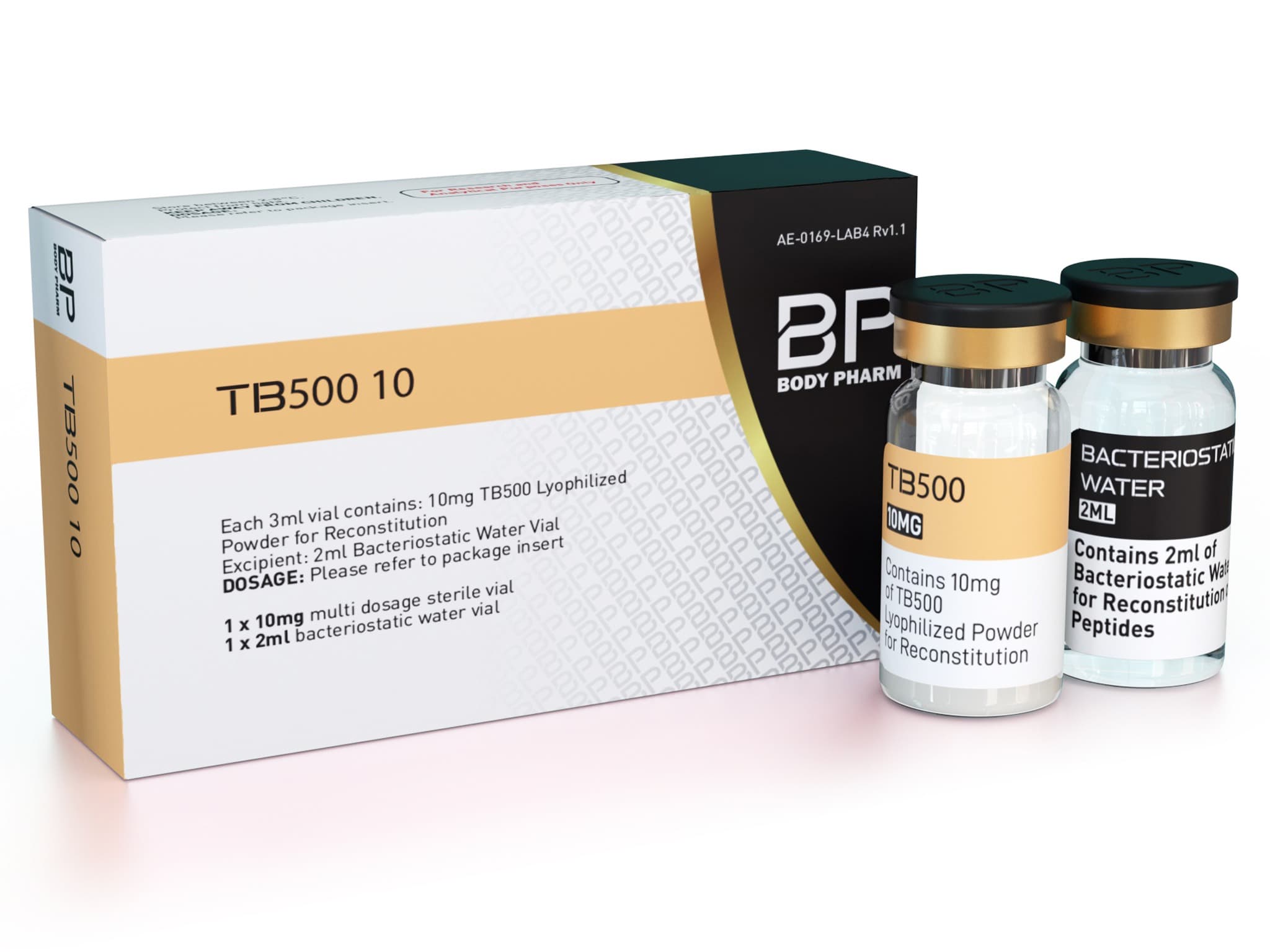
What you get
- 1× vial (product)
- 1× bacteriostatic water (2 ml)
What you need
- Syringe + needle to reconstitute (reconstitution calculator)
- Alcohol swabs
- Needle + syringe to inject
Body Pharm TB-500 10 Vial
R600.00R500.00On sale
SKU bptb50010
5.0(3 reviews)Body Pharm TB-500 10 Vial, supplied lyophilised and third-party assayed for purity and identity. Cold-chain handled and shipped discreetly from South Africa. Certificate of analysis available on request.
Who it's for
- ›Athletes and active individuals managing injuries
What it's used for
- ›Studied for muscle, tendon and ligament recovery
- ›Researched for flexibility and reduced inflammation
General research information, not medical advice.
Card · EFT · Bitcoin · Discreet delivery
Complete your kit
The supplies you need to store and use your order — add yours in one tap.
 BEARE Insulin Syringes 10 PackR35.00
- BEARE Insulin Syringes 20 PackR60.00
 Alcohol Swabs 50 PackR25.00
Body Pharm TB-500 10mg is a single-vial lyophilised research peptide (thymosin beta-4 analogue) that you reconstitute yourself with bacteriostatic water, giving you full control over concentration and dose volume that pre-filled pen formats (like the BodyPharm BPC-157/TB-500 32-pen) simply do not allow.
Key Takeaways
- Lyophilised vial format offers dosing flexibility and a lower cost-per-mg than the pre-filled blended pen
- Reconstitution takes two minutes with bacteriostatic water, an insulin syringe, and alcohol swabs; concentration is your choice
- Storage stability is superior pre-reconstitution (room temperature acceptable) but requires 2–8°C refrigeration after mixing for roughly 28–30 days
- No large-scale human RCT confirms TB-500 efficacy for musculoskeletal repair; evidence remains preclinical and anecdotal
- Research-only status: sold for laboratory research use, not for human therapeutic use
- COA verification (Certificate of Analysis) is available on request and should be checked against your batch number before opening
What Is Body Pharm TB-500 10mg?
Body Pharm TB-500 10mg is a synthetic analogue of Thymosin Beta-4 (TB4), supplied as a lyophilised (freeze-dried) powder in a single sterile vial and sold strictly as a research compound.
Thymosin Beta-4 is a naturally occurring 43-amino-acid peptide that binds G-actin and regulates actin polymerisation. In preclinical models this process has been linked to cell migration, angiogenesis and wound healing. TB-500 is the synthetic peptide fragment used in research settings to investigate those same pathways without sourcing native TB4.
What you are buying, in concrete terms:
- Format: lyophilised powder, single 10mg vial, sealed under vacuum
- Active: TB-500 (thymosin beta-4 fragment analogue)
- Reconstitution: requires bacteriostatic water (sold separately); see the Peptide Reconstitution Calculator for exact volumes
- Price: see the live product page
- Intended use: in vitro and in vivo research only; not for human consumption
- Lower-quantity option: the Body Pharm TB-500 5mg vial for researchers trialling the compound before scaling up
The research-only framing is not marketing hedge. The strongest published evidence for musculoskeletal repair remains animal and preclinical.
Lyophilised Vial vs Pre-Filled Pen: Key Differences
The lyophilised 10mg vial wins on cost-per-mg and dosing flexibility. The 32mg pre-filled pen wins on convenience and ready-to-inject speed. Which one suits you depends on whether you value precision and price (vial) or grab-and-go simplicity (pen).
Reconstitution. The Body Pharm 10mg vial ships as dry powder and requires bacteriostatic water plus a syringe before first use. The lyophilised format preserves the peptide in an inert state. The Body Pharm BPC-157 & TB-500 32mg pen arrives pre-mixed and ready to dial a dose.
Dosing flexibility. The vial lets you set any concentration you want. 10 mL of bacteriostatic water yields 1 mg/mL, and 5 mL yields 2 mg/mL. Dose increments are limited only by syringe graduations. The pen delivers fixed-click doses set by the manufacturer, which is faster but inflexible. Use the Peptide Reconstitution Calculator to plan vial concentrations before mixing.
Storage. Lyophilised powder is stable at room temperature before reconstitution and refrigerated (2–8°C) after mixing. The dry state resists moisture-driven degradation. The pen is a pre-mixed liquid and needs refrigeration from the moment it leaves cold-chain transit through to last use.
Cost-per-mg. The Body Pharm TB-500 10mg vial works out to a lower cost per mg than the Body Pharm BPC-157 & TB-500 32mg pen. The pen's figure splits across two actives (combined peptide), so the pure TB-500 cost-per-mg is higher still. See each product page for the current prices.
Shelf life after reconstitution. Vendor guidance commonly cites 28–30 days refrigerated, but no TB-500-specific peer-reviewed stability paper confirms that figure. Treat it as a working rule, not a guarantee.
Which format fits which buyer
The vial suits researchers who already own bacteriostatic water, syringes and a calculator, and who want to titrate concentrations across a study. The flexibility allows protocol adjustments mid-research. If you're testing the compound at a smaller scale first, the Body Pharm TB-500 5mg vial is the cheaper entry point.
The pen suits buyers who prioritise convenience, accept a ~35% cost-per-mg premium, and have reliable refrigeration from courier handover to last injection. The pre-filled format eliminates reconstitution steps.
Cost-Per-mg Comparison Table (2026)
| Product | Format | Total mg | Price (ZAR) | Cost per mg |
|---|---|---|---|---|
| Body Pharm TB-500 10mg vial | Lyophilised single-peptide vial | 10mg TB-500 | See live product page | — |
| Body Pharm BPC-157 & TB-500 32mg pen | Pre-filled blended pen | 32mg combined (BPC-157 + TB-500) | See live product page | — |
Body Pharm TB-500 10mg vial is the cheaper format per mg, versus the blended Body Pharm BPC-157 & TB-500 32mg pen. Caveat: the 32mg figure on the pen is combined BPC-157 and TB-500, not 32mg of TB-500 alone. The true per-mg cost of TB-500 inside the pen is higher once you separate the two actives, but the exact split is not published by the manufacturer. If you want a smaller test quantity before scaling, the Body Pharm TB-500 5mg vial is the lower-commitment option, and the Peptide Reconstitution Calculator handles the concentration maths.
How to Reconstitute the 10mg Vial: Step-by-Step
Reconstituting a Body Pharm TB-500 10mg vial takes about two minutes with bacteriostatic water, an insulin syringe, and alcohol swabs. The exact water volume depends on the concentration you want: 10 mL gives 1 mg/mL and 5 mL gives 2 mg/mL (math-based, not a manufacturer protocol).
Follow these steps in order:
- Gather supplies: one sealed vial of bacteriostatic water, a 1 mL insulin syringe (29G–31G), two alcohol swabs, and a marker.
- Wipe the septum: swab the rubber stopper of both the TB-500 vial and the bacteriostatic water vial. Let them air-dry for 10 seconds to reduce microbial contamination.
- Calculate volume: decide your target concentration and use the Peptide Reconstitution Calculator to confirm the mL of bacteriostatic water for a 10mg vial.
- Draw the water: pull the calculated volume into the insulin syringe.
- Inject slowly down the side: angle the needle against the inner glass wall of the TB-500 vial and release the water gradually. Direct injection onto the powder cake can cause foaming and peptide shearing.
- Swirl, never shake: rotate the vial gently between your fingers until the lyophilised powder fully dissolves. Shaking can shear peptide bonds and reduce purity.
- Label the vial: write the reconstitution date and concentration (e.g. "12 March 2026, 2 mg/mL") on the side for tracking and compliance.
- Store at 2–8°C: place the vial in the main body of a refrigerator, not the door, and not the freezer. Temperature fluctuations accelerate degradation.
- Use within 28–30 days: this is a widely repeated vendor rule rather than a TB-500-specific published stability figure.
If you want a lower-commitment trial before scaling up, the Body Pharm TB-500 5mg vial follows the same procedure with half the water volume.
This is general reconstitution guidance for research use. Consult a qualified medical professional before any administration.
How Body Pharm's Third-Party COA Process Works
A Certificate of Analysis (COA) is a lab-issued document that states what's actually inside the vial: peptide identity, purity percentage, and contamination checks. For a research compound like TB-500, it's the single most useful quality signal you have before opening the seal. The label alone tells you nothing about what survived synthesis and lyophilisation.
Two assay types matter most on a peptide COA:
- HPLC (high-performance liquid chromatography), separates the contents of the sample and reports the target peptide as a percentage of total peptide content. Reputable vendors typically aim for ≥98% purity because lower purity introduces unknown contaminants.
- Mass spectrometry (MS), measures the molecular weight of the eluted peak to confirm identity. The observed mass should match the theoretical mass of the intended thymosin beta-4 fragment sequence.
Body Pharm markets its TB-500 as third-party tested, with a COA available on request through BeSkinny. The specific testing lab and batch purity figures are not published on the public product listing, so request the COA to confirm them. To request it, email BeSkinny with the batch number printed on your vial and ask for the matching COA PDF.
What I check when a COA batch lands
When I receive a COA from a supplier, I run through the same checklist every time. Does the batch number on the document match the vial in front of me? Is the testing lab named and contactable? Does the report date fall within a reasonable window of the manufacture date? Does the HPLC chromatogram show a clean dominant peak? Does the MS reading match the expected mass for thymosin beta-4 fragment? If any of those fail, the batch doesn't get listed. A mismatch signals either mislabelling or degradation during transit.
What a COA does not do
A COA confirms what's in the vial. It does not constitute medical approval or evidence of safety for human use. TB-500 in this format is sold strictly as a research compound. A listing that advertises "lab tested" without offering a downloadable or on-request COA should be treated as a red flag rather than an oversight; request the BeSkinny COA before you buy. Transparency is the baseline for research-grade compounds.
TB-500 + BPC-157: The Recovery Stack Explained
The "Wolverine Stack" pairs TB-500 with BPC-157 because the two peptides are studied for complementary repair pathways. TB-500 (a thymosin beta-4 fragment) is researched for systemic actin upregulation and cell migration. BPC-157 is researched for localised soft-tissue, tendon, and gut repair. Researchers and community users combine them on the assumption that one covers systemic tissue turnover and the other targets the injury site directly.
The "Wolverine Stack" label itself comes from the research and fitness community rather than clinical literature. As of 2026, no large-scale human randomised controlled trial (RCT) has confirmed synergistic effects of BPC-157 + TB-500 in humans. The combination is commercially popular and anecdotally reported, but efficacy and synergy claims remain unproven.
Bundle pricing vs separate vials
Buying the Body Pharm TB-500 10mg and BPC-157 10mg together as the Wolverine Stack is priced below the two vials bought separately; see the product pages for the current bundle price and saving. For buyers who prefer a pre-mixed pen format instead of two lyophilised vials, BeSkinny stocks the BPC-157 & TB-500 32mg combination pen. Dosing flexibility is lower than with single-vial lyophilised stock.
Quick reference
- Stack rationale: TB-500 for systemic repair, BPC-157 for localised soft-tissue and joint repair.
- Evidence status: anecdotal and community-reported synergy; no large-scale human RCT confirmation as of 2026.
- Bundle price: lower than buying the two vials separately; see the product page for the current saving.
- Format choice: two lyophilised vials give dosing flexibility; the 32mg pre-filled pen trades flexibility for convenience.
- Reconstitution help: use the Peptide Reconstitution Calculator to set your concentration before drawing.
- Trial option: the Body Pharm TB-500 5mg vial is a lower-quantity entry point before stepping up to 10mg.
What TB-500 Is Studied For: Research Overview
TB-500 is a synthetic peptide fragment of Thymosin Beta-4 studied primarily for soft-tissue repair, inflammation modulation, and cell migration via actin regulation. As of 2026, the bulk of published work remains preclinical (animal models) and small-scale, with no large human RCT confirming musculoskeletal recovery endpoints.
Research areas covered in the literature
Muscle, tendon and ligament repair. TB-500 is marketed and discussed for connective-tissue recovery based on animal data and small human observations. Actin regulation supports cell migration to injury sites.
Inflammation and flexibility. Vendor and educational sources reference reductions in inflammatory signalling and improved range of motion in preclinical models. Human confirmation remains absent.
Cell migration and actin sequestration. Thymosin Beta-4's mechanism, binding G-actin and supporting cell migration to injury sites, is the most consistently cited rationale for its repair-related effects.
What the evidence does not show
No peer-reviewed human RCT identified in 2023–2026 confirms TB-500 as an effective treatment for musculoskeletal injury in humans. The randomised controlled trials of thymosin beta-4 conducted in people to date have targeted ophthalmic conditions, such as severe dry eye (phase 2) and neurotrophic keratopathy (phase 3), not connective-tissue repair. Claims of accelerated tendon healing, joint repair, or systemic recovery should be read as research hypotheses, not therapeutic outcomes.
Anti-doping and use framing
TB-500 is sold in South Africa as a research compound, not for human therapeutic use. Note also that thymosin beta-4 and its derivatives are prohibited at all times by the World Anti-Doping Agency under class S2, so athletes in tested sport should not use it. Nothing on this page is medical advice. Buyers researching the compound should set concentrations using the Peptide Reconstitution Calculator before any handling. Those wanting a smaller starting quantity for laboratory work can consider the Body Pharm TB-500 5mg vial instead of the 10mg format.
Storage and Cold-Chain: Why It Matters
Lyophilised TB-500 is stable at room temperature before reconstitution, but once mixed with bacteriostatic water it becomes a cold-chain product with a short usable window. Handling that transition correctly is the difference between a vial that retains its labelled purity and one that degrades before the research protocol is finished.
Pre-reconstitution storage
The sealed lyophilised powder can be kept at 15–25°C if it stays dry and out of direct light. Refrigeration at 2–8°C extends shelf life further. Moisture ingress is the main risk because water exposure triggers hydrolysis of peptide bonds. The rubber stopper should not be punctured until the vial is ready for use.
Post-reconstitution storage
After mixing, the reconstituted solution should be refrigerated at 2–8°C and used within roughly 28–30 days. That figure is widely repeated by peptide vendors but is not, in my reading, confirmed by a TB-500-specific peer-reviewed stability study. Freezing is generally avoided because freeze-thaw cycles can damage peptide structure. Set your working concentration before drawing the first dose using the Peptide Reconstitution Calculator.
Why cold-chain shipping matters in South Africa
South African summer ambient temperatures routinely sit well above the 2–8°C refrigerated range. A parcel sitting in a delivery vehicle in Johannesburg or Durban can spend hours at temperatures that accelerate peptide degradation. Domestic cold-chain dispatch from a South African warehouse avoids the customs delays and uncontrolled transit conditions associated with cross-border peptide orders. If you want a smaller quantity to validate handling before scaling up, the Body Pharm TB-500 5mg vial is the lower-volume option.
How to Buy Body Pharm TB-500 10mg in South Africa
Body Pharm TB-500 10mg is sold by BeSkinny, dispatched from within South Africa with discreet packaging and a COA available on request. The single-vial lyophilised format is sold strictly as a research compound.
Checkout accepts the following:
- Card payments (Visa, Mastercard) processed at checkout for immediate transaction confirmation
- EFT for buyers who prefer manual bank transfer and have time for processing delays
- Discreet local delivery from a South African warehouse, avoiding cross-border customs delays that can expose peptides to temperature fluctuations
- COA on request so you can verify the batch before opening the vial and confirm purity against the label claim
Bundle option: Recovery & Repair Stack
The Recovery & Repair Stack pairs TB-500 10mg with BPC-157 10mg at a bundle price below buying the two vials separately. Note that human RCT evidence for BPC-157 + TB-500 synergy remains unproven as of 2026. Treat the stack as a research protocol rather than a clinical recommendation.
Smaller quantity and further reading
If you'd rather validate handling and storage on a lower volume first, the Body Pharm TB-500 5mg vial is the trial-size option. Set your dilution before the first draw with the Peptide Reconstitution Calculator. Sold for laboratory research use only; not for human consumption.
Frequently Asked Questions
Is TB-500 banned in sport? TB-500 is sold by BeSkinny strictly as a research compound and is not approved for human therapeutic use. The product is labelled for laboratory research only, and thymosin beta-4 and its derivatives are banned in tested sport by the World Anti-Doping Agency.
How long does delivery take? Body Pharm TB-500 10mg ships from a South African warehouse with discreet packaging. Exact courier transit times depend on your delivery address. Check the BeSkinny shipping policy at checkout for the current cut-off and estimated arrival window.
Can I use TB-500 and BPC-157 together? The combination is widely sold as a stack, including the BeSkinny Recovery & Repair bundle and pre-mixed pen blends. No large-scale human RCT has confirmed synergistic effects as of 2026. Community protocols are not medical advice.
What bacteriostatic water volume should I use? For a 10mg vial, 10 mL of bacteriostatic water gives a 1 mg/mL concentration, and 5 mL gives 2 mg/mL. These are direct dilution calculations based on the target peptide mass. Run your exact draw volumes through the Peptide Reconstitution Calculator before the first injection into the vial.
Does the vial come with needles and bacteriostatic water? The single-vial lyophilised format is the peptide only. Syringes, needles, and bacteriostatic water are sold separately. Confirm inclusions on the product listing before checkout.
What is the difference between the 5mg and 10mg vial? The 10mg vial yields twice the milligrams per vial at a lower cost-per-mg than the smaller format. This suits longer research protocols because you avoid multiple reconstitution cycles. The Body Pharm TB-500 5mg vial is the lower-commitment option for first-time handling and storage testing.
Next Steps
Request a Certificate of Analysis from BeSkinny using the batch number on your vial before opening the seal. Use the Peptide Reconstitution Calculator to set your target concentration, then follow the nine-step reconstitution protocol above. If you're new to lyophilised peptide handling, start with the Body Pharm TB-500 5mg vial to validate your storage and dosing workflow at lower volume before committing to the 10mg format.
References
- Thymosin beta-4: actin-sequestering protein moonlights to repair injured tissues. Trends in Molecular Medicine, 2005.
- Thymosin beta-4 accelerates wound healing. Journal of Investigative Dermatology, 1999.
- Animal studies with thymosin beta, a multifunctional tissue repair and regeneration peptide. Annals of the New York Academy of Sciences, 2010.
- Thymosin beta-4 significantly improves signs and symptoms of severe dry eye in a phase 2 randomized trial. Cornea, 2015.
- 0.1% RGN-259 (thymosin beta-4) ophthalmic solution promotes healing in neurotrophic keratopathy patients: a randomized, placebo-controlled, double-masked phase III clinical trial. International Journal of Molecular Sciences, 2022.
- The 2026 Prohibited List (International Standard). World Anti-Doping Agency, 2025.