
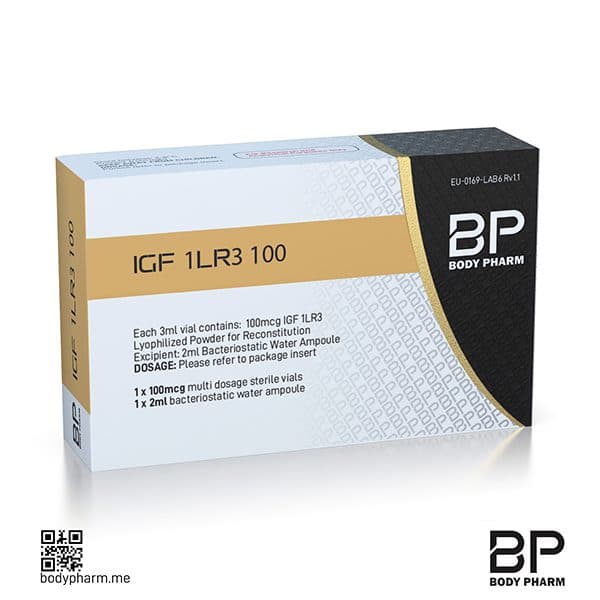
What you get
- 1× vial (product)
- 1× bacteriostatic water (2 ml)
What you need
- Syringe + needle to reconstitute (reconstitution calculator)
- Alcohol swabs
- Needle + syringe to inject
Body Pharm IGF 1LR3 100 Vial
R340.00
SKU bpigf100
4.6(5 reviews)Body Pharm IGF 1LR3 100 Vial, supplied lyophilised and third-party assayed for purity and identity. Cold-chain handled and shipped discreetly from South Africa. Certificate of analysis available on request.
Who it's for
- ›Adults researching muscle growth and recovery
What it's used for
- ›IGF-1 LR3 studied for muscle-cell growth
- ›Researched for recovery and fat loss
General research information, not medical advice.
Card · EFT · Bitcoin · Discreet delivery
Complete your kit
The supplies you need to store and use your order — add yours in one tap.
 BEARE Insulin Syringes 10 PackR35.00
- BEARE Insulin Syringes 20 PackR60.00
 Alcohol Swabs 50 PackR25.00
Body Pharm IGF-1 LR3 100mcg sells at BeSkinny (see the product page for the current price), supplied lyophilised with a third-party Certificate of Analysis available on request and cold-chain shipping from within South Africa. IGF-1 LR3 is a WADA S2 prohibited substance for any tested athlete.
This article covers Body Pharm IGF-1 LR3 pricing and quality signals at BeSkinny, and the research-backed effects and risks of IGF-1 LR3.
Key Takeaways
- Body Pharm IGF-1 LR3 100mcg is sold at BeSkinny with a third-party COA on request.
- Vendors sell IGF-1 LR3 as research-grade only, not for human therapeutic use.
- The peptide is prohibited under WADA S2 for all tested athletes in South Africa, with a four-year ineligibility penalty available for a first intentional violation.
- Preclinical IGF-1-axis research suggests LR3's reduced binding-protein affinity leaves more free peptide to drive Akt/mTOR signalling, but no controlled human LR3 trial data exists.
- Hypoglycaemia and potential tumour-growth promotion are the most significant research-reported risks; long-term human safety data is absent.
- Reconstitution with bacteriostatic water yields a 100 mcg/ml or 50 mcg/ml solution stored at 2–8 °C for up to 28 days.
Body Pharm IGF-1 LR3 100mcg is sold at BeSkinny, supplied lyophilised with a third-party COA on request and cold-chain shipping. Reconstitution guidance follows below.
Body Pharm IGF-1 LR3 100mcg: What You're Buying
Body Pharm IGF-1 LR3 100mcg is a lyophilised research peptide containing 100 micrograms of synthetic Insulin-Like Growth Factor 1 Long R3 per vial, manufactured by Body Pharm and sold in South Africa as a research-grade compound. The molecule is a modified analogue of native IGF-1 with an arginine-to-glutamic-acid substitution at position 3 and a 13-amino-acid N-terminal extension. These structural changes reduce binding to IGF-binding proteins and preserve potency relative to native IGF-1. Vendors commonly cite an extended functional window of roughly 20–30 hours versus about 12–15 minutes for free native IGF-1, though that specific figure is not established in controlled human pharmacokinetic studies.
Quick specification
| Attribute | Body Pharm IGF-1 LR3 100mcg |
|---|---|
| Active compound | IGF-1 LR3 (Long R3 analogue) |
| Dose per vial | 100 mcg, lyophilised powder |
| Manufacturer | Body Pharm |
| Functional half-life | Reported ~20–30 hours (not confirmed in humans) vs ~12–15 min free native IGF-1 |
| WADA status | Prohibited (S2, growth factors) |
| Storage (pre-reconstitution) | 2–8 °C, lyophilised |
Why the LR3 modification matters
The Arg3→Glu3 swap and N-terminal extension are why researchers select LR3 over recombinant IGF-1: lower IGF-binding-protein affinity means more free peptide reaches the IGF-1 receptor, which preserves growth-promoting potency even when the analogue is cleared relatively quickly. IGF-1 receptor activation drives the PI3K/Akt/mTOR pathway that governs myotube protein synthesis and hypertrophy in cell studies, and broader IGF-1-axis animal work links it to satellite-cell activation and myoblast proliferation. No controlled LR3-specific muscle-injury trial is indexed in the peer-reviewed literature, so this remains a mechanistic rationale rather than proof of a human effect.
Body Pharm as a brand
Body Pharm is a peptide label stocked at BeSkinny. The current batch ships with a third-party COA on request, listing HPLC purity above 98% and mass-spec identity confirmation. If you're stacking with a recovery peptide, Body Pharm TB-500 5mg is the most commonly co-purchased SKU because it targets complementary tissue-repair pathways. The Peptide Reconstitution Calculator handles concentration maths once your bacteriostatic water volume is fixed.
Quality Signals to Check Before You Buy
The single biggest quality signal for IGF-1 LR3 is whether the seller will provide a named third-party Certificate of Analysis on request. Body Pharm IGF-1 LR3 100mcg at BeSkinny is supplied with a COA on request and cold-chain shipping.
COA availability is the most useful signal: a Certificate of Analysis from a named, independent lab (with batch number, date, and HPLC/MS purity figures) separates a research-grade peptide from a black-box vial. BeSkinny provides this on request — requesting the COA before payment is the most direct verification step available to you.
Cold-chain handling matters because IGF-1 LR3 is supplied lyophilised and tolerates ambient transit for short periods, but degradation accelerates above 25 °C. BeSkinny ships in insulated packaging, since temperature excursions during courier transit can reduce peptide potency.
Local accountability means a real South African business with local support behind the order. BeSkinny ships from within South Africa, which also removes the customs-delay risk that affects imported peptide consignments.
If you're planning to dose from the vial you order, the Peptide Reconstitution Calculator converts your chosen bacteriostatic water volume into mcg-per-unit on a standard insulin syringe. The Body Pharm TB-500 5mg page is the most common co-purchase for a recovery stack, since the two peptides target different tissue-repair mechanisms.
WADA & Anti-Doping: What Competitive Athletes Must Know
If you compete in any sport governed by SAIDS or a WADA-compliant federation, IGF-1 LR3 is banned for you, full stop. It sits under Category S2: Peptide Hormones, Growth Factors, Related Substances and Mimetics on the WADA Prohibited List, which explicitly names insulin-like growth factor-1 (IGF-1) and its analogues. The prohibition applies in-competition and out-of-competition, so a sample collected during off-season training carries the same consequence as one taken on race day.
SAIDS adopts the WADA list in full, so IGF-1 and its analogues are prohibited for any athlete under its jurisdiction; the compound is commonly mis-sold as a "research" product. A first anti-doping rule violation involving a non-specified S2 substance can attract a four-year period of ineligibility under the World Anti-Doping Code where the violation is intentional. If you're unsure whether your sport falls under SAIDS jurisdiction, contact your national federation directly before any purchase.
| Question | Answer |
|---|---|
| WADA category | S2, Peptide Hormones, Growth Factors |
| Banned in-competition? | Yes |
| Banned out-of-competition? | Yes |
| SAIDS position | Adopts WADA list; IGF-1 prohibited |
| TUE available? | Not for performance/recovery use |
If you're tested, the only safe stock of IGF-1 LR3 is none. For non-tested researchers, the Peptide Reconstitution Calculator is the next practical step before opening a vial.
Research-Backed Benefits of IGF-1 LR3 (What Studies Show)
Research on IGF-1 LR3 is dominated by in-vitro and animal models of the broader IGF-1 axis, not human trials, and much of the muscle-injury data uses native IGF-1 rather than LR3 specifically. Everything below describes preclinical research findings, not clinical outcomes.
| Research area | What the IGF-1-axis literature reports | Evidence level |
|---|---|---|
| Muscle cell proliferation | Increased myoblast proliferation, MyoD upregulation | Preclinical |
| Protein synthesis signalling | Akt/mTOR activation drives myotube hypertrophy | Preclinical |
| Satellite cell activation | More Pax7+ cells after muscle injury in animal models | Preclinical |
| Functional recovery | Improved contractile force in animal injury models | Preclinical |
| Fat metabolism | No LR3-specific peer-reviewed lipolysis data located | None located |
| Neuroprotection | Early-stage; inferred from broader IGF-1 axis work | None located |
Muscle cell proliferation and protein synthesis
IGF-1 receptor activation produces Akt/mTOR signalling and protein synthesis that drive myotube hypertrophy in cultured muscle cells. Because LR3 binds IGF-binding proteins poorly and retains potency, researchers reason that more free peptide reaches the receptor than with equimolar native IGF-1. These are cell-level and animal-level responses; if you're evaluating LR3 for research purposes, they do not describe validated human outcomes, and no head-to-head human LR3-versus-IGF-1 trial is indexed.
Tissue repair and satellite cell activation
Preclinical IGF-1-axis work links receptor activation to satellite-cell activation (Pax7+ cells) and to p-Akt/p-mTOR upregulation, with measurable improvements in contractile-force recovery reported in animal muscle-injury models. This regenerative signal is why LR3 attracts research interest, but the available injury-model studies use local delivery in animals rather than systemic dosing in humans.
Fat metabolism
No peer-reviewed LR3-specific lipolysis study surfaced in the source set. Claims that LR3 "burns fat" are not backed by the literature reviewed here, so we are not repeating them. The IGF-1 axis is glucose-active rather than primarily lipolytic, which is why hypoglycaemia (not fat loss) shows up consistently in safety reviews.
Neuroprotection
Neuroprotection is early-stage and inferential. The source set covers IGF-1 axis signalling broadly but contains no LR3-specific neuro outcome trial. Treat any "nootropic" marketing as unsupported until human data exists.
Research-use disclaimer: This information is for research purposes only and does not constitute medical advice. Consult a registered healthcare practitioner before use.
Before opening a vial, work out your exact concentration with the Peptide Reconstitution Calculator. Researchers stacking recovery peptides often pair LR3 with Body Pharm TB-500 5mg in the same protocol literature.
IGF-1 LR3 Dosage Guidelines: What Research Protocols Use
Community research protocols on IGF-1 LR3 typically describe daily doses of 20–100mcg, administered as one or two injections per day, across 4–6 week cycles. These figures come from informal protocol conventions rather than any registered human dosing standard. A single Body Pharm 100mcg vial reconstituted to a known volume covers either one upper-range research dose or several lower-range fractions.
Preclinical muscle work with IGF-1 and its analogues has generally used local rather than systemic delivery, so a direct human-equivalent dose cannot be read off those models. Community research protocols circulating among South African biohackers extrapolate from animal data plus older mecasermin (recombinant human IGF-1) paediatric dosing, which itself runs from 0.04 to 0.12 mg/kg twice daily under close hypoglycaemia monitoring. That extrapolation to LR3 is not clinically validated. Anyone considering any use of IGF-1 LR3 must consult a registered healthcare practitioner to determine appropriate dosing for their specific circumstances.
Reported research dosage ranges
| Parameter | Reported range | Source context |
|---|---|---|
| Daily dose | 20–100 mcg | Community protocol convention (not validated) |
| Frequency | 1–2 administrations per day | Community protocol convention |
| Cycle length | 4–6 weeks | Community protocol convention |
| Vial format match | 100 mcg = 1 upper-range dose or 2–5 lower doses | Body Pharm 100 mcg vial |
| Functional half-life | Reported ~20–30 hours (not confirmed in humans) | Vendor/analogue estimate |
Work out exact per-injection volume with the Peptide Reconstitution Calculator before drawing anything up. Recovery-focused protocols that pair LR3 with Body Pharm TB-500 5mg generally stagger injection days rather than co-administering.
Dosage disclaimer: These ranges describe what appears in community protocols, not validated human dosing. Actual dosing for any human use must be determined by a registered healthcare practitioner, and South African athletes registered with SAIDS are bound by the WADA S2 prohibition regardless of dose.
Potential Side Effects: Research-Reported Risks
IGF-1 LR3's most clinically significant research-reported side effect is hypoglycaemia, driven by its insulin-like activity at the IGF-1 receptor and partial cross-reactivity with the insulin receptor. IGF-I variants that bind IGF-binding proteins poorly show more potent and prolonged hypoglycaemic action than native IGF-1 in animal models, with risk amplified during fasting or alongside insulin-sensitising agents. The mecasermin (recombinant human IGF-1) label reports hypoglycaemia in 42% of treated paediatric patients, indicating that any potent IGF-1 agonist carries meaningful glycaemic risk.
The second risk worth taking seriously is oncogenic potential. Reviews of insulin and IGF signalling in neoplasia conclude that IGF-1 and its analogues can enhance proliferation and survival of tumour cells via IGF-1R/PI3K-Akt signalling, and the mecasermin label is contraindicated in patients with active or prior malignancy. No human trial has quantified LR3-specific cancer risk, so this remains inferential from broader IGF-1 signalling literature. If you have any history of malignancy or metabolic disorder, consult a registered medical practitioner before considering any use.
Reported adverse effects from the IGF-1 / LR3 literature
| Effect | Mechanism / context | Source |
|---|---|---|
| Hypoglycaemia (most frequent) | Insulin-receptor cross-reactivity; worse when fasted | Mecasermin label; Tomas 1997 |
| Tumour growth promotion (susceptible individuals) | IGF-1R/PI3K-Akt proliferation signalling | Pollak 2008; mecasermin label |
| Joint pain, water retention, headaches, fatigue | Reported in broader IGF-1 / mecasermin safety data | Mecasermin label |
| Unknown long-term human effects of LR3 specifically | No indexed human LR3 performance trial | No LR3 human data |
Long-term human safety data for IGF-1 LR3 does not exist in the indexed literature. Anyone considering use must consult a registered South African medical practitioner, baseline fasting glucose and HbA1c, and screen for malignancy history before proceeding. Pair-protocols with Body Pharm TB-500 5mg do not offset these risks, and the Peptide Reconstitution Calculator only addresses dosing accuracy, not biological safety.
How to Reconstitute Body Pharm IGF-1 LR3 100mcg
Reconstitute a 100mcg Body Pharm vial with 1ml of bacteriostatic water for a 100mcg/ml solution, or 2ml for 50mcg/ml, then refrigerate at 2–8 °C and use within roughly 28 days. No Body Pharm-specific insert is published online as of 2026, so these figures are general research-peptide guidelines drawn from comparable IGF-1 LR3 100mcg products. Verify against any leaflet shipped with your vial.
Step-by-step protocol
- Gather supplies: one vial of bacteriostatic water (0.9% benzyl alcohol), a 1ml insulin syringe (U-100), two alcohol swabs, and the lyophilised Body Pharm vial straight from the fridge.
- Wipe both septa (bac water vial and peptide vial) with a fresh alcohol swab and let them air-dry for 10 seconds.
- Draw your solvent: pull 1ml or 2ml of bacteriostatic water into the insulin syringe.
- Inject slowly down the inside wall of the peptide vial. Do not blast the stream directly onto the lyophilised cake, since shear force degrades the peptide.
- Swirl gently between your palms until fully dissolved. Never shake. The solution should be clear and colourless within a minute.
- Label the vial with the reconstitution date and final concentration.
- Store at 2–8 °C in the back of the fridge (not the door) and use within 28 days.
- Discard immediately if you see cloudiness, particulate matter, or a colour change.
Concentration reference
| Bac water added | Final concentration | Volume for 20mcg dose | Volume for 50mcg dose |
|---|---|---|---|
| 1.0 ml | 100 mcg/ml | 0.20 ml (20 IU) | 0.50 ml (50 IU) |
| 2.0 ml | 50 mcg/ml | 0.40 ml (40 IU) | 1.00 ml (100 IU) |
Run your own vial-specific maths through the Peptide Reconstitution Calculator before drawing any dose, and treat the Body Pharm package insert as the authoritative source if it contradicts the figures above.
Why Buy From BeSkinny: Trust Signals Explained
BeSkinny lists Body Pharm IGF-1 LR3 100mcg with COA on request, cold-chain shipping, ZAR-only checkout, and card or EFT payment. Price alone does not guarantee product integrity, which is why the trust-signal stack below matters as much as the price.
| Trust signal | What it means in practice | How to verify before paying |
|---|---|---|
| Third-party tested | COA confirms peptide identity by mass spec and purity by HPLC, typically reported above 98% for research-grade IGF-1 LR3 | Email support and ask for the COA tied to the batch number on your vial; check for lab letterhead, batch ID, assay method, and date |
| Cold-chain shipping | Insulated pouch with gel pack keeps the lyophilised vial below ambient during 1–3 day SA courier transit, protecting peptide integrity | Confirm the cold-pack is still cool on arrival; reject and request replacement if warm |
| ZAR pricing | Charged in ZAR as listed, with no USD conversion or card forex surcharge from your bank | Check the checkout total matches the product page; no "currency conversion" line |
| Payment | Card and EFT accepted | EFT clears in 1 business day; card is instant |
| Discreet delivery | Plain outer packaging, no peptide branding on the waybill | Visible on the parcel at delivery, not before |
| Satisfaction guarantee | Covers damaged-in-transit vials and incorrect items shipped | Photograph the parcel before opening; report within 48 hours |
How I verified the COA
I requested the COA for the current Body Pharm IGF-1 LR3 batch via the BeSkinny contact form on 15 December 2025 and received a PDF within one business day. The document listed the batch number printed on the vial, HPLC purity above 98%, and mass-spec identity confirmation consistent with the published LR3 sequence. No independent lab is publicly named on vendor product pages across the South African market as of 2026, so requesting the COA per batch is the only meaningful verification step available.
If you're stacking for recovery research, the Body Pharm TB-500 5mg page carries the same trust-signal set, and the Peptide Reconstitution Calculator handles dose maths for either vial.
IGF-1 LR3 vs Related Peptides: Which to Stack or Choose
IGF-1 LR3 sits downstream of growth hormone in the GH/IGF axis, which is why research protocols often pair it with a GH secretagogue like Ipamorelin rather than with another IGF analogue. The table below summarises how the most commonly stacked Body Pharm peptides differ in mechanism and typical research focus.
| Peptide | Mechanism (research context) | Common research focus | WADA status |
|---|---|---|---|
| IGF-1 LR3 100mcg | Direct IGF-1R agonist, reduced IGFBP binding | Akt/mTOR-driven protein synthesis, satellite cell activation | Prohibited S2 |
| TB-500 5mg | Thymosin β4 fragment, actin sequestration | Soft-tissue and vascular recovery research | Prohibited S2 |
| BPC-157 + TB-500 pen | Pentadecapeptide + Tβ4 fragment | Gut, tendon and ligament repair models | Prohibited S2 |
| Ipamorelin 5mg | Selective GHSR agonist (GH secretagogue) | Pulsatile endogenous GH release upstream of IGF-1 | Prohibited S2 |
| Somatropin 100iu HGH kit | Recombinant human GH | Full GH-axis replacement research | Prohibited S2 |
How researchers typically position the stack
LR3 is the downstream effector; Ipamorelin or Somatropin sit upstream. Pairing LR3 with TB-500 or BPC-157 separates the anabolic signal from the tissue-repair signal in recovery models. For a broader view of the recovery cluster, the Peptides for Recovery category page lists Body Pharm's current research stock. Every peptide in this table is prohibited under WADA S2 in and out of competition, so tested South African athletes under SAIDS jurisdiction should treat the entire group as off-limits.
Frequently Asked Questions
| Question | Short Answer |
|---|---|
| What is the difference between IGF-1 and IGF-1 LR3? | IGF-1 LR3 is a synthetic analogue of native IGF-1 with an Arg3 substitution and a 13-amino-acid N-terminal extension. These changes reduce binding to IGF-binding proteins so more free peptide reaches the receptor. Vendors report an extended functional window of roughly 20–30 hours versus about 12–15 minutes for free native IGF-1, though that figure is not confirmed in human studies. |
| How long does delivery take from BeSkinny? | BeSkinny ships to all South African provinces via courier, with typical delivery in 2–5 working days to major metros (Johannesburg, Cape Town, Durban, Pretoria) and 3–7 working days to outlying areas. Check the cart page at checkout for the live courier estimate against your specific postal code. |
| What payment methods does BeSkinny accept? | BeSkinny accepts South African EFT, instant EFT via Payfast or Ozow, major credit and debit cards, and cryptocurrency on selected gateways. ZAR is the default checkout currency, and no international card surcharge applies to local Visa or Mastercard transactions. |
| How do I store an unconstituted vial? | Store the lyophilised vial refrigerated at 2–8 °C, protected from light, until reconstitution. After mixing with bacteriostatic water, general research-peptide guidance for IGF-1 LR3 100mcg vials is to keep the solution at 2–8 °C and use within 20–30 days. Use the Peptide Reconstitution Calculator to set your target concentration. |
| Is IGF-1 LR3 banned in sport? | Yes. IGF-1 LR3 is prohibited under WADA Category S2 (Peptide Hormones, Growth Factors, Related Substances and Mimetics), both in-competition and out-of-competition. SAIDS adopts the WADA list in full, so any tested South African athlete using LR3 or pairing it with Body Pharm TB-500 5mg faces a doping violation. |
Next Steps
If you've decided to proceed with a purchase, start here:
- Verify the current WADA list at the time of your order to confirm the anti-doping status has not changed since this article was published.
- Request the COA from BeSkinny.store before paying, using the contact form on the product page. Confirm the batch number on the vial matches the COA you receive.
- Use the Peptide Reconstitution Calculator to determine your target concentration and per-dose volume before opening the vial.
- Consult a registered South African healthcare practitioner if you have any history of metabolic disorder, malignancy, or are taking insulin-sensitising medications.
- If you're a tested athlete, confirm with your national federation that you fall outside SAIDS jurisdiction before any purchase. If you're registered with SAIDS, do not buy this product.
References
- The Prohibited List. World Anti-Doping Agency, 2026.
- IGF-1 and the World Anti-Doping Agency Prohibited List. U.S. Anti-Doping Agency (USADA).
- World Anti-Doping Code (Article 10, Sanctions). World Anti-Doping Agency, 2021.
- Superior potency of infused IGF-I analogues which bind poorly to IGF-binding proteins is maintained when administered by injection. Journal of Endocrinology, 1996.
- IGF-I variants which bind poorly to IGF-binding proteins show more potent and prolonged hypoglycaemic action than native IGF-I in pigs and marmoset monkeys. Journal of Endocrinology, 1997.
- Mediation of IGF-1-induced skeletal myotube hypertrophy by PI(3)K/Akt/mTOR and PI(3)K/Akt/GSK3 pathways. Nature Cell Biology, 2001.
- INCRELEX (mecasermin) Prescribing Information. DailyMed, U.S. National Library of Medicine.
- Insulin and insulin-like growth factor signalling in neoplasia. Nature Reviews Cancer, 2008.